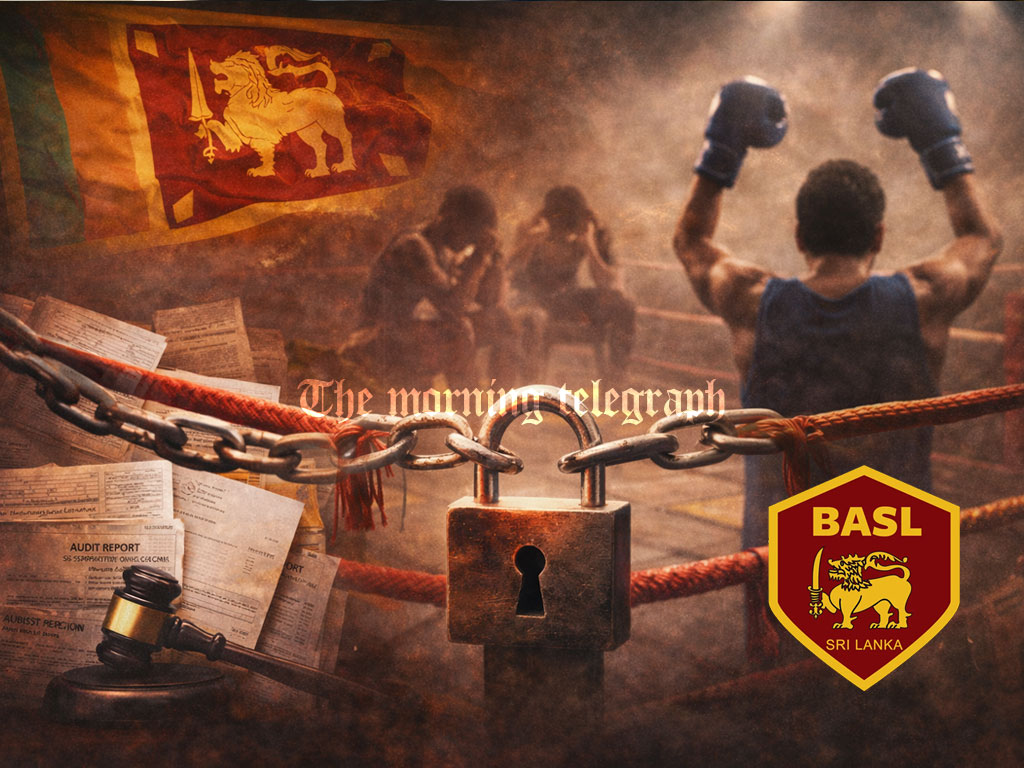
As three long-standing clubs are shut out of the Nationals, fresh allegations emerge that Sri Lanka’s boxing authorities themselves have failed basic governance tests, delayed AGMs, undisclosed accounts, and a paper trail critics say already exists inside BASL’s own books.
Clubs Barred, Athletes Affected
A serious governance dispute within the Sri Lanka Boxing Association has erupted after three registered boxing clubs were prevented from competing at the National Boxing Championships 2025, held in 2026. The decision has directly affected boxers preparing to compete, raising concerns that athletes are being punished for administrative and leadership decisions entirely beyond their control.
The clubs barred from participation are Westgate Boxing Club, Kamburupitiya Boxing Club, and Mihindu Boxing Club, all long-standing entities with documented histories within Sri Lanka’s boxing ecosystem.

Leadership Decisions Under Scrutiny
The controversy centers on the actions of the current President of the BASL, Anuruddha Bandara. Critics allege that the three clubs were selectively targeted and deliberately deprived of participation despite being registered, arguing that any compliance concerns could and should have been resolved through dialogue rather than exclusion.
Observers also point to the Olympic Charter, which clearly states that athletes must not be deprived of participation due to administrative disputes. In this instance, critics argue, that principle has been disregarded, with boxers paying the ultimate price.
Newspaper Notice Sparks Dispute
The dispute escalated after the BASL published a notice in the Sinhala-language daily Dinamina, requesting all clubs to register themselves with the association. The three affected clubs did not respond, with at least one club stating it was unaware of the newspaper advertisement.
Club representatives argue that relying solely on a newspaper notice for such a critical directive is improper and non-transparent, particularly when established BASL communication channels—formal letters, emails, and official WhatsApp groups—exist precisely for such purposes.
Westgate Sports Boxing Club Issues Formal Clarification
On 23 January 2026, Westgate Sports Boxing Club, operating under Westgate International (Pvt) Ltd, formally wrote to the Secretary of the BASL, MAL Perera.
In its letter, Westgate clarified that its correct and registered name is Westgate Sports Boxing Club, noting that any reference to “Westgate International Sports Club” was inadvertent and requesting BASL records be updated accordingly. The club stated that it has been a duly registered member for nearly 15 years and has consistently paid its annual subscription fees, asserting that no re-registration requirement arose.
Accounts, AGM Delays, and Governance Questions
Westgate further argued that it should not be required to resubmit proof of subscription payments, as those payments should already be reflected in the BASL’s own audited accounts. According to the club, the onus lies with the BASL to refer to its internal financial records, not to demand documentation that already forms part of its accounting trail.
More broadly, critics point out that the BASL itself stands accused of failing to meet fundamental governance obligations, including delays in conducting its Annual General Meeting and the non-disclosure of annual accounts and audit reports. In that context, demands placed on Westgate are viewed by some as inconsistent and selective.
Those close to the matter allege that repeated requests for documents constitute a deliberate delaying tactic aimed at keeping the club and its boxers out of the championships while the administrative deadlock continues.
Claims of Non-Communication and Due Process Failures
Westgate stated that it never received any formal notice of suspension or any official directive requiring re-registration. It described the reliance on a single newspaper notice as deeply concerning and inconsistent with transparency, due process, and good governance.
The club also highlighted that it was admitted to the BASL Annual General Meeting, attendance at which was limited to registered clubs with voting rights—something it says confirmed its continued recognition as a registered member.
Warnings of Constitutional and Legal Action
In its correspondence, Westgate warned that unequal and discriminatory treatment would amount to violations of Articles 12(1) and 12(2) of the Constitution of the Democratic Socialist Republic of Sri Lanka. It stated it was prepared to seek legal redress before the Human Rights Commission of Sri Lanka and the Supreme Court if the matter remained unresolved.
The club also raised concerns that the actions in question could potentially fall within the scope of the Anti-Corruption Act, No. 9 of 2023, and indicated it was considering whether to approach the Commission to Investigate Allegations of Bribery or Corruption. Responsibility, it said, would extend to the President, Secretary, Treasurer, and the full Executive Committee of the BASL.
BASL Rejects Allegations, Cites Sports Law
The BASL responded on 24 January 2026 with a formal rebuttal, categorically rejecting claims of unfair treatment, non-transparency, and discrimination. Citing the Sports Law No. 25 of 1973 and the BASL Constitution (Revised 2024), the association maintained that club affiliation is not a perpetual right and is subject to periodic validation and compliance audits.
The BASL defended newspaper publication as valid constructive notice and stated that clubs bear responsibility for maintaining their compliance status. It also argued that admission to an AGM does not guarantee permanent recognition, noting that provisional attendance may be permitted pending administrative audits.
Documentation Demands and Ongoing Deadlock
To resolve the matter, the BASL requested that Westgate Sports Boxing Club submit proof of subscription payments for 2023, 2024, and 2025, records of athlete participation over the past three years, and documentation relating to its most recent annual renewal.
Despite the exchange, the outcome remains unchanged. Boxers affiliated with the three clubs continue to be excluded from the national championships.
Athletes Left Paying the Price
As the standoff drags on, critics argue that the real casualties are the athletes—young boxers deprived of competition, exposure, and progression through no fault of their own. The dispute has raised uncomfortable questions about proportionality, transparency, and whether Sri Lanka’s boxing authorities are upholding their most basic obligation: to place athlete welfare above administrative power struggles.