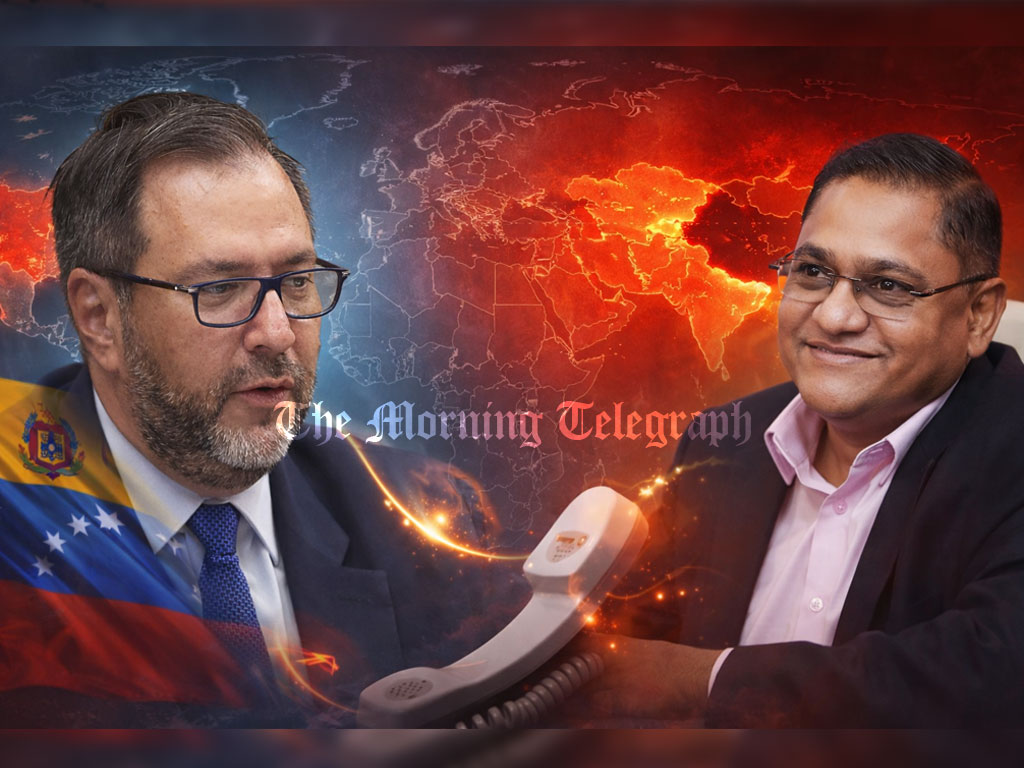
A quiet diplomatic phone call reveals Sri Lanka’s bold positioning amid global power politics, U.S. pressure, and China’s growing influence.
China was among the foremost countries to condemn the United States invasion of Venezuela, setting the tone for a wider geopolitical response. This backdrop gained relevance when the Chinese Foreign Minister made a recent transit visit to Sri Lanka and held bilateral discussions with Foreign Minister Wijitha Herath. According to the official statement released after the meeting, the situation in Venezuela and the U.S. invasion were directly discussed. The joint communiqué made this position clear.

“Wang said that in the face of an increasingly complex and volatile international situation, China will firmly safeguard the legitimate rights and interests of developing countries, especially small and medium-sized countries, uphold the purposes and principles of the UN Charter and international law, and work with like-minded countries to oppose the resurgence of the ‘law of the jungle,’ resist all forms of power politics and bullying, and defend multilateralism and international fairness and justice.”
Shortly after this engagement, Foreign Minister Wijitha Herath held a telephone conversation with the Venezuelan Foreign Minister. Venezuelan Foreign Minister Gil Pinto later confirmed the discussion through a statement posted on his Telegram channel.
“The Minister of People’s Power for Foreign Affairs of the Bolivarian Republic of Venezuela, Yván Gil, spoke this Friday via telephone with the Minister of Foreign Affairs, Tourism and Overseas Employment of Sri Lanka, Vijitha Herath, from whom he received expressions of support from his Government for the Venezuelan people.”
“The show of solidarity from the South Asian country comes after the attack against our political and territorial sovereignty and the kidnapping of President Nicolás Maduro and First Lady Cilia Flores,” Gil added.
During the dialogue, both ministers reaffirmed their commitment to international law and a bilateral agenda based on reciprocity and solidarity.
Most South Asian governments remained cautious. India expressed concern without condemnation, Pakistan urged dialogue, Nepal issued a statement, while others stayed silent. In Sri Lanka, the JVP and MP Bimal Ratnayake openly condemned the invasion, preceding the ministerial call.
Against this regional silence, Sri Lanka’s outreach stands out. Whether coordinated with China or taken independently, how Washington interprets this move remains an open and sensitive question.