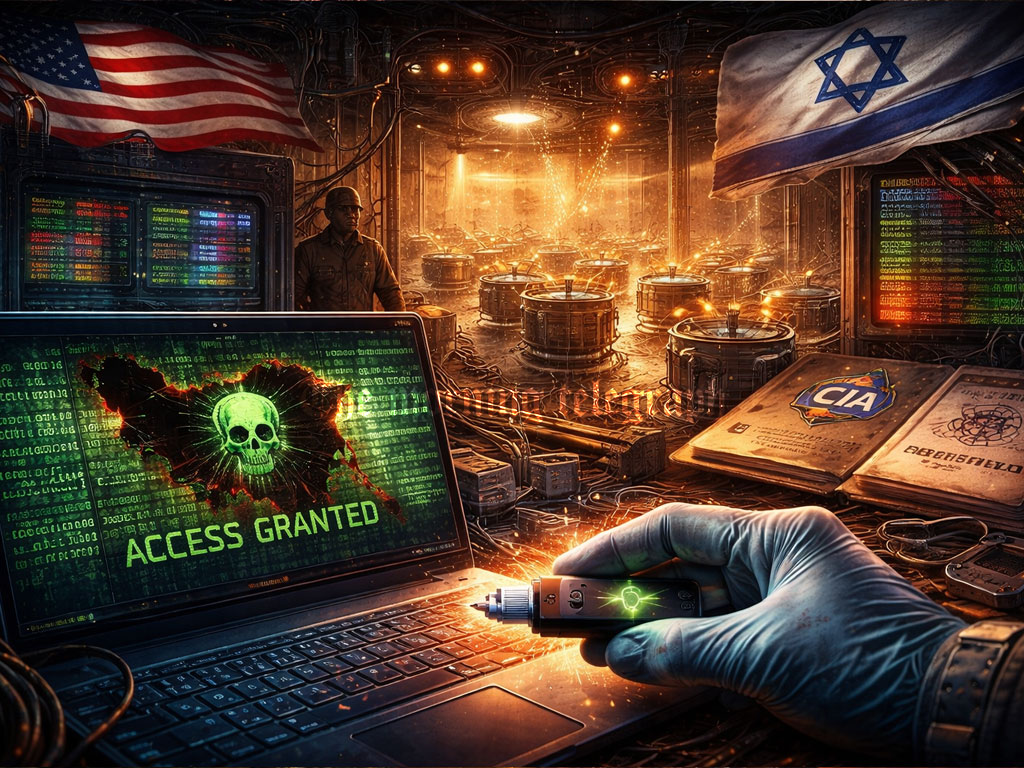
A silent digital strike, hidden from radar and cameras, proved that modern wars can be won without bombs, bullets, or borders.
When we think of war, we picture fighter jets, missiles, and armies clashing on battlefields. Very few imagine lines of computer code as weapons capable of reshaping global power. Yet one secret operation did exactly that. Without a single explosion or shot fired, Operation Stuxnet crippled Iran’s nuclear ambitions and quietly changed the future of warfare.

This is not just the story of a computer virus. It is a story of geopolitics, espionage, intelligence agencies, and the frightening power of technology when used as a weapon. What unfolded was one of the most sophisticated covert operations in modern history.
Deep in the Iranian desert lies Natanz, a heavily guarded nuclear enrichment facility buried nearly fifty feet underground and protected by thick layers of reinforced concrete. Inside this fortified complex, uranium enrichment took place using high speed centrifuges. These machines spin thousands of times per second. Even a minor fluctuation in speed can cause them to malfunction or self destruct.
The United States and Israel feared that Iran could eventually use this facility to produce nuclear weapons. A direct military strike on Natanz risked triggering a regional or even global war. Faced with that danger, intelligence agencies allegedly chose a different battlefield. Instead of bombs, they designed a digital weapon.
According to widely reported investigations, the CIA and Israel’s Mossad worked together under a covert program known as Operation Olympic Games. Their creation was a highly advanced cyber weapon called Stuxnet, reportedly costing millions of dollars to develop. Unlike ordinary malware, Stuxnet was designed to strike only a specific target. It was programmed to activate only inside Iranian nuclear systems. If it detected it was elsewhere, it remained inactive. As the code itself implied, “If you are not inside an Iranian nuclear system, please be quiet.”
The greatest challenge was access. The Natanz facility was air gapped, meaning it was not connected to the internet. Hackers could not reach it remotely. Instead, human vulnerability became the entry point. Through unknown means, a USB drive was introduced into the system. Once plugged in, Stuxnet slipped inside without raising alarms.
The virus did not attack immediately. It observed silently for months, studying Siemens programmable logic controllers that regulated the centrifuges. When ready, it launched its assault in stages. First, it forced the centrifuges to spin far faster than safe limits. Then it abruptly slowed them down. The repeated stress caused internal components to tear apart and fail.
The most disturbing aspect was deception. While machines were being destroyed, control room monitors showed normal operations using previously recorded data. Engineers saw nothing wrong. By the time the damage was detected, thousands of centrifuges were ruined.
Stuxnet remained hidden for years until a minor coding error allowed it to escape the facility and spread online. Cybersecurity experts, including researchers in Belarus, were stunned by its complexity. The virus contained four zero day vulnerabilities unknown even to Microsoft at the time.
Stuxnet became the world’s first known cyber weapon. It proved that a nation could be crippled without troops or missiles. Today, major powers invest heavily in cyber armies, knowing that power grids, banks, hospitals, and communication systems are potential targets.
Neither the United States nor Israel has officially admitted responsibility. But one truth remains clear. We now live in an era of digital warfare. The next global conflict may not begin with explosions, but with code silently executing behind a screen.