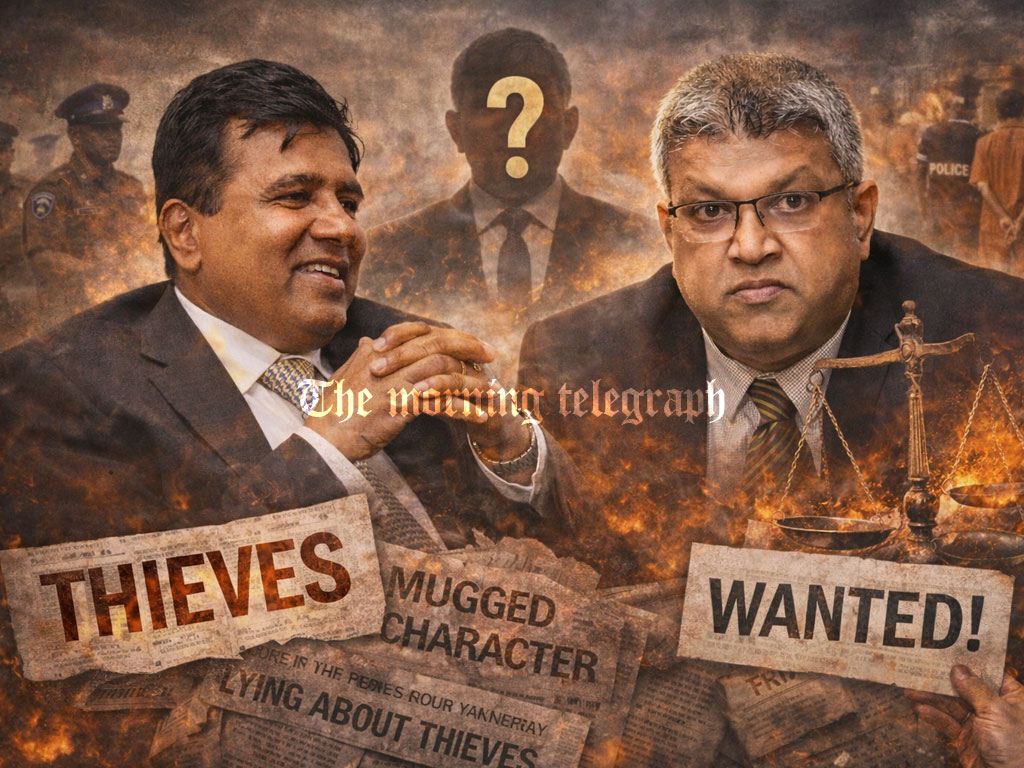
A haunting political cycle is repeating in Sri Lanka, where justice ministers appointed to punish corruption instead become symbols of betrayal, turning a powerful slogan into the very force that destroys governments.
In the aftermath of Sri Lanka’s 2015 Presidential Election, an unusual cultural moment unfolded. Popular stage dramas carried titles such as “Stripped with Thieves…”, “Thieves and Lies…”, and “Nothing Without Thieves…”. These productions reflected a simple political reality. “Catching thieves” had become the most powerful slogan in the country.

That slogan was elevated by former Speaker Karu Jayasuriya’s Movement for a Just and Fair Society, guided by Ven. Sobitha Thero. Civil society groups, including Purawesi Balaya, rallied around the demand to defeat corruption, violence, and impunity linked to the Rajapaksa family. The objective was clear. Field a common candidate and clean up governance.
In 2015, the UNP, the JVP, and Sarath Fonseka’s faction joined the movement. Maithripala Sirisena defected from the Rajapaksa government to become the common candidate, along with senior ministers who claimed they had broken away due to corruption. The public believed them. Maithripala became President, Ranil Wickremesinghe Prime Minister, and the administration was branded as the Yahapalana government.
Public expectations were unmistakable. Arrest the thieves. As a result, the Ministry of Justice became the most politically powerful portfolio in the country. It symbolized accountability. It symbolized truth.
Wijeyadasa Rajapakshe, former Bar Association President, was appointed Justice Minister. He was seen as ideal for the role, having earlier investigated corruption through COPE. Yet cracks soon emerged. Senior figures such as Sarath Fonseka, Champika Ranawaka, and Rajitha Senaratne accused Wijeyadasa of blocking corruption probes, particularly the Avant Garde floating armoury case.
Civil society groups turned against him. Ven. Sobitha Thero famously warned that “when the pan is hot, you must bake the bread”. Wijeyadasa resisted, clashed openly with activists and ministers, and was eventually removed from the Justice Ministry in August 2017. He crossed over to the opposition and later aligned with the Rajapaksas he once condemned.
The consequences were swift. At the February 2018 local government elections, the Yahapalana government collapsed. The Rajapaksas, once branded thieves, returned with overwhelming public support. The promise to catch thieves had been reduced to political theatre, and the public punished the betrayal.
A similar pattern resurfaced in 2024. Grassroots activists and social media campaigns demanded accountability for those who bankrupted the country in 2022. The JVP later absorbed this momentum, and Anura Kumara Dissanayake emerged as President with a historic two-thirds majority.
Once again, the Justice Ministry became the centre of public expectation. Anura entrusted it to Harshana Nanayakkara, a figure rooted in traditional politics and a complex family legacy spanning the Mahajana Party, the UNP, and former Rajapaksa administrations.
Now, the same accusation once levelled at Wijeyadasa is being directed at Harshana. Young activists who powered the 2024 uprising are questioning whether justice is being delayed, diluted, or selectively applied.
The difference between 2015 and 2024 is stark. Maithripala governed with a weak mandate and a divided Parliament. Anura commands an overwhelming majority and a shattered opposition. Yet history offers a warning. It was not the opposition that destroyed the Yahapalana government, but the very forces that brought it to power.
The question lingers ominously.
“Will it be that same cry, not the opposition, that brings down this government too…?”