A routine court hearing spiraled into explosive exchanges as prosecutors accused former President Ranil Wickremesinghe of turning a private family trip into a taxpayer-funded mission, igniting fresh debate over power, privilege, and accountability.
A case filed against former President Ranil Wickremesinghe over the alleged misuse of public property for a trip to London to attend his wife’s graduation ceremony was taken up before Colombo Fort Magistrate Isuru Neththikumara on the 28th, setting the stage for intense legal and political confrontation.

Appearing on behalf of the Criminal Investigation Department, Additional Solicitor General Dileep Peiris informed court that a detailed investigation had been conducted into the medical reports submitted by Wickremesinghe. As these submissions began, Wickremesinghe was seated in the dock, prompting Peiris to question who had granted him permission to sit there. Magistrate Isuru Neththikumara immediately cautioned Wickremesinghe, emphasizing that court proceedings must follow established procedure.
Continuing his submissions, Peiris delivered a scathing account of events following Wickremesinghe’s remand. “Your Honour, initially it was claimed there was bleeding from a valve. Even in the suspect’s conduct, there are ‘valves’,” he said, alleging a pattern of manipulation. He told court that Wickremesinghe was first taken to a prison hospital, then transferred to the National Hospital, and subsequently admitted to the Intensive Care Unit. According to Peiris, a nationwide publicity campaign portrayed the former President as critically ill, creating the impression that he was close to death. Bail was later secured.
Peiris further alleged that Wickremesinghe continued to misuse public resources while occupying ICU facilities, claiming he was reading books, meeting associates, and posing for photographs with doctors. He questioned how many ordinary patients were left waiting for ICU beds at the National Hospital while a politically powerful figure occupied one. “The bail granted is not the end of this matter,” Peiris warned. “I will raise this again. This is not over.”
At this point, lawyers appearing for Wickremesinghe asked whether the prosecution was acting out of revenge, triggering loud arguments between both sides. The Magistrate intervened to restore order before Peiris resumed.
He informed court that a team of officers had been deployed to England as part of the investigation. Peiris revealed that three lawyers, including Ronald Perera and Anuja Premaratne, had questioned the Attorney General about how a police team traveled to England without prior notification. The Attorney General, he said, was fully satisfied with the legality of the action. Attempts to create internal divisions had failed, Peiris added.
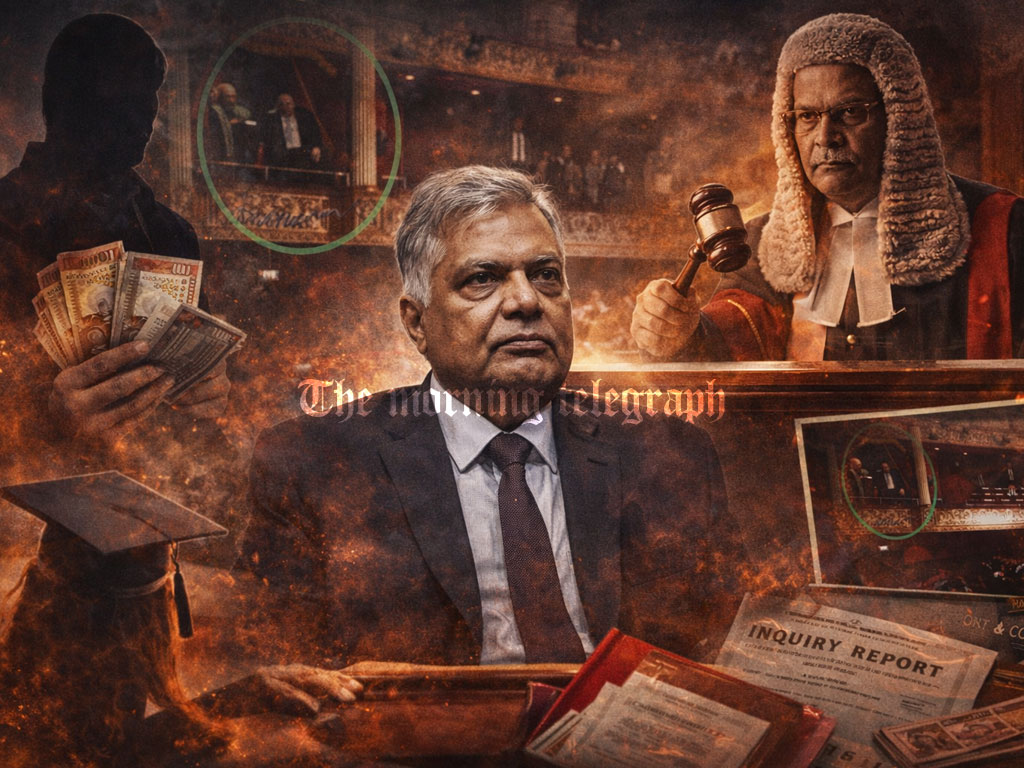
The prosecution then disclosed that statements obtained from Sri Lanka’s High Commission in London confirmed Wickremesinghe attended the graduation ceremony but sat in the general balcony and was not invited to the stage. The Magistrate questioned whether any of the 26 conclusions in the ‘B’ report classified the visit as official.
Peiris responded by outlining four categories of travel: official, state, diplomatic, and private. He stressed that an official visit requires involvement from the host state. “No one came to receive Ranil Wickremesinghe,” he said, adding that the letter claiming an invitation was never received by the High Commission. He argued these facts proved it was not an official visit, pointing out that there were no official photographs or videos from the United Kingdom. Even the former Presidential Media Unit photographer, he said, confirmed this absence. Peiris also noted that Saman Ekanayake, who accompanied Wickremesinghe, claimed he only learned it was a graduation ceremony after returning to Sri Lanka.
President’s Counsel Tilak Marapana, appearing for Wickremesinghe, strongly rejected these claims. “I am not in the habit of speaking nonsense,” he told court, arguing that most of the prosecution’s statements were irrelevant. He questioned why investigators had not verified the authenticity of the invitation letter by contacting the university directly. He also criticized the investigation process, likening it to “asking the thief’s mother to identify the suspect.”
The Magistrate questioned whether a university invitation could be considered official, to which Marapana replied in the affirmative. Peiris countered by stating the institution was a private university with no links to the British government and no semi-state sponsorship. He told court that investigations were complete and that indictments would be filed in March, with plans to proceed before a three-member trial-at-bar.
Further arguments erupted when comparisons were made to other presidential travels, prompting the Magistrate to remind all parties that the court values facts, not noise.
The court granted permission to name Saman Ekanayake as the second suspect. His counsel stated that Ekanayake was present in court and had no intention of evading justice. The prosecution, however, alleged negligence and abuse of authority, claiming Ekanayake authorized the release of funds bearing the state emblem.
After considering all submissions, the Magistrate observed that nearly Rs. 16 million appeared to have been misused and noted that expenses related to presidential travel must be personally scrutinized by the Presidential Secretary. Based on the material presented, the court stated the trip appeared to be private. The Magistrate ordered the remand of Saman Ekanayake until the 11th and directed the CID to urgently obtain a statement from the University of Wolverhampton in London, preferably through inquiries made from Sri Lanka.