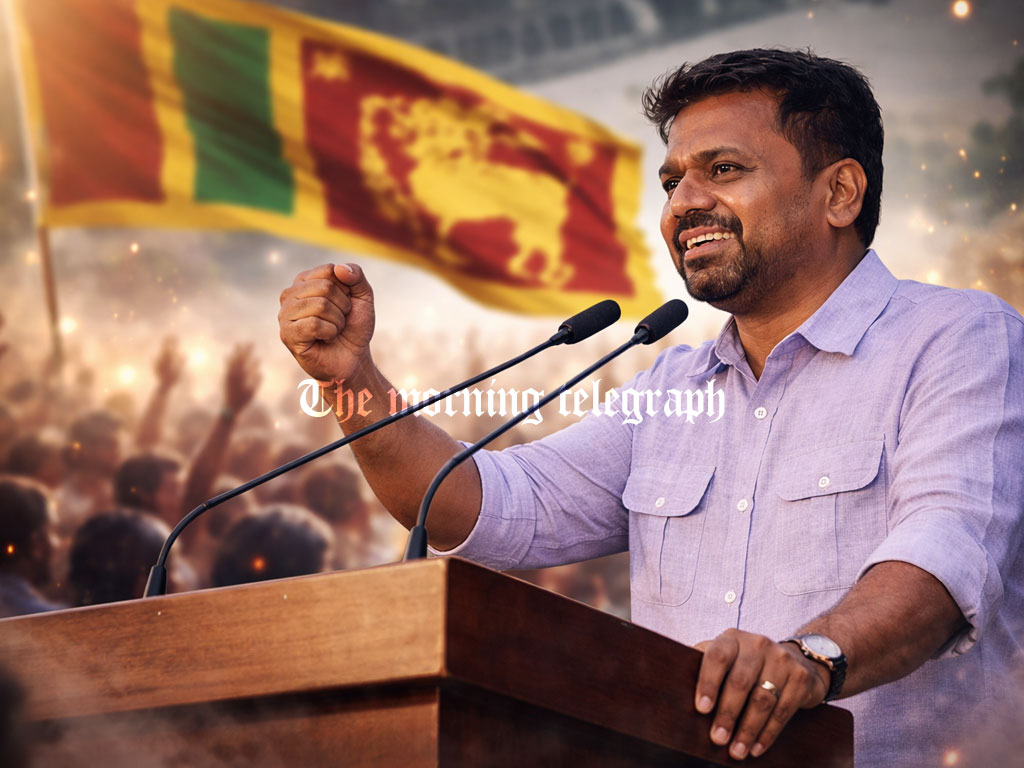
Bold promises of justice, economic reform, and equal accountability mark a defining moment as the President vows to end corruption, rebuild trust, and ensure the rule of law finally reaches everyone in Sri Lanka.
I want to clearly state that the objective of this government is to end the era in which the economic achievements of this country were concentrated around a few powerful families and a ring of thieves connected to them. Our goal is to ensure that every benefit gained by strengthening the national economy flows directly to the people who stand at the bottom of Sri Lanka’s economic ladder. That is the responsibility we have accepted, and that is the promise we intend to keep.

I also want to make it absolutely clear that the law will be enforced against anyone who has acted wrongly, regardless of the position they held, the time period involved, or the dignity they once claimed. No individual will be shielded by power, influence, or status. This year will be remembered as the year in which justice and fairness earn the deepest trust of the people of this country.
I made these remarks while participating in a program held at the Central Provincial Council Auditorium today, where compensation was awarded to individuals and industrialists whose houses and livelihoods were damaged by Cyclone Ditva. This was not just a ceremonial event. It was a reminder of our responsibility to the people who suffer first when disasters strike and last when recovery is delayed.
Compensation was distributed to 150 beneficiaries from the Kundasale, Medadumbara, Pathadumbara, and Panwila Divisional Secretariat Divisions. I personally joined the symbolic distribution of compensation, not as a formality, but as a commitment to rebuilding lives with dignity and fairness.
Under Sub Number 12 of Budget Circular 08/2025, cheques of Rs. 2 million were distributed as the first installment of the Rs. 5 million allocated for families whose houses were completely destroyed. This assistance applies to individuals who rebuild on their own land, on the same plot, or even on government land. No discrimination was applied. The objective was immediate relief combined with long-term recovery.
Under Sub Number 14 of the same circular, compensation was also provided for houses that were partially damaged. While assessments can reach up to Rs. 25 lakh, we introduced a mechanism to provide immediate relief. Beneficiaries who opted to receive Rs. 5 lakh without waiting for full assessments were given that support without delay.
Additionally, Rs. 2 lakh was distributed to each industrialist whose business premises or machinery were damaged by Cyclone Ditva. This assistance applies to every registered business, whether small, medium, or large scale. The intention is clear. We want businesses to restart quickly, workers to return to employment, and local economies to recover without unnecessary bureaucratic delays.
Strengthening the economy is a fundamental responsibility of any government. We learned a painful lesson two or three years ago when the economy collapsed. Hospitals ran out of medicine. People stood in long queues for fuel and milk powder. An economic collapse does not punish only the poor or only the rich. It brings disaster to every layer of society.
That collapse was not accidental. It was caused by years of flawed economic policies, bribery, fraud, and corruption tied directly to political decision-making. Many development projects were launched not because the country needed them, but because they served political interests or benefited a few individuals. A recent report revealed that nearly 1,800 government buildings were either abandoned halfway or completed and left unused. These projects were not based on national priorities. They were driven by personal agendas and improper transactions.
Some of these buildings cannot even be maintained today. This is the cost of corruption combined with poor planning. That collapse is not over yet. Recently, I requested a report to assess the cost of restarting stalled projects. Out of 43 major projects, 20 were examined. If they had been completed in 2022 or 2023, the cost would have been Rs. 300 billion. Today, the same projects require Rs. 610 billion. The price of corruption is still being paid by the people.
When we took over the government, our first priority was economic stability. Without stability, there can be no rule of law, no social justice, no proper education system, no healthcare, and no reliable transport network. Everything depends on a stable and fair economy.
We have made progress. But our mission is not just growth. Our mission is distribution. Historically, economic gains accumulated around a few families and a small circle of thieves. We reject that model completely. We do not intend to pocket a single cent of public money. Our aim is to ensure that the benefits of national development reach those who were always excluded.
That is why disaster relief, housing, infrastructure, and livelihoods matter. We are rebuilding houses, roads, and public facilities with the support of friendly nations including India and China, along with assistance from private entrepreneurs. This is not charity. It is a collective responsibility to raise living standards across the country.
We, as rulers and public servants, were educated using public funds. We owe our service to the people in return. The rapid recovery we achieved after Cyclone Ditva is due to the dedication of public officials. I sincerely thank every officer who worked tirelessly during this crisis.
Economic development must go hand in hand with the rule of law. We are committed to that. There are weaknesses in institutions such as the judiciary, law enforcement agencies, and the Attorney General’s Department. We are addressing those weaknesses. We have approved higher salary structures and direct recruitment for the Bribery or Corruption Investigation Commission. Legal frameworks have been strengthened, and new mechanisms are in place.
We have passed laws to recover illegally acquired assets. Amendments to the Prevention of Terrorism Act will be introduced soon. New laws are being prepared to combat organized crime and meet international standards on money laundering. Institutional reform is not optional. It is essential if Sri Lanka is to be a civilized and lawful state.
Everyone must stand below the law. No one stands above it. In this transformation, those who act correctly will not be harmed. Those who act wrongly will face consequences. Good ideas alone are not enough. Action is required, and action demands courage.
Some believed the law would never reach them. They thought influence and connections would protect them forever. That illusion is collapsing. The law will reach everyone, big or small, powerful or powerless. Criminals should fear the law, not honest citizens.
Mistakes cannot be buried by time. Accountability will come, whether today or tomorrow. That is the message we must embed in this country so that future generations can believe in a just society.
This year will be the year that earns the trust of the people in justice and fairness. We are prepared to face anything to make that a reality.