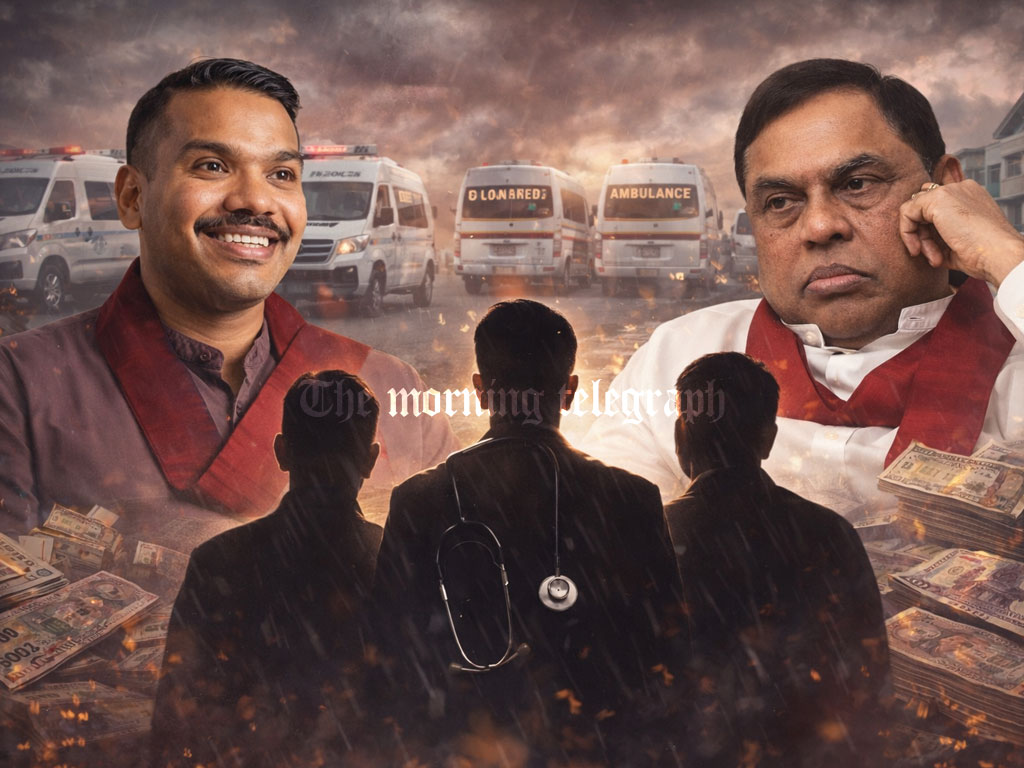
A fiery political broadside questions power, priorities, and public pain as Namal Rajapaksa accuses the government of riding on loans while patients struggle without care.
Sri Lanka Podujana Peramuna National Organizer and Member of Parliament Namal Rajapaksa has launched a sharp attack on the government, accusing it of ignoring the suffering of ordinary citizens while indulging in wasteful spending. Responding to journalists’ questions on whether Basil Rajapaksa had returned to Sri Lanka, Namal turned the focus to what he described as misplaced priorities in governance, particularly in health, public finance, and accountability.

He said a government that refuses to listen to the reasonable demands of doctors and professionals has no hesitation in importing luxury cabs for its own use, even if those vehicles are brought on loan. Namal argued that while it was once portrayed as shameful to acquire military and police equipment on credit during the war years, there now appears to be no embarrassment in riding imported cabs purchased through borrowing. He urged the government to think about patients suffering helplessly in state hospitals, saying funds wasted on vehicles could instead be redirected to the health sector to provide medicines, equipment, and fair solutions to doctors’ demands.
Namal made these remarks while answering a question on Basil Rajapaksa’s presence in the country, using the opportunity to expand his criticism of the administration’s conduct and political direction.
He said his party is steadily strengthening itself at the village level, as it has always done, and claimed that many individuals who had previously distanced themselves are now returning. According to Namal, young people and capable individuals are joining the party, creating a practical political force that understands grassroots realities, speaks honestly, and seeks solutions to people’s everyday problems. He emphasized that decisions on candidates and alliances will be made closer to elections and not under pressure or speculation.
He added that the party has no reason to join hands with anyone at present, as there is no election underway. Instead, he said the focus is on rebuilding organizational strength, forming branch associations, and preparing to stand independently in future contests.
On provincial council elections, Namal said his party supports holding them and questioned the government’s commitment to democracy. He noted that while the government claims to speak loudly on behalf of people in the North and East, particularly the North, southern provincial councils remain under governors instead of elected chief ministers. If the government truly believes in democratic values, he argued, it should return power to elected representatives.
Namal also revisited political events surrounding the 2015 election, alleging that money was used to defeat the Rajapaksa family and claiming that those involved are now contradicting themselves. He questioned why political forces should unite merely to defeat individuals rather than make principled decisions aimed at serving the country’s needs.
Turning to law enforcement and corruption, he said the Police Minister has spoken of strict punishments, especially regarding the coal scam. However, Namal questioned why greater attention was paid to 1,775 imported cabs and 323 containers allegedly released from the port, while serious questions remained unanswered about two drug containers. He said even in Parliament, the minister could not explain who was responsible for smuggling them, despite knowing other unrelated details. According to Namal, the public expected decisive action and accountability over the containers linked to the coal issue.
He also dismissed repeated references to Basil Rajapaksa, saying those who worked with Basil in the past are free to contact him directly. He accused the government of recycling old cases through anti corruption mechanisms, insisting that such tactics would not intimidate his party.
Using a metaphor, Namal described what he called the government’s pickpocket theory, where attention is diverted while larger thefts occur. He alleged that while money is lost through scandals like coal, the government spends excessively on imported cabs and labels others as thieves. He reiterated that the funds spent on thousands of vehicles could instead meet doctors’ demands and ensure patients receive essential medicines.
Namal again urged the government to prioritize the health sector, saying ordinary people are bearing the cost of poor decisions. He argued that stopping former MPs’ pensions has created an opportunity to redirect funds to citizens affected by disasters such as the Ditva cyclone, rather than focusing on symbolic actions or political vendettas.
According to him, the real test for the government is whether it chooses to serve people in hospitals, villages, and disaster hit areas, or continue policies that, in his view, deepen public suffering while those in power ride comfortably on borrowed wheels.