
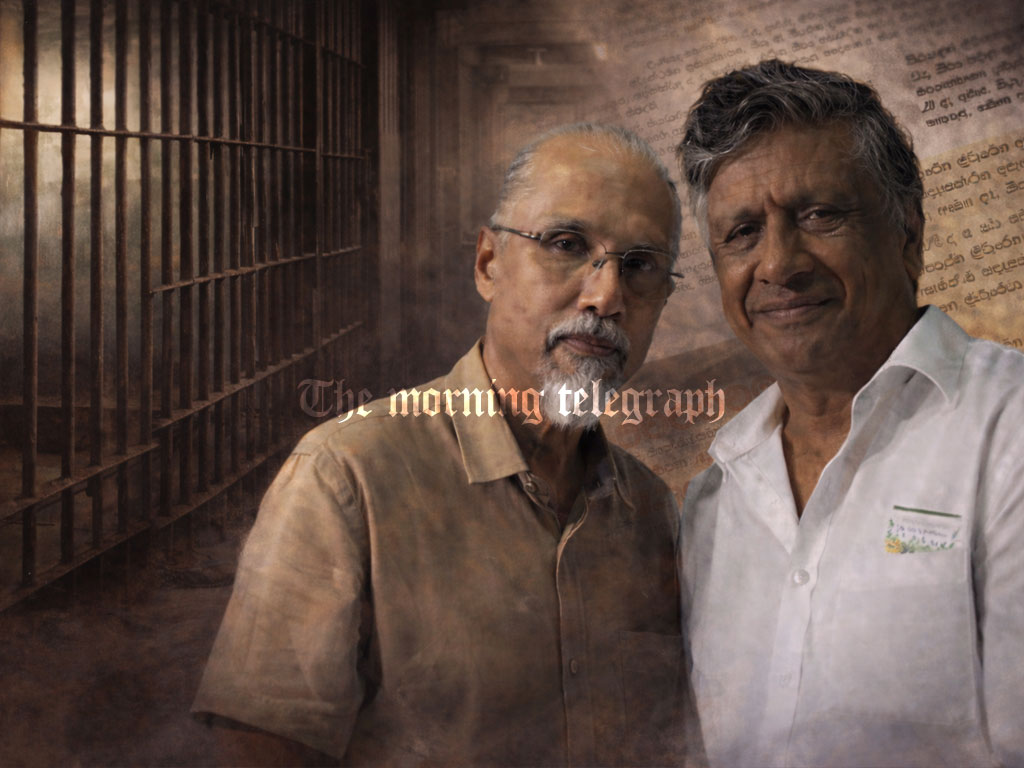
My name is Saman Athaudahetti, and this is a confession I make with a heart heavy with regret and a mind troubled by consequence. The distinguished, fiercely dedicated civil servant Saman Ekanayake is in jail today, and the origin of his current plight can be traced directly to a suggestion I made in a different era, over thirty years ago. If I had never spoken his name at that critical juncture, his life’s path would have been profoundly, undoubtedly different. This is the story of the exemplary officer I came to know, the immense value he brought to a nation in its times of greatest need, and the heavy, personal burden of responsibility I now carry for his fate. It is a narrative that interrogates the very nature of public service, reward, and sacrifice in the complex tapestry of Sri Lankan governance.

Our shared story begins in the late eighties, a period etched in memory. We were tasked with broadcasting the live radio commentary for the National Games from a stadium outside Colombo. Our operational base was a modest, functional pavilion situated right next to the main sports hall. The grand opening ceremony was scheduled for the afternoon, but our team had been on the sun-baked field since morning, laboring over the intricate technical arrangements required to connect our remote broadcast point to the main studio in Colombo via VHF waves. It was detailed, precise work.
From the first light of dawn, we observed a flurry of activity. Officials from the Ministry of Youth Affairs and Sports dashed across the grounds, their faces etched with the concentration of last-minute orchestration. The opening ceremony finally commenced in the evening under the distinguished patronage of the Prime Minister. In our commentary box, the voices of Hemajith Fernando, Michael Karunathilaka, and myself filled the airwaves, describing the vibrant spectacle. About an hour after the proceedings began, a young man arrived at the entrance to our pavilion. He was dressed in simple white clothes, and he was drenched in sweat from head to toe. The only seats in that confined space were reserved strictly for the radio technical crew and commentators. Unfazed, he found a spot on a sturdy pole at the very end of the structure, sat down, and after catching his breath, began to chat with us in a friendly, unassuming manner. He was animated. After a while, he excused himself and ran off to some other duty, only to return later, resuming our conversation as if it had never paused.
I had distinctly noticed this particular person laboring tirelessly since daybreak, a constant blur of purposeful motion amidst the organized chaos. My curiosity was piqued. Who was this official, still running and engaging with such energy while many others who had worked hard all morning now sat comfortably in the main pavilion, dressed in formal European clothes, enjoying the inauguration? With us was the veteran volleyball coach K. A. K. Wijepala, assigned by the ministry to assist our commentary team with logistical and procedural insights.
“Vijay… who is that young man there?” I asked when I found a quiet moment between commentaries, nodding towards the enthusiastic figure.
“That is Assistant Secretary Saman Ekanayake,” Wijepala replied without hesitation.
That name, Saman Ekanayake, stuck with me. I made a point of observing him over the next three days of the National Games. His commitment was not a show for the opening day; it was a constant. He worked with a relentless, focused dedication that seemed to stem from a genuine passion for the event’s success, not just the fulfillment of a duty roster. The most telling incident, the one that truly revealed his character, occurred on the final day. The highlight of the entire athletic meet was a premier running event, a marquee race. The President of the country, the chief guest for the closing ceremony, was already in the stadium, awaiting this climax. Then, about two hours before the event was to start, a tense ripple went through the organizing team. We learned that a prominent, star athlete scheduled to participate had developed a serious grievance and intended to boycott the competition.
This was a potential disaster, a national embarrassment in front of the highest authority. As soon as we heard this, I, along with Brother J. H. Wilson, the Sports Director of the television broadcaster, immediately went to find the athlete. Our mission was clear: to somehow persuade him to participate, to resolve the issue. The official named Saman Ekanayake, upon hearing the news, joined our impromptu operation without a second’s hesitation, without waiting for a formal order. He was part of the solution-seeking team instantly. We negotiated, we listened, we pleaded. Finally, our collective efforts prevailed. That athlete ran the race. Not only did he run, but he also won. The stadium erupted, the ceremony proceeded with glory, and a crisis was averted. That moment of shared purpose was how I truly got to know Saman Ekanayake. I saw an officer who did not see problems as territorial boundaries but as puzzles to be solved for the greater good, irrespective of whose formal responsibility it was.
Later, at the invitation of Charitha Ratwatte, the insightful Secretary of the Ministry of Youth Affairs at that time, I became involved in many voluntary activities for the Ministry and the National Youth Services Council. During those engagements, I was able to gain a deeper, more nuanced understanding of the unique method by which this Saman Ekanayake operated. He was not a bureaucrat who mastered the art of saying ‘no’. He was an enabler who mastered the science of ‘how’. When the Ministry leadership decided to publish a new sports magazine called ‘Jawaya’, it was Saman Ekanayake who ensured it was not just another minute paper decision that faded away. He embodied the drive that translated policy into practical reality. It became a tangible magazine on desks and in hands because of the concerted, detailed efforts he made for it, navigating procurement, content, and distribution with quiet efficiency.
The pivotal moment, the true origin of my current guilt, arrived in the landmark year of 1993. Mr. Ranil Wickremesinghe had just become Prime Minister. I was then working in the Ministry of Industries, but was shortly transferred to the pivotal Prime Minister’s Office. The Prime Minister called me and gave me an urgent task: to find a specific school principal named Saman Lalitha as soon as possible, as he hoped to appoint him as the Prime Minister’s Private Secretary. I located Saman Lalitha and brought him to the Prime Minister.
Then, in a follow-up conversation, the Prime Minister informed me that he also needed a particularly capable, energetic administrative officer to serve in a key role within his office. The need was for someone who could manage the complex machinery of that central institution. At that very moment, the name that sprang to my mind, based on my observations from the games and the ministry work, was Saman Ekanayake. I suggested him. Later, Mr. Charitha Ratwatte also confirmed independently that my suggestion was correct, that Saman was indeed a standout officer. Consequently, Saman Ekanayake was appointed as an Assistant Secretary in the Prime Minister’s Office. For a brief, amusing period, people within the political and administrative circles jokingly referred to the Prime Minister’s Office as the “Saman Devalaya” because three key officials—Saman Lalitha, Saman Ekanayake, and myself, Saman Athaudahetti—all worked there in concert. That period marked my first sustained experience of working in the same office with Saman Ekanayake, and it reinforced my early impressions of his diligence.
His reputation for excellence and positive thinking continued to grow beyond that office. One evening in the late year of 1999, the then Foreign Secretary, the revered senior civil servant Lionel Fernando, affectionately known as “Loku Sir,” was present at a friendly intellectual gathering held at the residence of Professor Carlo Fonseka. During the wide-ranging evening chatter, he made a thoughtful request to Professor Fonseka. “Carlo, if you know of a young man in the Administrative Service who has genuinely positive thinking, a constructive mindset, please tell me. I want to take him to the Foreign Ministry. We need that kind of fresh energy.”
As Professor Carlo Fonseka, a man of great discernment, pondered the question, I felt compelled to step forward. “Loku Sir, there is an officer named Saman Ekanayake. He is currently working in the Youth Services sector. I do not have a great personal relationship with him, so I say this objectively. But from all accounts and my own limited experience, he is an officer who seems a perfect match for the culture you wish to build,” I said, offering my unsolicited but sincere recommendation. Not long after that casual evening, the elder statesman of the foreign service told me that Saman Ekanayake had indeed been appointed as the Administrative Director of the Foreign Ministry. Then, with a characteristic twinkle, he added a caveat. “Do you think I took him purely at your word? No. I conducted proper interviews. I interviewed him and a few other promising candidates. He was the one who scored the highest, who presented the clearest vision. Let us see now how he will perform in the upcoming complex issues facing the ministry.”
Later, after observing Saman’s work, Loku Sir told me something that was, in the world of Sri Lankan civil service, a monumental compliment. He said Saman Ekanayake was an administrative officer of their generation. He was referring to that legendary old guard of civil servants, the storied positive thinkers who existed at a different time. Those were the officers who knew how to climb administrative fences not for personal gain, but to serve the people. They were the individuals who possessed the unshakeable backbone to not make mistakes outside the strict financial and administrative regulations, no matter what political influence or pressure came their way. They were the masters who knew how to pave a way for work, not find a path away from work. Names like Sarath Amunugama, Austin Fernando, M.J. Perera, Leal Gunasekara, Amaradasa Gunawardena, Ananda Guruge, Neville Jayaweera, Ridgeway Thilakaratne, Bradman Weerakoon, and H.B. Dissanayake represent that golden standard. According to Lionel Fernando, Saman Ekanayake belonged to that same esteemed lineage. This was a powerful testament to his professional character and capability.
Our professional paths converged again, decisively and fatefully, in the transformative year of 2015. After the presidential election results were released and the new political landscape settled, Mr. Wickremesinghe, assuming the office of Prime Minister, called Saman Ekanayake. It was a few days after the Opposition Leader’s Office had begun the frantic, hopeful planning to transition into the machinery of the Prime Minister’s Office. Saman, after meeting with Mr. Wickremesinghe, came straight to my office to talk. We sat down. It was the first proper, lengthy conversation we had had after many years of separate career journeys.
At that precise moment, he was holding a prestigious, high-paying international position in the United Nations Human Settlements Programme (UN-Habitat), a role worth millions of rupees annually, with global exposure and security. Mr. Wickremesinghe had invited him to leave all that behind—the salary, the stability, the international career ladder—and return to Sri Lanka to serve the people during a window of historic hope.
“What do you think I should do?” he asked me, genuinely seeking counsel.
“I am saying you should accept this challenge,” I replied without artifice. “The whole country is brimming with new hope, a collective desire for change and good governance. So, at this precise juncture, the Prime Minister needs a positive, proactive Secretary who can run around, think on his feet, and work twenty-four hours a day if necessary. The nation needs you.” The very next day, demonstrating a staggering commitment to public service over personal comfort, Saman Ekanayake assumed the formidable post of Secretary to the Prime Minister.
Those were exceptionally challenging yet hopeful times. The “good governance” or “Yahapalanaya” government was a complex coalition of vastly different political persuasions. Their collective hopes were immense, varied, and often contradictory. The Prime Minister’s Secretary, therefore, had to bear the intellectual and administrative burden of reconciling these hopes, in addition to managing the crushing daily routine of running the country’s central executive office. There were many policy areas that were consistent across the coalition, and many that were wildly inconsistent. There were administrative threads that were loose and required tying, and others that were dangerously tangled and needed careful unknotting. There were issues highly visible on the surface for media scrutiny, and many more critical operations that remained invisible to the public eye but were vital for state function.
In such a volatile and high-stakes context, Saman Ekanayake made the Prime Minister’s Office a law-abiding, disciplined, and exemplary institution. I know this because I saw, from a close vantage point, the examples he set, the personal commitments he made to integrity, and the systematic plans he implemented for efficiency. According to the constitution of our country, the post of Prime Minister, in certain frameworks, does not inherently wield the greatest executive power. Its influence must be built, its authority crafted through activity and competence. Only a creatively thinking Prime Minister and a strategically capable Secretary can jointly achieve that. Under Saman’s steady leadership, the Prime Minister’s Office became an active and powerful tier of governance. It was not only an efficient office processing files; it also became a nerve center that played a prominent, coordinating role in overall state governance and policy implementation.
Among all the state institutions that fell under the rigorous authority and scrutiny of the Parliamentary Accounts Committee, the Prime Minister’s Office, from 2015 to 2019, received the gold award for the institution with the most optimal, transparent financial management. This was not a minor accolade; it was irrefutable, audit-proven evidence of his meticulous administrative methods and uncompromising financial discipline. It was a tangible rebuttal to the culture of waste and opacity.
Not only that. Understanding that institutions are only as good as their people, he also took pioneering steps to provide international-level training and capacity building to the employees of the Prime Minister’s Office. He organized all these high-value training courses in such an innovative way that they were not a burden on the strained finances of the Sri Lankan government. In selecting candidates for these opportunities, partisanship, mere acquaintances, and personal friendships were not considerations. Merit and potential were the sole criteria.
But my honest observation here must also be mentioned. Those who were truly willing to learn, who attended that training with open minds, gained invaluable knowledge. With that enhanced knowledge, they still provide light and competence to the institutions they serve and, by extension, to the country. However, some of those who went to the training emerged with a different attitude. They are those who now think that no one else is knowledgeable except them. They spend their full time and energy not in service, but in the art of deceiving successive secretaries, ministers, prime ministers, and presidents with half-truths and sycophancy. It was not that Saman Ekanayake’s tenure was free of such individuals. The public service is a vast ecosystem. But he possessed a sharp acuity; he was able to understand their nature very quickly. He recognized the genuinely talented and empowered them. He mentored the competent into becoming more capable. He showed the right path to the willing, the “Nissans” as one might say in local parlance—the reliable workhorses. These individuals, the Nissans, always respect him. They continue to do good for their institution and the country along the path of integrity he demonstrated. The “pussies,” the sleek opportunists, resent him. Their method is to socialize lies, to weave narratives that serve their survival rather than the truth.
Saman also faced uniquely delicate professional challenges that he handled with grace. The Tower Hall Theatre Foundation is an institution that was officially under the purview of the Prime Minister’s Office. In 2015, Lionel Fernando, the same retired senior civil servant who had once been his superior, was appointed as its Director General. The dynamic was fascinating: Lionel Fernando, who was his superior officer at the Foreign Ministry in 2000, was now technically his subordinate officer in this new structure. Conversely, for Mr. Fernando, Saman, who was his subordinate officer in 2000, was now his supervising Secretary. We watched with great professional interest how this group of mature officers performed their duties without ego, focusing only on the institution’s welfare. I learned significant lessons in humility and duty from observing both of them navigate this role reversal.
His stature as a fair and effective administrator was such that he became a respected bridge even during periods of high political tension. The former President’s Secretary, P.B. Abeykoon, once told me a revealing story. “The President cannot be approached when he is in a state of anger. He criticizes everyone in the room. At such volatile times, if I have something critically important to communicate, I will route it through Saman Ekanayake. The President listens to Saman. He does not criticize Saman.” This spoke volumes about the trust and respect Saman commanded across the political divide.
Later, when substantive policy disagreements arose between President Maithripala Sirisena and Prime Minister Ranil Wickremesinghe, the position of Secretary to the President was held by Mr. Austin Fernando, another senior administrative officer of great repute. In his autobiography, Fernando provides a firsthand account of Saman’s crucial role:
“…….. Without any further discussion, the President agreed to my proposal. I immediately met the Prime Minister.
‘Prime Minister, it is important that you and the President act peacefully and amicably. I think that by intervening with Saman Ekanayake and me, you can reach a compromise on issues that are difficult and unsuitable for discussion with the President.’
He also said nothing against it, which was tantamount to an agreement.
The conversation, which initially took place between the Prime Minister and myself at around noon, took place a second time at around seven in the evening of the same day with the participation of the Prime Minister’s Secretary, Saman Ekanayake…’ (I, Austin; page 319)”
The professional, discreet, and institution-saving manner in which the two secretaries managed the profound disagreements between the two executive heads of state at that time was a masterclass in crisis management and constitutional duty. This commitment to preserving institutional integrity over political rivalry continued even during the infamous 52-day constitutional crisis in late 2018. After that unprecedented turmoil was resolved by the Supreme Court, Saman, with Prime Minister Wickremesinghe’s consent, made it a point to invite the Secretary to the President, Mr. Udaya Seneviratne, to every official function held at the Prime Minister’s Office. Saman never took steps to avoid bringing the differences or heat that arose between politicians into the realm of professional, collegial institutional duties. Udaya Seneviratne, to his credit, also followed that noble practice and participated in every such occasion. Those incidents taught many of us enduring lessons in the true meaning of public service—that the state machinery must outlast and operate above transient political conflicts.
After the political change in 2019, he resigned from the post of Secretary to the Prime Minister. Yet, in 2022, when the country was plunged into its deepest crisis since independence, the call to service came again. Sri Lanka was literally on fire. The state was bankrupt, officially. Foreign reserves were empty. There was no gas for cooking, no kerosene, no diesel, no petrol. Electricity blackouts lasted half the day. The people were in a constant, anguished struggle for survival. The state itself was shaking, its foundations crumbling. People’s lives were collapsing.
But at that apocalyptic moment, Saman Ekanayake did not think twice, did not calculate personal risk. He took on the post of Prime Minister’s Secretary once more, becoming a pillar of strength and operational sanity for Ranil Wickremesinghe, who now faced the task of steering a ship that everyone believed was sinking.
‘This is a difficult challenge. Everyone thinks that this cannot be turned around. They say it is not possible. But I believe it is possible. If you work hard, dedicate yourself utterly, and work with honesty, you can,’ he told me with quiet conviction over the phone. It was a statement of faith in the system and in the people.
It was an extremely difficult, almost impossible time. In a matter of days, following President Gotabaya Rajapaksa’s resignation, Ranil Wickremesinghe assumed the presidency, and Saman was entrusted with the colossal responsibility of the post of Secretary to the President, taking charge of the Presidential Secretariat.
When he took over the Presidential Secretariat, it was in utter chaos. It was a physical mess because protestors had occupied and stormed the building. It was an even deeper administrative and financial mess because of the unexpected, destabilizing events that had occurred during the previous year of political and economic paralysis. Systems had broken down, files were lost, procedures were ignored, and accountability had vanished.
He sorted out all this multidimensional mess within three to four months. It is a testament to his skill that, later, when charges were brought against him, the very administrative and financial procedures he had re-established in the Presidential Secretariat ensured that official files were in order and safe, providing a clear audit trail that ultimately protected the integrity of the office from many baseless allegations. His own systems became a shield for the institution.
When Saman assumed office, the President’s Fund, a vital lifeline for countless citizens seeking medical and educational assistance, was in the midst of an intractable mess, mired in delays and opacity. Together with the diligent Chief Accountant Sarath Kumara, Saman untangled all this chaos. When he assumed office in July 2022, about 8,000 patient assistance files had not even been touched, gathering dust. This was because relief to patients from the fund had been almost completely stopped for about a year due to the crisis. Yet, more desperate requests were pouring in every single day. By December 2022, through sheer will and re-engineered processes, not only had all these backlogged requests been processed and met, but a new, efficient mechanism was also developed to resolve the urgent needs of those seeking relief from the fund within three days—a bureaucratic miracle under the circumstances.
Furthermore, the list of diseases eligible for medical assistance under the President’s Fund was expanded to be more inclusive. The financial limits for paying for critical illnesses like cancer surgeries, heart surgeries, and liver transplants for children were increased substantially to match actual costs. He also initiated a compassionate program to provide scholarships to one hundred thousand students and novice monks facing severe economic difficulties, funded through the President’s Fund.
All this monumental work was not done in a normal, stable situation. It was achieved at a time when the country had fallen to the formal level of a bankrupt state. It was executed at a time when the brutal, complex struggle to negotiate with the International Monetary Fund and restructure debt was the main, all-consuming objective of the entire state apparatus. It was carried out at a time when the diplomatically difficult task of regaining the shattered trust of the entire world—of lenders, investors, and partners—was being shouldered by the President and his team.
While fully dedicating himself to all those macro-level tasks as the Secretary to the President, he simultaneously took the initiative to make the Presidential Secretariat itself an exemplary office in terms of internal administration and finance. He cut unnecessary expenses ruthlessly. He limited essential expenses to the bare minimum, setting an example of austerity from the very top. Through these measures, by the year 2023, Saman was able to bring the Presidential Secretariat to the impressive third place among all state institutions for the best, most transparent annual reports and accounts—a leap from the disarray he inherited.
As the Secretary to the President, his role was coordinative across government. He looked into the work of all ministries, providing strategic guidance. The secretaries of all ministries and the district secretaries met regularly under his coordination, preparing and launching concrete operations to rescue the country from the terrible economic abyss it had fallen into. The contribution he made to President Wickremesinghe’s near-impossible mission to stabilize and rescue the country was priceless. It can never be valued in mere terms of money or rank. It was a contribution of intellect, integrity, and tireless execution.
My personal association with Saman became closer due to these intense periods of official duty. During my time working in the Prime Minister’s Office, I had to accompany the Prime Minister’s Secretary on many domestic and foreign official trips. During long official discussions and on intercontinental flights, we would often sit next to each other. I first experienced this kind of working travel intimacy with the legendary Bradman Weerakoon. After 2015, I experienced it with Saman. On flights, Bradman had a habit of falling asleep immediately after eating. After Bradman slept, I would also sleep. Saman, however, has a different ritual. He likes to watch movies after eating. I would try to stay awake, but often, I would sleep. When I woke up, Saman would say, ‘This film will definitely have an impact, it was profound.’ To be perfectly honest, the only in-flight movies I have watched in their entirety during my career have been on Saman’s recommendation and insistence.
Apart from cinema, another of his great personal passions is literature. Regardless of what high position he holds, he regularly, almost religiously, visits the Colombo International Book Fair. During his tenure in any institution, he strives to nourish its library with new, relevant literature. He actively guides the minds of employees through charitable staff associations to appreciate and nourish literature and the arts. Saman is also fond of taking photographs, possessing a keen eye for composition. But he is not a gear-obsessed photographer. He does not carry expensive cameras or telephoto lenses. Saman takes his pictures solely with his smartphone camera. Although I have suggested to him several times that we should put a selection of his best pictures together and hold a small exhibition, Saman has shown no interest whatsoever in organizing such a self-promotional thing. His art is for personal reflection, not public acclaim.
Throughout my long career in media and government, I have served under various types of government officials. Similarly, I have served alongside a wide spectrum of government officials. Various government officials have also, in different capacities, served under my supervision. Of all these numerous individuals, across decades, I have developed the most profound respect for Saman Ekanayake. His defining characteristic is that he does not say no to the right thing, to the necessary task. He does not waste time looking for reasons not to do the work; he immediately starts searching for the practical reasons and methods to do it. He manages state property and precious resources with the care of a frugal owner, not a careless tenant. He maintains institutional discipline not through fear, but through consistent example. He upholds financial and administrative regulations not as shackles, but as the essential guardrails that keep the vehicle of state on the road and moving towards its destination.
A recent social media post by Lalith Lankathilaka, a former head of the United Nations Human Settlements Programme, on his Facebook wall, testifies independently to Saman’s professional ability and bedrock honesty from an international perspective.
‘During the time you worked with me at the United Nations Human Settlements Programme, we received about $30 million in aid from Japan, the European Union, Australia and India. You managed it all properly. You ensured that the money was spent properly on the intended projects, and you were accountable for every single dollar spent. That integrity was never in question.’
I am deeply saddened, to the point of personal sorrow, by the situation that such a capable, proven, and honest officer has to face today. However, I remain stubbornly hopeful that in the end, truth and justice will be served, and his name will be cleared. Yet, on one hand, I must bear full responsibility for this unfortunate incident that befell Saman. This is the core of my confession. Because if I had not proposed his name for service in the Prime Minister’s Office back in 1993, this entire story, his ascent into the heart of Sri Lanka’s most volatile political storms, his shouldering of impossible burdens during national crises, and his subsequent targeting, could have been completely different. He might have had a quieter, safer, perhaps internationally based career. By putting his name forward, I set him on a path of supreme national service that has now led to a prison cell. His current plight, therefore, is in a very real and poignant sense, because of me.




Saman’s story is one of great national importance. Such people are rare. It is sad that there is no legitimate process to right this wrong. So, he must face the convoluted legal process and accept the woes of remand with rectitude and courage. I don’t know Saman personally but I can relate to the many endorsements from varied officials who vouch for his absolute integrity.