A photocopy of a classified agreement, allegations of treason against the JVP-led NPP government, and a tourism industry drowning in poor tourists, opposition firebrand Wimal Weerawansa launches a blistering two-hour media briefing, accusing President Anura Kumara Dissanayake and JVP national organizer Tilvin Silva of scripting the final act of Indianization while families of fallen cadres watch in silence.
The atmosphere inside the National Freedom Front party office was tense. Reporters shuffled, cameras positioned, and standing behind the lectern with the demeanor of a man carrying state secrets was Wimal Weerawansa. His opening words were measured, but his hands trembled slightly as he raised a stack of papers bound together. A photocopy, he said. Not the original. But enough.

“Today, we have decided that you should draw the attention of the public of this country to two main issues. The first is that we currently have an agreement prepared in a very secret manner to hand over the entire mineral resources and exploration and mining of mineral resources in this country to Indian government and semi-government institutions and companies.”
He paused, allowing the weight of the sentence to settle. Then he repeated himself, slower this time, as if speaking to children who had not yet grasped that the house was on fire. All mineral resources. Entire exploration rights. Extraction rights. Mining rights. Mapping rights. The entire geological inheritance of the island, from the highest peak to the deepest seabed, packaged and offered to Indian state enterprises and private sector conglomerates under an arrangement that has deliberately been kept away from parliamentary scrutiny, public discourse, and cabinet oversight.
“All our mineral resources, various valuable mineral resources, those valuable rare mineral resources on the Sri Lankan land surface and on the ocean floor belonging to Sri Lanka, should be mapped. A Memorandum of Understanding is being prepared very quickly these days to identify the areas where those mineral resources are located and to offer them to Indian institutions and government institutions and companies to carry out all mining and exploration activities in those areas. This is that Memorandum of Understanding. This is a photocopy of it.”
The room leaned forward. Weerawansa held the document aloft, turning it so that multiple camera angles could capture the blurred text, the official letterhead, the signatures not yet affixed but the spaces already reserved. He did not claim to possess the original. But he claimed something far more damaging. He claimed to possess knowledge of what the original contains. And he claimed that the machinery of state has already been set in motion to accommodate it.
“This is not an agreement that has been made public yet. There are many pages in this agreement. Now this is the proposed Memorandum of Understanding. This agreement is scheduled to be signed in the very near future.”
Weerawansa then made an observation that shifted the briefing from speculative opposition rhetoric to investigative political journalism. He noted that mineral mining licenses across various districts have quietly ceased to be renewed. Applications that once moved through bureaucratic channels with predictable efficiency now gather dust. Companies that have operated for decades, employing local workers and contributing to local economies, have been informed informally that their permits will not be extended.
“You know that some mineral resource mining licenses have already been stopped in various parts of the country. Their extension has been stopped. The reason for that is that the government has already decided to allocate all these areas, all mineral resources for Indianization.”
This was the smoking gun, in his telling. The clearing of the field. The removal of existing players to make room for incoming ones. He described it as a systematic, deliberate, and coordinated effort to vacate Sri Lanka’s mineral-bearing lands of domestic claimants so that they could be reallocated under a bilateral framework that excludes competitive tender, excludes environmental impact assessments conducted by local authorities, and excludes any meaningful role for provincial councils or local government bodies.
“What will happen now through this? This agreement says, one is the exploration, extraction and mining of mineral resources. Or the process of digging them up. These agreements signed by India and Sri Lanka provide Indian companies. The other is that our continental region, that is, as I said earlier, the rare mineral resources on the ocean floor, it can be mineral sands, all of these have been given the ability to obtain them if they want.”
He stressed the words “continental region” and “ocean floor” with particular emphasis. This was not merely about land. This was about the extended continental shelf, the seabed resources that Sri Lanka has spent years and significant diplomatic capital claiming under international law. Cobalt deposits. Rare earth elements. Mineral sands containing monazite, which itself contains thorium, which itself is central to certain nuclear fuel cycles. All of it, he alleged, has been mapped, catalogued, and prepared for transfer.
“Also, the areas that have been ‘mineralized’ by Indian organizations or companies, that is, you call them mineralization, now you know that in some Indian films, in those areas that have been called mineralized areas, ‘even the villages’ are removed. Even the villages are removed, I mean those stories are created based on true events. Then, even the villages are removed and those mining activities are carried out in those areas. Now these people first identify these mineralized areas.”
He was drawing a parallel, and it was not a subtle one. Indian cinema has documented, sometimes fictionally and sometimes with documentary precision, the forced displacement of communities from resource-rich zones. Adivasi populations in central India. Forest dwellers in the northeast. Farmers on the Deccan plateau under which bauxite and iron ore lie in abundance. Weerawansa was asking his audience to imagine such scenes transplanted into Sri Lankan soil. Survey teams arriving. Notifications issued. Communities relocated. And behind it all, a Government to Government agreement legitimizing the entire apparatus.
“Then you separate them into those parts and use them for all projects including mineral exploration and mining. Actually, what is different in this is that this agreement also says to promote mining-related activities and investments in the natural resources sector. That means to promote Indian investments in these areas and mining… That means this is being opened up not only to the public sector but also to the private sector in India.”
The distinction was crucial. Earlier iterations of Indo-Lanka economic cooperation, at least those publicly disclosed, tended to focus on state-owned enterprises. Indian Oil Corporation. Indian Railways. National Thermal Power Corporation. But this agreement, according to Weerawansa, explicitly invites the Indian private sector. Adani. Vedanta. Reliance. Companies with balance sheets larger than some nations, and with environmental records that have been the subject of international litigation. They too, he claimed, would be welcome.
“The other thing that is being said here is a very important issue, a serious issue. The allocation of the mineralized area for Indian state-owned companies through ‘G TO G’. That means Government to Government. The Indian government and the Sri Lankan government jointly allocate the mineralized area for Indian state-owned companies. The two governments should come together and allocate the special area where there are mineral resources for Indian government agencies and companies.”
He paused again. He looked directly into the camera lens.
“Let’s imagine that if we find a very rare and valuable mineral resource deposit under where you are, the two governments will come together and allocate that mineralized area for Indian government agencies and companies.”
The room was silent. He was not speaking to the journalists anymore. He was speaking to the man or woman watching at home, sitting in their living room, unaware that beneath their feet, beneath their village, beneath their paddy field or tea smallholding or ancestral home, there might lie a deposit of something Delhi very much wanted. And if that deposit existed, this agreement would ensure that two governments—not the landowner, not the local council, not even the provincial administration—would decide its fate.
“Then you are… Next, you know that in some African countries, when they find places with such mineral resources, they create ‘private armed’ armed groups there. They create mercenary armies and give money to those mercenary armies and kill people in those areas and drive them out of their villages. In some African countries, these things are happening live. Then now, after these people identify the mineralized area, the two governments will come together and agree to allocate it for Indian government agencies and companies.”
The comparison to Africa was deliberately inflammatory. It was also carefully chosen. Sri Lankans are accustomed to thinking of their nation as more developed, more stable, more institutionally mature than resource-cursed African states. Weerawansa was dismantling that assumption. If the resources are valuable enough, he suggested, and if the agreement is permissive enough, the same dynamics can reproduce themselves anywhere. The only variable is the legal architecture that permits or prevents such outcomes. And this agreement, in his reading, not only permits them but actively facilitates them.
“The other thing is that it also facilitates investment in the mining sector. That mining sector can be gem mines, and investments in all those mines can be opened up to Indian investors. The Sri Lankan government is committed to providing facilities. Next, it says that a joint unit will be formed for these two. The people of India and the people of Sri Lanka will come together to review this, discuss progress and work on future projects.”
He then moved to the mineral inventory. This was not rhetoric. This was catalogue. Weerawansa began listing, with evident familiarity, the specific geological endowments of the island nation.
“Then we know that Sri Lanka has very rare and valuable mineral resources that have been identified so far. We know that ‘Ceylon graphite’ is high-quality graphite with a very unique identity. We have that mineral resource. There are ‘gems’ and ‘blue sapphires’ that are of great value in the world.”
Ceylon graphite is not merely graphite. It is among the purest natural graphite deposits on the planet. It commands premium prices in international markets precisely because of its crystalline structure and carbon content. It is used in lithium-ion batteries, in refractory materials, in nuclear reactor components. China dominates global graphite processing, but Sri Lanka dominates the high-end vein graphite segment. Weerawansa was arguing that this strategic advantage was being negotiated away.
“Next, we have ‘mineral sand’ in Pulmoddai. Along with that mineral sand, we have ‘ilmenite’. We have ‘rutile’. We have ‘zircon’. Not only that, we have ‘Monazite’. In this way, we have a lot of large mineral resources. We also have high-quality ‘Silica’.”
Ilmenite and rutile are titanium ores. Titanium is essential for aerospace alloys, for military hardware, for medical implants, for white pigments used in everything from paint to toothpaste. Zircon is used in ceramics and nuclear applications. Monazite contains rare earth elements, the group of seventeen minerals that are essential for smartphones, electric vehicles, wind turbines, guided missiles, and night vision goggles. China currently controls approximately eighty percent of global rare earth production. The United States, Europe, Japan, and India are all desperate to diversify their supply chains. Sri Lanka sits on deposits that have barely been touched.
“We all know that all these things are for those ‘Hi-Tech Industries’, that is, industries that are more technologically advanced. Many of these things are especially ‘Silica’, ‘Advanced Silica’, ‘Optical’ and ‘Fiber’. They are needed in the production of ‘Solar’. All these things are produced using this ‘silica’ or ‘silicon’.”
Silica sand. High purity. Suitable for photovoltaic panels, fiber optic cables, integrated circuits. The entire global energy transition, the shift from fossil fuels to renewable electricity, depends on silicon. And silicon comes from silica. Sri Lanka has some of the highest purity silica deposits in South Asia.
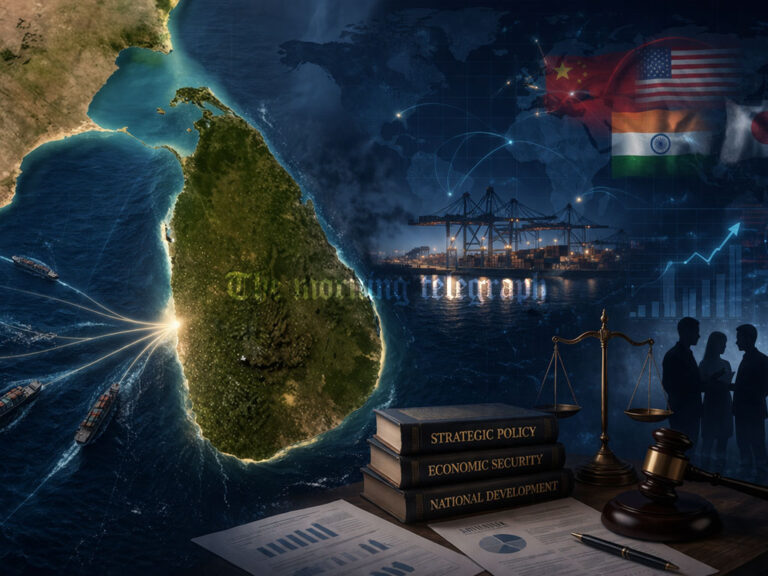
“We have ‘rock phosphate’. A very rare deposit. Rock phosphate… Then we have ‘dolomite’. There is a ‘cobalt deposit’ under the sea. India is trying to take ownership of it. They say it is their seabed. But it is the cobalt deposit under the seabed that belongs to Sri Lanka. Cobalt is also one of the most valuable and rare minerals in the world with a very high demand. This land is full of extremely valuable mineral resources that have not been identified and taken in this way.”
Cobalt is the backbone of lithium-ion batteries. No cobalt, no electric vehicles. No cobalt, no grid-scale battery storage. No cobalt, no transition away from oil. And beneath the waters between Sri Lanka and India, there are nodules rich in cobalt, nickel, manganese, and copper. The legal ownership of these resources is contested. India has made submissions to the Commission on the Limits of the Continental Shelf. Sri Lanka has made counter-submissions. Weerawansa was alleging that this agreement would effectively concede Sri Lanka’s claim in exchange for commercial access.
He then turned to the political architecture enabling this transfer. And his language shifted from geological enumeration to blistering personal attack.
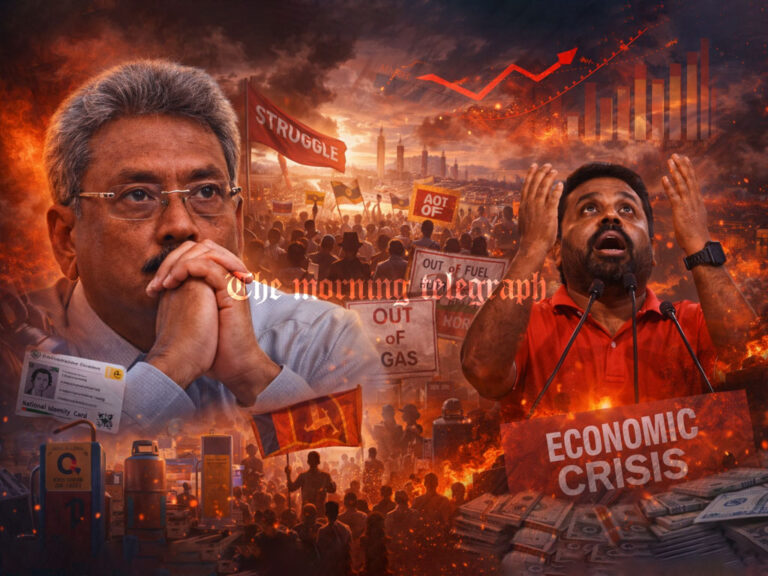
“What is being built now? Now this is being built. Muko brought Mr. Tilvin Silva on a trip to India. Now this work needs to be done quickly. The speed needs to be increased… The speed needs to be increased. To increase it, put a little fuel in the ‘wheel’ called Tilvin Silva and make it spin faster. Yes. Anura Kumara’s wheel is also well oiled. You need to put some oil on the other one. Then both wheels will spin well.”
The reference to “Muko” was widely understood to mean a prominent businessman of Indian origin with extensive operations in Sri Lanka. The implication was that the JVP leadership was being cultivated, entertained, and ultimately captured by Indian corporate interests. Weerawansa described recent visits, scheduled visits, private meetings, and public conferences as part of a coordinated charm offensive.
“Mr. Tilvin Silva and his team have now gone to India to spin both… I have seen them wearing something like a scarf. Where to make fun of India… To make fun of it. However, these people brought this party to India to make them happy, and they built an ideology against the ‘Great Indian Expansionism’. A party that raised its voice day and night about defeating the ‘Indian expansionist’ interests. A party that fought for it and put a large number of its members and supporters in a position to lay down their lives. The founders of the party lost their lives in the political process of fighting against that Indian domination. Such a party is used to cut the pig’s fish on the pig’s back.”
The Sinhala idiom was cutting. To use the pig to cut the pig’s own fish. To employ the very instrument of resistance as the instrument of surrender. Weerawansa was not merely accusing the JVP of changing its policies. He was accusing it of desecrating its own dead.
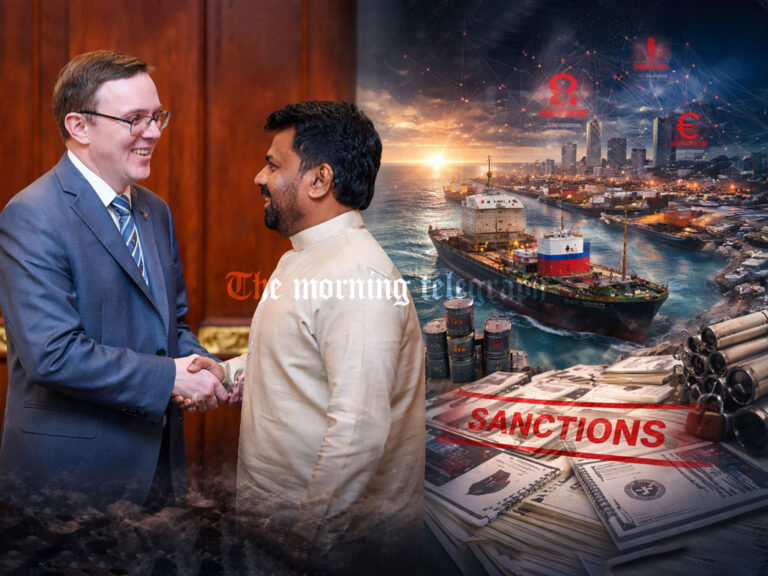
“Now India tried to bring in Mr. Sajith Premadasa in the presidential election. But if that had happened, Sajith Love would not be doing these things today. The JVP in the party is protesting against this today. Now when they are protesting, they are going on ‘Indian tours’. The Indian tours are given to Tilvin Silva and his team. Anura Kumara is going to India on the 19th to attend a conference. He is going there and all this is being fully agreed upon. This is what is happening.”
He alleged that the President’s upcoming visit to New Delhi was not a routine diplomatic engagement but a signing ceremony disguised as a conference. He alleged that the groundwork had been laid by Tilvin Silva’s delegation. He alleged that the JVP’s grassroots cadres, many of whom still harbor deep suspicion of Indian strategic intentions, were being kept in the dark while the leadership negotiated the final terms.
“That is why the Minister of Industries is saying that he has stopped issuing certain mineral mining licenses. Why? They are going to give them to Indian companies. Gems in this country are a mineral resource. Our rock phosphate is a mineral resource. Dolomite is a mineral resource. Cobalt deposits are a mineral resource in our seabed. Therefore, an agenda is being pursued to deprive us of all these.”
He then expanded the indictment beyond minerals.
“Therefore… not only that. Don’t think that it will stop here. It is not just the mineral resources. By signing ‘seven fraudulent agreements’, the ‘pharmaceutical market’ is being filled with Indian dirty medicines. Our country’s pharmaceutical market has been sealed with seven fraudulent agreements. No one knows what those seven agreements contain. There is no official agreement.”
The pharmaceutical sector has long been a battleground between local manufacturers, who supply approximately forty percent of domestic demand, and Indian multinationals, who seek greater market access. Weerawansa claimed that seven separate memoranda had been executed without tender, without parliamentary oversight, and without regulatory review. These agreements, he said, would progressively displace domestic production and create dependency on Indian suppliers whose quality standards are allegedly lower than those required by Sri Lankan law.
“In addition, now they are discussing the Indianization of the Kankasanthuru Port in the near future. They have already proposed to give $63.5 million to develop the Kankasanthuru Port. They will take over the Kankasanthuru Port and control it for 10 years… That means it will be their control from then on.”
Kankesanthuru, in the Jaffna Peninsula, is strategically located near the northern coast. Indian interest in its development has been publicly acknowledged. But Weerawansa framed this interest as a precursor to permanent control. He noted that ten years of operational management, combined with investment in infrastructure, typically leads to lease extensions, renewal options, and eventually the normalization of foreign administration of sovereign territory.
“Then this is the agenda regarding the Trincomalee Port. They already have a significant amount of oil tankers in the Trincomalee Port. If they want to do this business based on that, they believe that they need the Trincomalee Port. Not only that. There have been discussions today to establish a ‘military’ unit called the ‘Emergency Response Unit’. India and the US are united. Then the ‘Trinco Port’ usually shows the profit of the Sri Lankan government, which is usually two to two and a half million rupees per year. Then India shows that it can earn a much larger income. Saying this, now the Trincomalee Port, which has become a very important ‘strategic’ point of the war, and which was ‘used’ very badly by the Allied forces in the Second World War, is being arranged to give this Trincomalee Port to India today.”
The Emergency Response Unit reference was particularly alarming. A joint military formation, structured for rapid deployment, ostensibly for humanitarian assistance and disaster relief. But Weerawansa noted that such units, once established, tend to acquire permanent basing, permanent facilities, and permanent operational mandates. He characterized it as the militarization of Indian economic penetration.
“That is why Tilvin Silva is visiting India. President Anura Kumara is visiting India on the 19th. Oh, the people who became full-time members of the JVP’s ‘Indian expansionism’ class, the people who believed in it, fought and gave their lives, the people whose families collapsed because of the sacrifices they made, these people are today shouting. Cursing. They put their lives at risk, they lost their fathers, they lost their brothers. Today, those people are falling into a very sad lifestyle. Having done all that, they are now engaged in the final act of treason, giving everything to India.”
This was the emotional crescendo of his political address. He was not speaking as an opposition leader scoring points. He was speaking as a witness to what he considered the ultimate betrayal. He invoked the families of fallen JVP cadres, the mothers who never saw their sons again, the children who grew up fatherless, the widows who spent decades believing their husbands died for a sovereign Sri Lanka. And now, he said, the party those men died for is completing the work their enemies could not complete.
“A political movement that talked about patriotism. If there is any patriotism, can this betrayal, this treacherous act be allowed? Can all our mineral resources be given to Indian companies to mine? If patriotism is tainted by a tenth. Not only that. Can we even talk about giving the Kankasanthuru port to the Trincomalee port? If there is even a patriot. This is India, India is dancing. The country is dancing properly, Anura Kumara and Tilvin Silva are holding our country in their hands and dancing to swallow it as they want. Everything they want is being done through this puppet regime.”
He then issued a direct appeal.
“Therefore, we invite the common people of the country to unite and fight against this Indianization, this treacherous operation that is giving our country’s economy and the entire society our valuable resources to an Indian corporate regime. In doing so, we first appeal to you to unite and take action with one goal and fight.”
The second half of the briefing addressed the tourism sector. But this was not a separate topic. It was, in Weerawansa’s framing, another manifestation of the same underlying pathology. A government that cannot secure value from its assets. A government that confuses quantity with quality. A government that celebrates foot traffic while revenue declines.
“The second point is tourism growth. Our second point is that everyone knows that the government is very excited and says that there is a ‘huge growth’ in tourism in our country. In terms of tourist arrivals, there is a numerical growth. But now I will give you an example: January 2026 recorded the highest number of tourists ever in January, 277,327. But that is compared to 2025. A 9.7 percent increase compared to the number of arrivals in January 2025.”
He paused to let the numbers land.
“But you know… Even though this 9.7 percent growth was recorded in January of this year, the revenue received from tourists in January of this year was $378.3 million. But a smaller number came in January 2025. They received $400.7 million. The revenue received in January 2025, which was even lower, was $400.7 million. Moreover, that is, a 9.7 percent growth compared to January 25, the revenue received in January 2026 was $378.3 million. Then 400 there and 378.3 here. What does that mean? The amount increases. The amount of income increases. The income received decreases. Why is this happening?”
He answered his own question.
“Now, even if the amount of income increases, it will not be useful. If the income received does not increase. We need to increase the income rather than increasing the amount. The only way to be happy about the increase in the number is if the income increases. What has happened now? The number increases, the income decreases. The number of visitors increases, the income decreases.”
He cited government survey data.
“Now the government agencies themselves say that after conducting a survey on this, the amount spent per day was previously $171. Now it has dropped to $148. It has dropped from 171 to 148. There are many reasons for this. Maybe that means… there are ‘economic leaks’ within this tourism industry. We can say that now we are booking ‘everything online’. All those facilities are paid for in those countries. Then the money is allocated here less. It has been there before, and it will be the same problem in 2025. This is not a new situation.”
He quantified the leakage.
“But one thing for us is that we spend an average of $1.13 billion annually on things we bring from abroad to run the tourism industry. That means $1.13 billion is leaking out. Of that, about $800 million can be the raw materials needed for the tourism industry, food and drinks. It is spent on bringing in things like that. Then, as much money as is coming in, a much larger amount is going out.”
Then came the diagnosis that departed from conventional tourism economics.
“The other thing is what has happened now. The main problem is that a significant number of tourists coming to Sri Lanka are very ‘poor tourists.’ You can see it on our video screen. This is one tourist of that race. There is one more tourist of that race. Look, they sell goods. So, no matter how many tourists come now, you are actually tourists who don’t have any money and come and earn money. These are not tourists who spend money here. Tourists who hold a board with Sinhala written on it to get on the bus. Tourists who sell some beads on the payment. Then these people do not come here to spend money. Find some money here and spend the little money you need for life here and save it and go to your own country. Now, is Sri Lanka suitable for a ‘poor man’s tourism business’ like this?”
He argued that the nation’s branding has shifted, perhaps unintentionally, toward the lowest possible market segment.
“Now, this has been positioned for a poor man’s tourism business. A poor man’s tourist paradise. Then what is the result of positioning Sri Lanka as a poor man’s tourist paradise? What will happen if you ‘position’ Sri Lanka? When the coastline is filled with such tourists, no tourists who can ‘spend’ anything will come. Because you understand that these tourists are not suitable for you. What will happen is that even tourists who can spend something will be discouraged. Then, by making Sri Lanka a poor man’s tourist paradise and showing it inflated, there will be no benefit. What will happen is that the amount of money going out of the country will be the same, but the amount of money coming into the country will not increase compared to the number of tourists. That is why we say that there is no point in the government promoting a myth.”
His prescription was specific.
“To revive the tourism industry in this country, it is necessary to attract middle-income tourists with a certain income level. The necessary strategic intervention is needed for that. Otherwise, turning Sri Lanka into a tourist paradise for the poor will not do the country any good. No one in the industry involved in tourism will benefit from it. It will collapse the industry and create a number of sub-social problems. It will only create those problems.”
His final appeal to the government was almost plaintive.
“Therefore, we earnestly request the government. Instead of turning the tourism industry in this country into a tourist paradise for the poor, choose measures to turn Sri Lanka into a paradise for tourists with a certain income and spending capacity. Otherwise, we request the government not to be stingy with the money.”
The briefing concluded. Weerawansa gathered his documents. The photocopy of the alleged Memorandum of Understanding was placed back into its folder. The journalists began typing their dispatches. The cameras stopped recording.
But the allegations remained suspended in the air, unrefuted, unverified, but also undismissed.
No official statement has been issued by the Presidential Secretariat regarding the mineral resources agreement. No denial has been issued by the Indian High Commission. No press release has been distributed by the Ministry of Industries or the Geological Survey and Mines Bureau. The silence from the government has been total.
Weerawansa has placed a document before the public. He has named names. He has provided dates, mechanisms, and institutional pathways. He has connected the suspension of mining licenses to the impending bilateral framework. He has linked diplomatic travel to commercial outcomes. He has invoked the foundational mythology of the very party he now accuses of treason.
The burden of proof now shifts. Either the government produces the alleged Memorandum of Understanding and demonstrates that Weerawansa’s photocopy is a fabrication, or the government continues its silence and allows the public to draw its own conclusions.
In the absence of official denial, the photocopy remains the only document on the table.
And Wimal Weerawansa, whatever one thinks of his political history, his shifting alliances, or his rhetorical excesses, has done something that no journalist, no civil society organization, and no opposition parliamentarian has done since this government assumed office.
He has produced a document.
He has made an allegation.
And he has forced a question that will not disappear simply because it is uncomfortable.
What exactly is in that Memorandum of Understanding?
And why will no one in authority say what it contains?