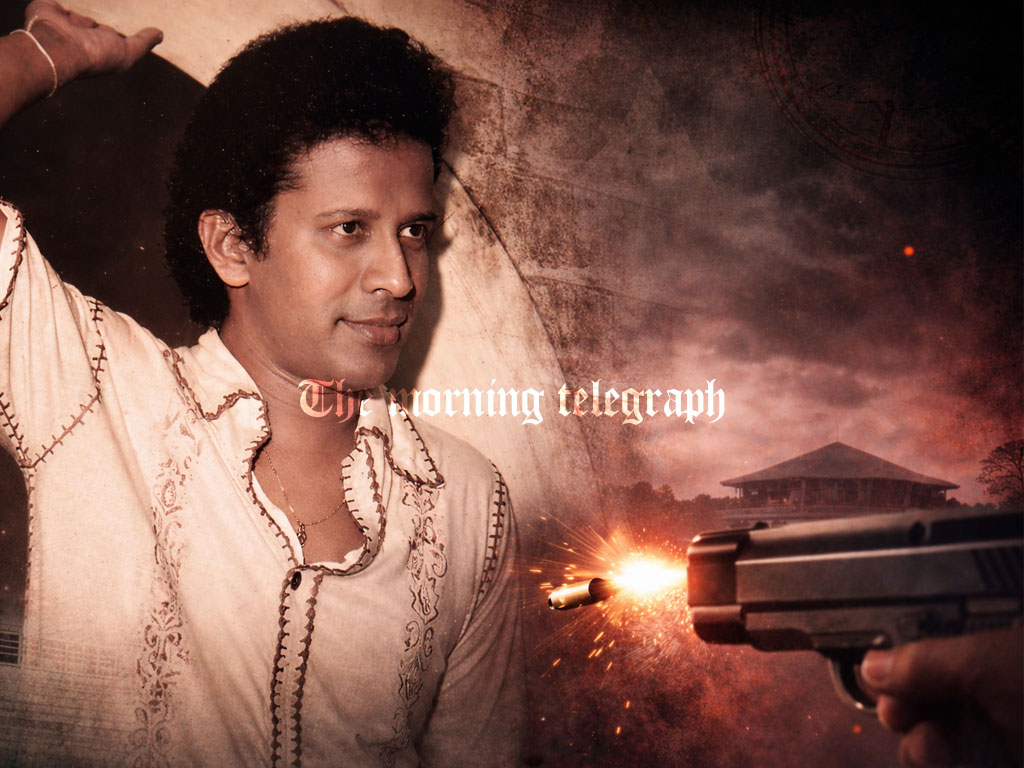
Thirty eight years after the assassination of Vijaya Kumaratunga, new reflections on political terror, motive, confession and consequence force Sri Lanka to confront one of its darkest and most painful chapters.
On the February 16th, Sri Lanka marks exactly 38 years since the assassination of Vijaya Kumaratunga, the charismatic actor turned politician whose death stunned a nation. Even today, the same haunting questions echo across generations. Who truly murdered Vijaya Kumaratunga? What was the motive behind killing a man celebrated not only for his cinematic brilliance but also for his humanitarian politics? And politically, what objective was achieved by silencing him?

Vijaya was more than a film star. He was a political symbol of hope during one of the darkest periods in Sri Lanka’s modern history. To understand his assassination, one must first revisit the national climate of that time. The country was gripped by terror during the second JVP insurrection. Violence, assassinations, and fear had become part of daily life. The SLFP and the Mahajana Party, which Vijaya represented, were rooted in left-wing political ideology. Within that tense landscape, there was growing belief among certain factions that Vijaya’s immense popularity posed a threat to the JVP’s political momentum.
A month or two before his assassination, Vijaya delivered a powerful speech at a Mahajana Party rally at Kosgas Junction. In that speech, he openly criticized the brutal wave of political killings carried out by the JVP. Many who listened that day warned him privately. They feared that no one labeled a traitor to the movement was allowed to survive. Friends urged him to take his security seriously.
Yet Vijaya, known for his sincerity and courage, did not believe that engaging directly with the people would bring harm. Those closest to him later testified that he never imagined he would be killed. He believed in political dialogue, not in hiding behind fear.
However, according to senior members of the Mahajana Party, Vijaya had received direct death threats. On the advice of Uma Maheswaran of the PLOTE organization, arrangements were made to provide him with armed personal guards. Two AK-47 rifles were reportedly secured, and trained young men were assigned for his protection. The weapons and guards were initially stationed at Vijaya’s residence. However, Chandrika Bandaranaike Kumaratunga was reportedly uncomfortable with keeping armed personnel at home. Premasiri Perera later stated that disagreements arose over this matter.
Eventually, the weapons and guards were removed from Vijaya’s house and relocated to Talakotuwa Garden, his mother’s residence. Premasiri Perera later reflected that had those armed guards remained at Vijaya’s home, the assassin would not have found it so easy to carry out the killing in broad daylight. The removal of security, whether coincidental or consequential, remains one of the most debated aspects of the tragedy.
The identity of the killer later emerged during a police investigation. The assassin was Lionel Ranasinghe. His name became public only after he was questioned following a chance encounter with a police sergeant. His confession was widely reported in newspapers at the time.
Lionel Ranasinghe, also known as Gamini, Mahinda, or Jayathilaka, was born on 12 May 1961. He was 27 years old when arrested. In his police statement, he described his background:
“I dropped out of school and studied at the Horana Vidyarathna Faculty of Science until 1981. A person named Jayasiri studied with me at the Horana University Faculty. He was a year above me in class. He was a resident of Yalagala. He was a member of the JVP. I was recruited into the JVP in 1981. During this time, an office of the JVP was located in a house on Seelarathana Road, Horana.”
He further explained that he attended five ideological classes conducted by the JVP:
“The JVP held five classes at this office. The five classes were (1) the current political crisis (2) who is responsible for the crisis? (3) the history of the old left-wing parties (4) the history of the Janatha Vimukthi Peramuna and (5) the path we should take. Apart from these five classes, other lectures were also held.”
Lionel admitted participating in the second JVP insurrection and receiving weapons training in multiple locations including the Sinharaja forest and Sripada region. His confession detailed involvement in numerous attacks, raids on military camps, police stations, and high-profile assassinations. He claimed participation in dozens of violent operations and weapons seizures during 1987 and 1988.
According to police records, Lionel confessed to killing 41 individuals, including Vijaya Kumaratunga. Among the victims were senior police officers, politicians, local leaders, and civilians. The scale of violence outlined in his statement reflected the depth of insurgent terror during that era.
Lionel stated that he received orders to assassinate Vijaya from the Patriotic People’s Movement, identified as the armed wing of the JVP. He described the events of 16 March 1988 in chilling detail.
“We took the bag and came to the shop on the bicycle. We parked the motorcycle in the garden, put the bag on the motorcycle and waited on the road. After being on the road for about 5 or 6 minutes, we saw Vijaya Kumaratunga coming out of the house. He came alone and spoke to someone at the gate of the house. The person we spoke to was wearing trousers and a shirt. After that, Herath and I went and got on the bicycle. I put the bag on my lap, opened the zip, put the safety down and took the gun in my hand and came on the motorcycle with Herath and parked the motorcycle on the side of the road about 20 yards away from where Vijaya Kumaratunga was standing. Vijaya Kumaratunga was standing in front of the gate of his house. He had a folded file with leaves in his hand. He was standing and talking to someone there.
I stopped on the bicycle and opened fire with the T56 rifle. Vijaya Kumaratunga was shot twice in the back. He had his back to me. He fell to the ground when I fired those two shots. I got off my bicycle and went there and shot him several times in the head.”
Question – Why did you shoot Vijaya Kumaratunga again after shooting him from the motorcycle?
Answer – I thought that Vijaya Kumaratunga was not properly shot. Therefore, I got off the motorcycle and went to him and shot him in the head while he was lying.
Question – How many shots did you shoot Vijaya Kumaratunga?
Answer – I do not remember how many shots were fired now.
Question – Why did you shoot Vijaya Kumaratunga?
Answer – I shot Vijaya Kumaratunga because of the order I received from the Patriotic People’s Movement of the JVP.
The brutality of the assassination shocked the country beyond party lines. Even those critical of Vijaya politically were shaken by the manner of his killing. Rather than strengthening the insurgency, the murder intensified public anger. The JVP suffered severe backlash. Violence spiraled further. The state responded with its own brutal counterinsurgency campaign. Thousands died in the cycle of terror that followed.
In the end, the assassination of Vijaya Kumaratunga did not silence political dissent. Instead, it deepened national trauma. It remains one of the most painful political assassinations in Sri Lankan history. The bloodshed of that era left scars that have yet to fully heal.
Thirty-eight years later, the question remains not only who pulled the trigger, but why Sri Lanka allowed a climate of hatred and extremism to flourish to such deadly consequences. Vijaya Kumaratunga’s death stands as a permanent reminder of how fragile democracy can become when political violence replaces dialogue.
SOURCE :- MAWBIMA