Global human rights experts warn that Sri Lanka’s proposed anti-terrorism framework risks entrenching sweeping powers, prolonged detention, and weakened judicial oversight under the banner of national security.
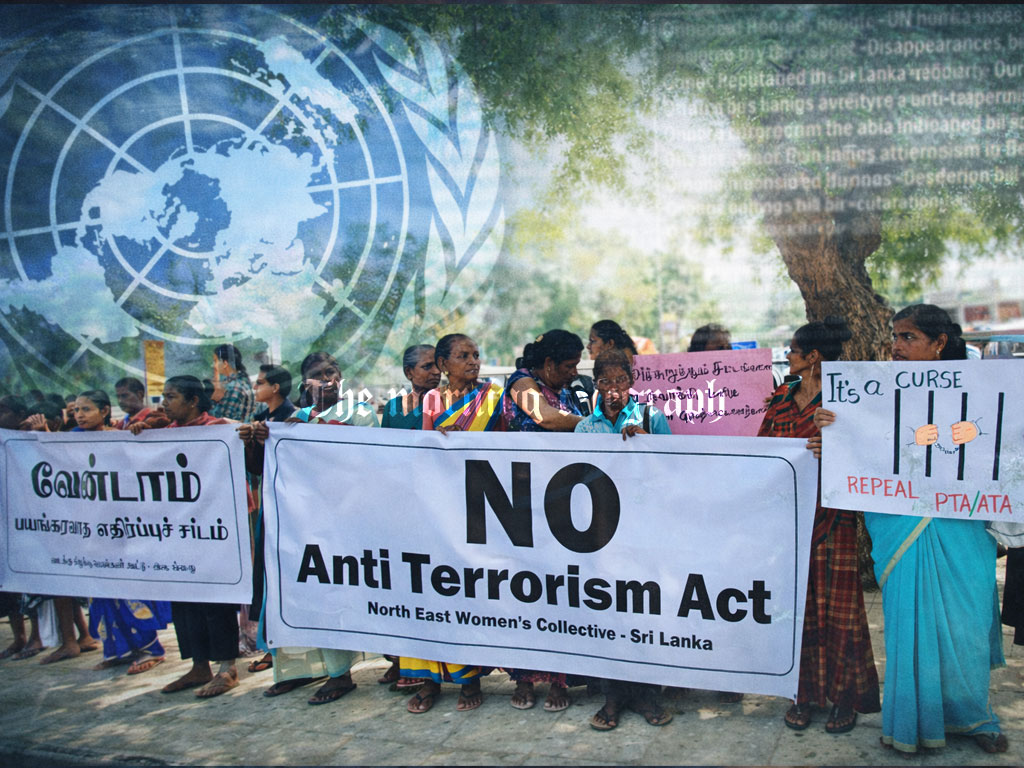
Multiple United Nations Special Rapporteurs have delivered a strongly worded response to Sri Lanka’s revised anti-terrorism bill, cautioning that the proposed law still falls far short of international human rights standards. The draft legislation, titled the Protection of the State from Terrorism Bill, is intended to replace the controversial Prevention of Terrorism Act of 1979. However, according to the UN mandate holders, the new bill retains deep structural flaws that could enable abuse.

The joint communication was issued by the Special Rapporteur on counter-terrorism and human rights, alongside the Working Group on Arbitrary Detention, the Working Group on Enforced or Involuntary Disappearances, and Special Rapporteurs on extrajudicial executions, privacy, torture, and human rights defenders. Their collective message was clear. The revised framework continues to contain substantive deficiencies that undermine compliance with international law and established human rights principles.
At the heart of the criticism lies the definition of terrorism under Section 3 of the draft bill. The experts argue that the definition is vague and overly broad, failing to meet the principle of legality. International best practice confines terrorism to acts involving death, serious bodily injury, or hostage taking. By contrast, the Sri Lankan draft includes lesser offences such as property damage, ordinary robbery, and weapons related crimes. The UN experts warn that such expansive language creates space for misuse and may expose civil society actors to prosecution.
Another major concern is the mental element of criminal liability. The draft extends culpability beyond intention to include knowledge or recklessness. According to the rapporteurs, this lowers the legal threshold and risks criminalising conduct that does not meet the gravity associated with terrorism. They also objected to loosely framed intent clauses, including references to infringing sovereignty, which could be interpreted in politically sensitive ways.
Freedom of expression emerged as another flashpoint. Section 78’s broad definition of confidential information, when read together with Section 8, could criminalise legitimate journalism, reporting on police misconduct, or documentation of human rights violations. The experts stressed that counter-terror legislation must not silence media scrutiny or civic activism. The use of the term encouragement instead of incitement further troubled the rapporteurs. They noted that international standards require proof of double intent, meaning the speaker must intend both the message and the resulting terrorist act. The current draft does not appear to meet that threshold.
The offence of disseminating terrorist publications is also framed in sweeping language. Journalists, researchers, and activists could potentially face prosecution simply for analysing or discussing contentious material. Such ambiguity, the experts caution, may foster self censorship and erode democratic space.
Perhaps the most serious alarm was raised over detention powers. The bill authorises military detention for up to 24 hours, in addition to unspecified travel time, creating what the rapporteurs describe as a potential environment for short term enforced disappearances. The extension of police style authority to the armed forces and coast guard risks normalising what they call a permanent state of militarised emergency.
Prolonged detention provisions intensify these concerns. The draft allows detention for up to two years, including one year of administrative detention imposed by the executive branch. Crucially, magistrates would lose effective authority to review the legality of detention or grant release. This removal of judicial oversight strikes at the core of due process and the right to liberty.
Surveillance provisions also drew criticism. The bill permits warrantless searches and communication interception based on the vague belief that a person is likely to commit an offence. There are additional concerns over attempts to weaken end to end encryption by compelling service providers to grant data access. In an era where privacy rights are increasingly recognised as fundamental, such provisions have triggered alarm among international observers.
The draft retains what the experts describe as an overbroad immunity clause shielding officials from civil or criminal liability for actions taken in good faith. The absence of an effective remedy mechanism for victims further compounds accountability concerns. In a symbolic yet significant suggestion, the rapporteurs urged the government to reconsider the bill’s title, recommending a shift from protecting the State to protecting the people.
Local critics echo these warnings. Former Human Rights Commission member Ambika Satkunanathan has described the proposed law as one of the most troubling revisions in recent years. She noted that a similar Counter Terrorism Act was proposed in 2018, replicated in 2023, and previously challenged before the Supreme Court by members of the current government when they were in opposition. She questioned why the administration would now adopt language it once opposed.
Satkunanathan also highlighted that while the maximum detention period technically remains one year, the gap between pre bail detention and remand could extend proceedings to two years. Under the existing PTA, bail becomes available if court proceedings do not commence within a year. The new structure, she argues, effectively prolongs detention without meaningful judicial progress.
Concerns extend to accountability in arrest procedures. Under the current framework, detention orders are issued by the Minister of Defence. The proposed legislation transfers this authority to the Secretary of Defence, a move critics say reduces political accountability and oversight.
As Sri Lanka navigates post conflict reconciliation and democratic reform, the revised anti-terror bill has become a litmus test for its commitment to rule of law and human rights protection. The UN experts’ intervention signals that global scrutiny remains intense. The coming months will determine whether the government recalibrates the draft to align with international standards or proceeds with a framework that continues to draw deep concern from the international community.