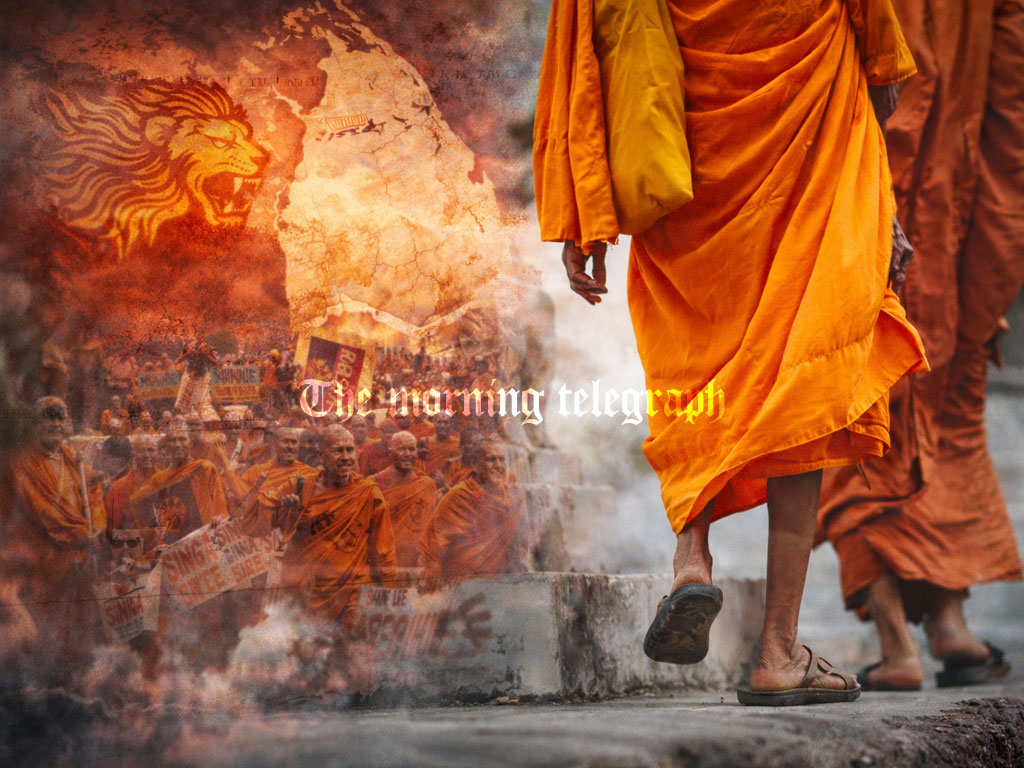
As monks prepare for a powerful convention, echoes of 1956, Rajapaksa-era politics, and the rebirth of identity-driven nationalism raise urgent questions about Sri Lanka’s future.
“Ordered disorder, planned caprice,
And dehumanized humanity…” – Brecht (The Exception and the Rule)
A new Sangha convention is scheduled for 20 February, led by veteran trade unionist Muruththettuwe Ananda thero. The organisers claim they feel sidelined by those in power and insist that their objective is to protect rata, jathiya, agama, sanskruthiya, and hediyāva. The language is emotionally charged and rooted in identity politics, reflecting deeper currents within Sri Lanka’s nationalist discourse.

In a constitutional democracy, even one with imperfections, the right to peaceful assembly under Article 14(1)(b) applies to monks as much as to any citizen. It is vital that any government respects that right. The memory of 2010 still lingers, when the Rajapaksa administration faced criticism for allegedly pressuring senior clergy who attempted to convene a similar gathering following the arrest of General Sarath Fonseka. That earlier Sangha Convention, intended to defend democracy and good governance, never materialised despite initial momentum.
Historical records describe how chief prelates at the time publicly condemned Fonseka’s arrest and sought collective consultation at the Maha Maluwa in Kandy. Yet the assembly was postponed indefinitely. Senior monks later claimed that government-aligned clergy and political actors exerted heavy pressure. Allegations surfaced of bomb threats and institutional intimidation. International religious freedom reports from that period noted claims that monks were discouraged from speaking on political issues and warned of consequences if they proceeded.
Whether Muruththettuwe Ananda thero played a role in those events remains unclear. Today, he argues that previous governments listened to the Sangha. Critics question that assertion, pointing to episodes such as the Kandy night races controversy and the impeachment of Chief Justice Shirani Bandaranayake, when appeals from religious leaders were ignored.
These tensions raise broader concerns about political Buddhism and the recurring entanglement between clergy and state power. The question is not merely about a convention, but about the ideological trajectory of Sri Lankan nationalism.
Dreams of 1956
Muruththettuwe Ananda thero invokes 1956 as a formative era when, in his words, rulers listened to the Sangha on matters of country, race, and religion. That year marked the ascendancy of Sinhala Only policies under S.W.R.D. Bandaranaike. By elevating the Sangha within the Pancha Maha Balavegaya, Bandaranaike fused religious authority with political mobilization. While this strategy secured electoral success, it also ignited long-term ethnic tensions.
The Bandaranaike-Chelvanayagam Pact of 1957 attempted to address minority grievances but collapsed under pressure from nationalist monks staging protests outside the Prime Minister’s residence. The abrogation of that pact deepened mistrust between communities and contributed to the violent unrest of 1958. The ripple effects shaped decades of ethnic conflict and ultimately fed into the prolonged civil war.
Literature and firsthand accounts from that era capture the emotional rupture experienced by ordinary citizens. Narratives describe shock, betrayal, and a sense that the social contract had been fundamentally altered. Language policy became more than administrative reform; it became symbolic of exclusion and dominance.
The legacy of 1956 continues to influence contemporary politics. Sri Lanka today aspires to multilingual competence and reconciliation, yet the historical wounds remain visible. Educational challenges and ethnic polarization can be traced, in part, to decisions made during that transformative period.
This Conference of monks
In 2007, inflammatory allegations surfaced claiming that Buddhist monks faced biological threats from religious minorities. Though those claims later dissipated, they revealed a pattern: the recurring construction of an external enemy. Over time, narratives shifted from Tamil militancy to Christian proselytization to Muslim extremism. Each phase corresponded with broader political campaigns that relied on mobilizing fear and consolidating majoritarian sentiment.
After the civil war ended in 2009, attempts were reportedly made to sustain the perception of internal threats. Controversial incidents, later questioned or debunked, fueled suspicion among communities. The Sinha Le movement emerged around 2015, marked by slogans painted on gates and vehicles. Though the movement lost momentum, its symbolism persisted, particularly during episodes such as the sterilization pills controversy.
In a 2020 media interview, a leading monk associated with Sinha Le described alleged discussions with political figures during its formation. Such statements intensified debate about whether nationalist movements operate independently or align strategically with political actors seeking electoral advantage.
Now, as another monk-led conference approaches, speculation grows. Is this a renewed assertion of cultural guardianship, or the prelude to another cycle of identity-driven mobilization? The rhetoric of saving the nation from moral decline resonates deeply among segments of the electorate. Yet history warns of unintended consequences.
Muruththettuwe Ananda thero has stated that the movement will support any politician who aligns with its agenda. That declaration invites scrutiny. Throughout Sri Lankan history, rulers have both courted and constrained the Sangha. The relationship has rarely been purely spiritual; it has often been transactional.
The imagery of The Conference of Birds offers a poetic lens. In the epic, birds search for a sovereign only to discover their own reflections. The metaphor suggests that societies must confront internal impulses rather than project blame outward. Political actors, religious leaders, and citizens alike share responsibility for the direction of national discourse.
Sri Lanka stands at a delicate juncture. Economic recovery, constitutional reform, and reconciliation require inclusive dialogue rather than divisive narratives. Identity politics can energize constituencies, but it can also fracture pluralistic societies. The challenge is to balance cultural preservation with democratic pluralism.
The planned Sangha convention underscores enduring tensions between religion and governance. It also exposes unresolved debates about nationalism, sovereignty, and collective memory. If the past is a guide, emotional mobilization around race and religion carries both political potency and social risk.
Ultimately, the question is not whether monks have the right to assemble. They do. The deeper question concerns the purpose and the political ecosystem that surrounds such gatherings. Are they platforms for moral reflection, or catalysts for renewed polarization?
Sri Lanka’s history demonstrates that alliances forged in moments of passion can produce consequences lasting generations. As the date approaches, citizens would do well to examine not only the speeches delivered, but also the narratives revived and the interests served.
Before opening yet another chapter shaped by grievance and identity, it may be wise to look inward. Nations, like individuals, must reckon honestly with their past if they hope to chart a different future. The mirror often reveals uncomfortable truths, but it is preferable to repeating cycles of conflict.
Sri Lanka’s future depends not on resurrecting old divisions, but on building a shared civic identity that accommodates diversity while honoring heritage. Whether this conference contributes to that goal or complicates it remains to be seen.