
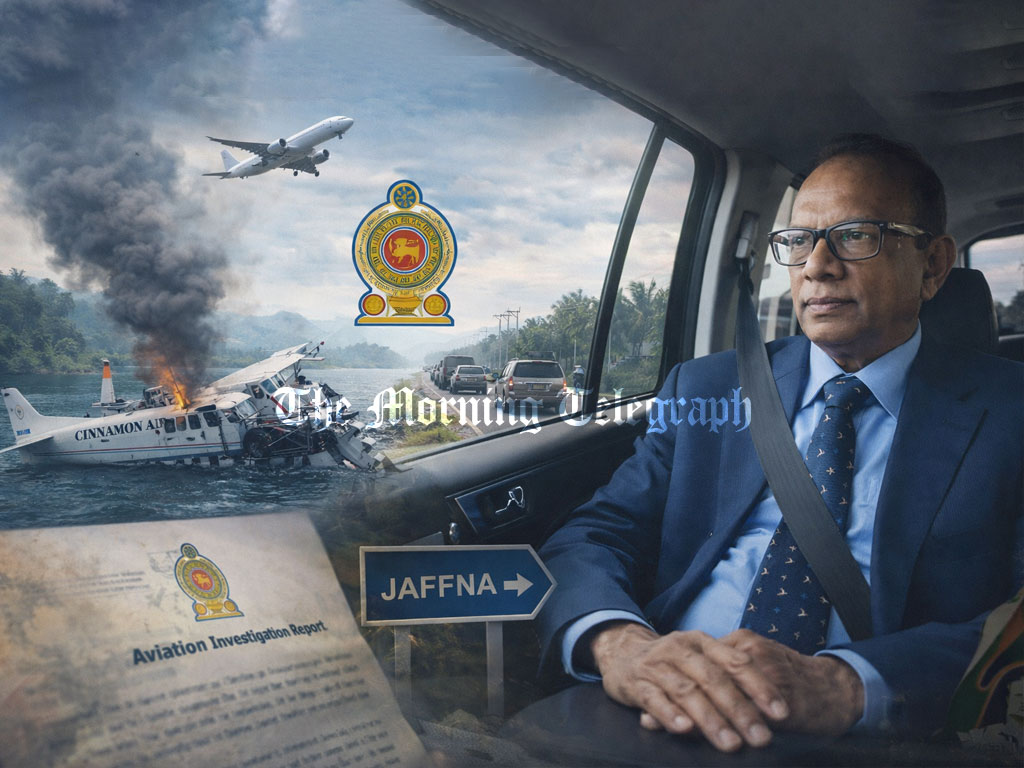
An eight-hour road convoy led by the very minister responsible for civil aviation has cast a long shadow over Sri Lanka’s domestic skies. His decision to avoid a one-hour flight has reignited fears about the safety and credibility of the country’s internal air network, intensifying unease within a tourism sector still reeling from the Cinnamon Air crash at Lake Gregory in Nuwara Eliya.
Sri Lanka’s domestic aviation industry is facing what insiders are calling a crisis of confidence after the Minister responsible for the sector reportedly chose to travel more than six hours by road to Jaffna this morning at dawn, instead of taking a one-hour domestic flight.
The early-morning departure, said to have begun around 4am with the aim of reaching Jaffna by lunchtime, has raised eyebrows across the aviation and tourism sectors. If the man overseeing civil aviation does not trust the skies, what message does that send to the public?

The decision comes in the shadow of the recent crash involving Cinnamon Air at Lake Gregory in Nuwara Eliya, an incident that sent shockwaves through the domestic tourism circuit. Lake Gregory, long marketed as a postcard-perfect highland destination, became the scene of tragedy at least for domestic aviation. For many travelers, especially high-spending tourists relying on quick air transfers across the island, the crash planted the first seeds of doubt.
Those doubts have only grown following what critics describe as a “shambolic” preliminary report submitted by an allegedly improperly constituted Aircraft Accident Investigation Board (AAIB) appointed by the Director General Capt. Daminda Rambukwella. Instead of restoring confidence, the document reportedly raised more questions than answers, fueling speculation and mistrust.
In what observers say is an unmistakable signal, the Minister opted for asphalt over air.
Accompanying him on the long road journey are his own Secretary W.W.S.Mangala and the Chairman and Director General of the CAASL Sunil Jayaratne and Capt. Daminda Rambukwella respectively. Their presence together on a road convoy rather than aboard a domestic flight has amplified public scrutiny.
Yet one conspicuous absence did not go unnoticed, the Human Resources Directress, often seen accompanying Chairman Sunil Jayaratne at public functions. Her absence has added fresh intrigue to an already tense situation, particularly in the wake of their widely reported joint visit to the official residence allocated to the Director General of the Civil Aviation Authority of Sri Lanka. That residence was allegedly being occupied by Chairman Jayaratne until he was instructed to return the keys, an episode said to have been documented on camera and CCTV, further fueling speculation and scrutiny.
The optics are hard to ignore.
Sri Lanka’s Aviation Division operates under the Ministry of Ports, Shipping and Aviation, tasked with shaping national civil aviation policy, enforcing international safety regulations, developing domestic airports, and managing bilateral air service agreements. Institutions under its umbrella include the Airport and Aviation Services (Sri Lanka) and SriLankan Airlines.
On paper, it is a structured and regulated ecosystem. In practice, perception is everything.
Tourism insiders warn that confidence, once shaken, is difficult to restore. Domestic air travel has long been marketed as the luxury shortcut for visitors eager to move from Colombo to Jaffna, from the Cultural Triangle to the southern beaches, in under an hour. A ministerial road convoy sends the opposite message.
Industry stakeholders now fear a ripple effect. If policymakers appear reluctant to use the very domestic services they regulate, tourists may begin to question safety standards. Travel agents could shift recommendations toward lengthy road transfers. High-end visitors may rethink multi-destination itineraries.
At a time when Sri Lanka is striving to rebuild its tourism numbers and attract premium travellers, the symbolism could not be more damaging.
Because in aviation, confidence is currency.
And once the runway of trust cracks, it takes far longer than six hours to repair.



Why would he spend over 3750 usd equivalent to travel to Jaffna and back for one person or even 6 on a charter? It’s not about not wanting to fly there, it’s there are no flights, in my humble opinion!
There are no scheduled services to any destination in Sri Lanka that’s badly required as the charges and ease of operation is not conducive for it at the moment.
Talks are going on to help domestic operators and I hope and pray someone decides to make a decision sooner than later, as we can have a wonderful internal air hub setup to benefit everyone.
If not it’s not going to look good if operators start to shutdown due to losses being made all the time.
This is a redecules logic. Does the Navy commander has take a boat to all his stations or Airforce commander has to take an aircraft to all statios he visits? The writer seems not to understand government policies of keeping costs down. It is not a problem of Cinnamon Air, as they do not operate regular schedule flights to Jaffna. Chartering an aeroplane for the comfort of few officials does not justify the exorbitant cost. CAA not having sufficient staff is a different issue.
Also the writer does not seem to understand the difference between an interim report and the final report of sir accidents. Please refer to ICAO Annex13.
The Essence of above article is more like a gossip story which is bringing discredit to ” The Morning Telegraph”.
Interesting take on the two thoughts that Johann came up with while I somewhat agree with the second part I would like to say “not with this bunch of JOKERS both in the Ministry and mainly in the Civil Aviation Authority”. A Failure and A Corrupt crony as a Director General/CEO and a Womanizing ex-customs officer as a Chairman. Bit like the Blind leading the Blind as I see it. I quite understand why Johann has to go behind the corrupt lot at the CAA when considering how DP Aviation went through the certification process with the shortcomings therein specially now that they are considering bringing in an ATR 72 (which is a good thing), but will have to tow the line by saying good things about these idiots to get the approvals needed. Nothing new for this country.
As for Mr Ranaweera (Short and bald Stuff) LOGIC AND GOVERNMENT POLICY are a tall order for someone short. However, since you seem to have some knowledge of aviation I assume you also are aware that the Airforce operates a shuttle service to Jaffna in which government officials are also allocated seats, if required and does not cost that much..
I’d also like to draw your attention to the time factor and man hours saved by getting to the destination in 1 hour in comparison to being on the road for over 7½ hours wasting a whole lot of shoe leather on the way. Penny wise Pound foolish.
The writer’s emphasis on the Cinnamon Air crash I believe is purely a highlight of the shortcomings therein of the released preliminary report which has been tailor made with ulterior motives. Since you speak of Annex 13 I wonder if you are familiar with the Aviation Act of Sri Lanka and also the Implementing Standards therein.
The preliminary report is a product of an investigation board consisting of Illegally appointed members carefully manipulated by nonother than incumbent DGCA/CEO where all the main actors were ex-airforce members – the DGCA, The Crashed Pilot, The Lead Investigator (I can go on).
There has been many other crashes in SL of GA aircraft and the public would like to know what remedial action has been taken to prevent a further accident/crash that is waiting to happen.
Having the right people in the right positions would have mitigated all these issues.
Never has the CAA fallen into such disrepute as it has done so now.
Tch, Tch….