With long queues, empty cylinders and rising public anger, the government has signaled a dramatic intervention in Sri Lanka’s gas crisis, warning private suppliers to comply with the law or face market consequences.
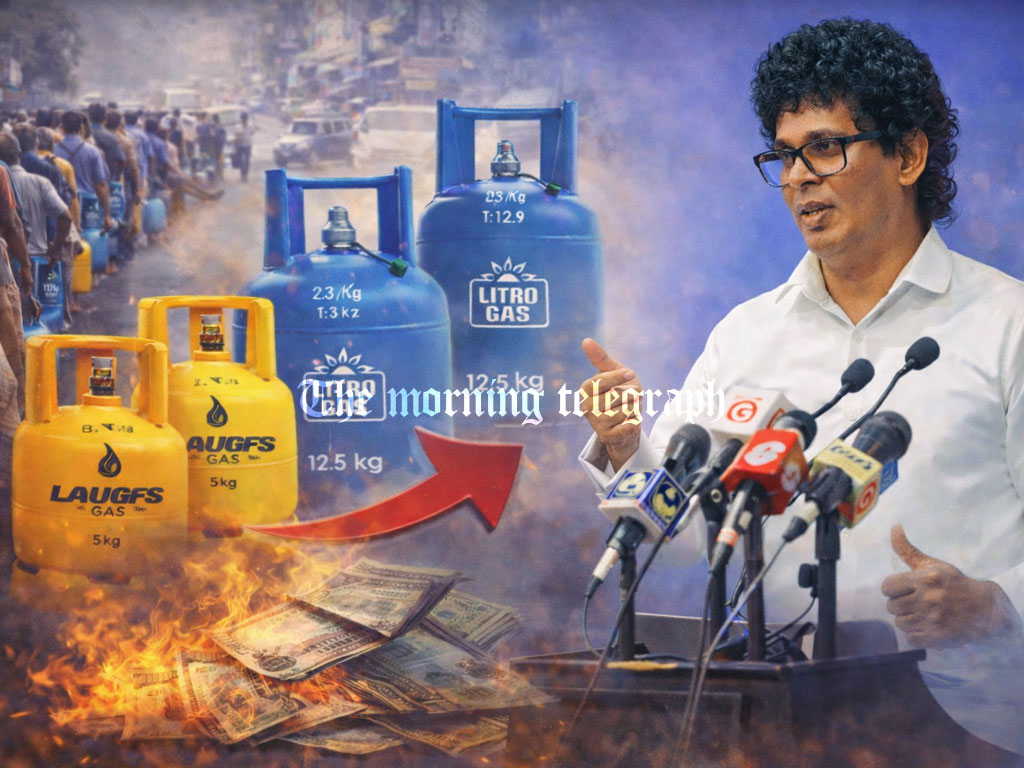
A fresh wave of gas shortages has gripped several major cities across Sri Lanka, leaving consumers scrambling for both Litro and Laugfs cylinders. In many areas, supply interruptions have lasted for days, triggering long queues outside gas outlets and widespread frustration. Households complain that the quantity of cooking gas released to the market is far below demand, while reports suggest that some traders are exploiting the scarcity by selling cylinders above the regulated price. Gas companies, however, insist that adequate stocks have been released to stabilize the market.

Amid mounting public pressure, Minister of Trade, Commerce, Food Safety and Cooperative Development Wasantha Samarasinghe announced that the government has secured contractual agreements to increase the release of gas cylinders from the 12th. He made it clear that consumer protection remains the top priority during this supply disruption.
“If the concerned company fails to provide gas to its gas cylinder, then the company should arrange to return the amount of the cylinder to the customer. Otherwise, there is no point in the customer keeping a cylinder without gas.”
The Minister stressed that if Laugfs, which controls around 20 percent of the domestic LPG market, fails to fulfill its obligations, the government is prepared to intervene decisively. He pointed out that consumers have the practical option of switching cylinders to ensure uninterrupted access to cooking gas, particularly by moving to the Litro blue cylinder network.
As an immediate response to the LPG shortage, the government has decided that Litro Gas will release cylinders and gas to customers who currently use Laugfs cylinders from March 12. According to the Minister, this emergency measure has become necessary due to what he described as the deliberate suspension of supply by Laugfs.
Addressing the root of the crisis, Minister Samarasinghe alleged that Laugfs is attempting to violate existing legal conditions governing its Hambantota terminal operations. Under current regulations, 20 percent of gas stored at the terminal must be released to the domestic market, while 80 percent can be exported. He claimed that the company seeks to capitalize on crisis conditions to sell more gas locally under pressure, disregarding established legal frameworks.
“This company thinks that they will sell all the gas they bring to Hambantota when there is a crisis and pressure. As a government, we cannot agree to work by breaking the law,” the minister emphasized.
To counter the shortage, Litro has increased daily gas releases from 1100 to 1500 metric tons. Additionally, three gas vessels carrying 1300 metric tons each are expected to arrive within the next eight days, strengthening supply stability.
The Minister reiterated that if Laugfs fails to supply customers, it must refund payments collected for cylinders. He reminded the public of similar artificial shortages in 2021 and 2022, warning that the government will not allow a repeat. If required, the state will expand the market share of Litro Gas, which operates under the Ministry of Finance led by President Anura Dissanayake.