Explosive claims in Parliament allege substandard coal imports, procurement fraud, forged quality reports and multi-billion rupee losses that could trigger fresh power cuts and higher electricity bills.
Since the coal imported after the current government came to power is of substandard quality and there has been fraud through it, an opposition member submitted a proposal to Parliament demanding strict action against all those responsible. The debate has now evolved into one of the most serious procurement controversies linked to the Norochcholai Lakwijaya Coal Power Plant, raising urgent concerns about energy security, public finance, and electricity pricing.

Samagi Jana Balavegaya MP S. M. Marikkar told Parliament that although the Government Finance Committee had provided clear policy instructions based on the Auditor General’s recommendations regarding the coal procurement process, those fundamental requirements had allegedly been violated. He claimed that coal had been purchased by misleading both the Cabinet and Parliament, contrary to established government procurement guidelines. On February 20, MP Marikkar delivered a lengthy and detailed presentation outlining concerns over coal quality, tender conditions, and possible financial losses.
The opposition MP further revealed what he described as multiple irregularities in the coal purchasing mechanism. According to him, when the former chairman of the coal company initiated the tender, he did not follow the data and recommendations submitted by the Auditor General on 20 September 2022 and subsequently approved by the State Finance Committee and presented to Parliament.
He argued that emergency procurement procedures that were used during the 2022 power crisis and long electricity queues had once again been applied, despite the Auditor General advising the use of a normalized and transparent system. He said that the original requirement to supply one million metric tons of coal over three years was reduced to five hundred thousand, and the calorific value requirement was lowered from over 5,900 kilocalories to a significantly reduced threshold. “This gave opportunity to corrupt companies to come in,” he told the House.
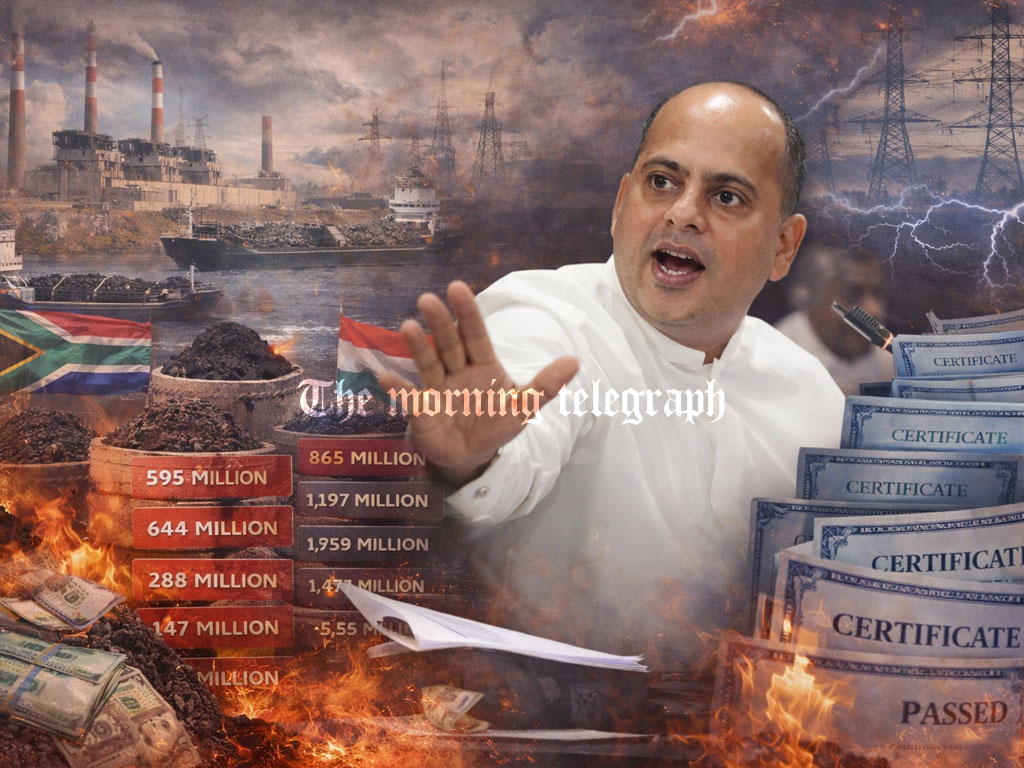
Marikkar also questioned the timeline and documentation of shipments. The first coal ship was scheduled to arrive on 14 December but reportedly arrived only on 30 December. He said that standard procedure requires a report from the port of loading immediately upon shipment. However, for the first time in Sri Lanka’s history, coal loaded from South Africa reportedly had documentation issued from Indonesia. He questioned whether the samples tested in Indonesia truly represented the coal that had been loaded.
He stated that the first shipment failed quality tests at the Lakvijaya plant. The second shipment, which arrived after warnings had been issued, also allegedly failed. “When the second ship arrived, we said it was a failure, then Panala said, ‘No, it’s not a failure.’ If it fails, they said, ‘we will be fined’. There is no such thing as a fine anywhere,” he claimed, casting doubt on enforcement clauses within the coal tender agreement.
Marikkar then presented figures he said were supplied by the Additional Secretary of the Ministry of Electricity. According to those numbers, the first ship resulted in a loss of 595 million rupees, while 644 million had been charged. He listed losses from the second through eighth ships as hundreds of millions more, claiming cumulative losses amounting to billions of rupees. He insisted that these were not personal calculations but official data submitted from within the Electricity Board’s coordination office.
The opposition warned that continued use of substandard coal could render the Lakvijaya plant inoperable. He alleged that while local tests indicated failure, reports from an Indian company had shown the shipments as passed, raising suspicions of fabricated or manipulated documentation. If inferior coal continues to be used, he argued, Sri Lanka may face either renewed power cuts or forced purchases of expensive diesel generated electricity.
He also claimed that electricity tariffs may be increased to cover these alleged losses. “This government is setting up to increase the bill to cover the theft,” he alleged, suggesting that consumers could ultimately shoulder the financial burden of flawed procurement decisions.
Samagi Jana Balavegaya MP Ajith P. Perera added further figures to the debate. He told Parliament that by 11 February 2026 the Electricity Board would submit a letter calculating losses from four coal ships. According to his statement, the direct power generation loss was estimated at approximately 496 million rupees, with additional maintenance and renewal costs of over 237 million rupees. He said the total estimated loss exceeded three billion rupees, while only around 1.7 billion rupees could potentially be deducted from suppliers.
Ajith P. further claimed that when the Minister of Energy altered coal procurement conditions, the Director of the Technical Department of the Ministry of Electricity had submitted a report warning that coal quality could be inferior.
Responding to the allegations, Minister of Energy Kumara Jayakodi presented relevant recommendations and procurement guidelines to Parliament. He maintained that the Auditor General’s recommendations had been followed and that suppliers were selected strictly according to those guidelines. “In this procurement, we have not done any method of changing suppliers or favoring them. If we can default at any time, we will do so at that time. Other than that, we cannot do anything illegal, we are working legally,” he said.
The minister also addressed technical issues raised by the opposition, defending the procurement process and rejecting claims of misconduct. However, the parliamentary exchange has intensified scrutiny over coal imports, tender transparency, and accountability within Sri Lanka’s energy sector.
As the debate unfolds, the larger question remains whether these allegations signal isolated technical disputes or a deeper systemic failure in energy procurement governance.