As Sri Lanka pushes to build a new floodlit international cricket stadium in Jaffna, sudden environmental objections have ignited a fierce debate over development, accountability, and the nation’s ambition to host a Cricket World Cup alone.
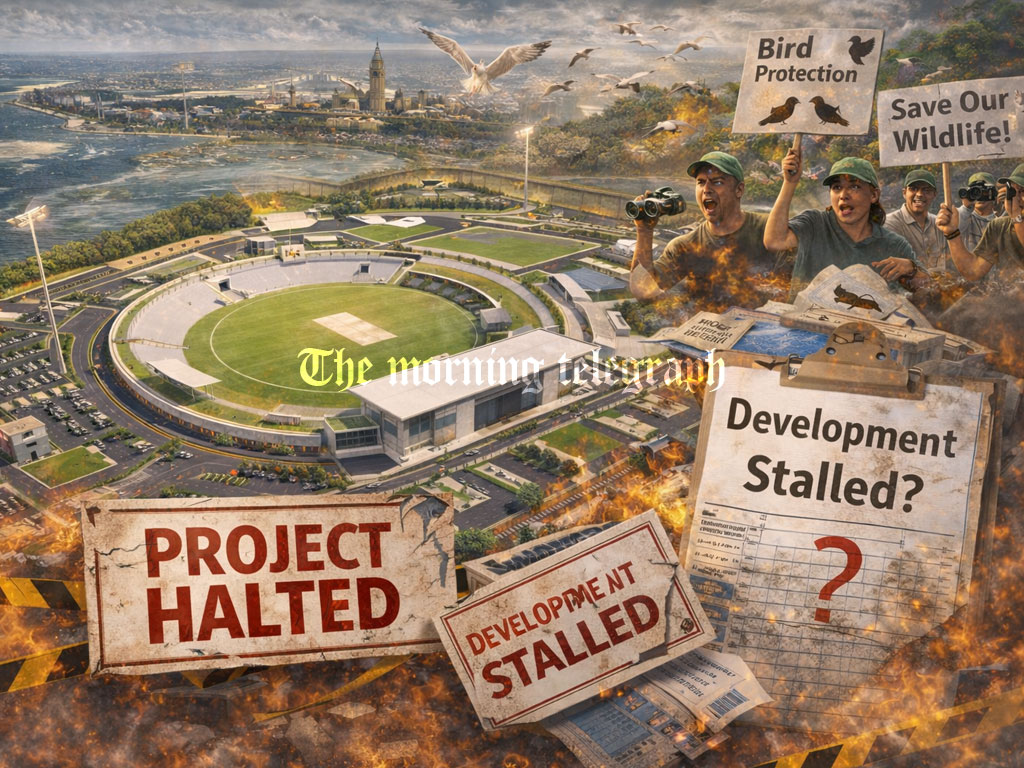
The abrupt stoppage of construction work on the proposed Jaffna international cricket stadium has triggered a storm of controversy, placing the government and environmental activists on a collision course. What was initially presented as a milestone development project, complete with a presidential foundation stone ceremony and Ministry of Sports backing, is now mired in uncertainty over concerns about local birdlife.

The project was not conceived in haste. The identified land had reportedly undergone the usual administrative procedures, reviews, and approvals before the President traveled to Jaffna to lay the foundation stone. The Ministry of Sports was directly involved. In Sri Lanka’s infrastructure framework, such public endorsement typically signals that technical, environmental, and legal clearances have already been examined.
Yet, weeks later, objections have surfaced claiming that birds and ecological factors are being negatively affected.
The timing has raised serious questions.
Sri Lanka’s northern province has long lacked a world-class, floodlit international cricket stadium. The Jaffna stadium project was positioned as more than a sports facility. It was framed as a catalyst for regional development, youth empowerment, sports tourism in Sri Lanka, and national reconciliation through cricket infrastructure investment. In a country where cricket is intertwined with identity and global recognition, this development carried symbolic and economic weight.
The environmental concerns now dominating the conversation focus on the presence of birds in and around the proposed site. However, global cricket history offers perspective. At the Melbourne Cricket Ground in Australia, seagulls routinely invade the pitch during major matches. Authorities even introduced trained wedge-tail eagles, Zorro and Sabrina, to manage the issue. The MCG continues to host World Cup matches and remains a global sporting landmark.
At Lord’s Cricket Ground in England, a sparrow was famously struck by a cricket ball in 1936. The incident became part of cricket folklore, and the preserved bird is displayed in the museum. The ground did not close, nor was international cricket suspended due to wildlife presence.
At the M. Chinnaswamy Stadium in India, birds of prey are frequently seen circling during international fixtures. Across county grounds in the United Kingdom, seagulls have damaged pitch covers. These examples demonstrate that international cricket stadiums and wildlife coexist, supported by mitigation strategies rather than project cancellations.
Sri Lanka’s situation carries additional urgency. Currently, the country cannot host a Cricket World Cup independently because it lacks the required number of floodlit international venues. As a result, Sri Lanka must co-host global tournaments. Being one floodlight stadium short limits revenue, tourism inflows, and global sporting influence.
A Jaffna floodlit stadium would close that gap. It would strengthen Sri Lanka cricket infrastructure, expand international hosting capacity, and reinforce the country’s ambition to organize a Cricket World Cup alone.
Environmental protection must never be dismissed. Responsible development requires credible environmental impact assessments and mitigation measures. However, the core question is whether these objections are being raised constructively within the planning framework or introduced late in the process, after official endorsements and public commitments have already been made.
If environmental safeguards need strengthening, they should be addressed transparently. If mitigation plans are required to protect birdlife near the Jaffna stadium site, they should be implemented with scientific guidance. But indefinite suspension risks projecting administrative inconsistency at a time when Sri Lanka is actively seeking foreign investment and international credibility.
The broader debate now extends beyond Jaffna. It touches on Sri Lanka sports development policy, infrastructure governance, and the balance between environmental activism and national progress.
Cricket remains one of Sri Lanka’s strongest global brands. A modern international cricket stadium in Jaffna is not merely a construction project. It is a statement about regional inclusion, post-war development, and the country’s readiness to compete on the global sporting stage.
The challenge is clear: can Sri Lanka pursue sustainable development while advancing its cricket ambitions, or will recurring stoppages keep the nation permanently one stadium short of its World Cup dream?