In a wide-ranging and candid interview, JVP General Secretary Tilvin Silva addresses Sri Lanka’s foreign policy reset, past controversies, economic philosophy, and allegations of hidden influence, offering rare clarity on where the National People’s Power truly stands.
In a political landscape shaped by shifting alliances, historic grievances, and evolving geopolitical realities, the Janatha Vimukthi Peramuna has long remained one of Sri Lanka’s most scrutinized political movements. From its militant past to its present role within the National People’s Power government, the JVP’s transformation has drawn both suspicion and admiration.

In an exclusive interview with Meera Srinivasan of The Hindu, JVP General Secretary Tilvin Silva responded to pointed questions about India-Sri Lanka relations, the Indo-Lanka Accord, China ties, alleged foreign influence, economic philosophy, constitutional reform, Buddhism, media freedom within the party, and whether he himself wields unseen power behind the scenes.
The conversation reveals a party eager to reposition itself as pragmatic rather than ideological, forward-looking rather than trapped in history, and confident rather than defensive about its foreign and domestic policy direction.
Question: Why did you decide to go to India?
Answer: I did not decide to go. I was invited through the Indian High Commission to participate in the Distinguished Visitors Programme (DVP) of the Indian Council for Cultural Relations (ICCR). It was my first visit to India.
Question: Did they arrange the programme or did you choose the places to visit?
Answer: They arranged the programme, but they asked me if I had any particular preference. I said that I wanted to go to Kerala because I felt that Kerala was very similar to Sri Lanka.
Question: You went to visit the Amul cooperative. Did your visit make any difference in the decision of the National People’s Power government to cancel the agreement signed by the previous government with Amul to run Milko and the National Livestock Development Board (NLDB)?
Answer: This visit was organized to showcase India’s development, especially the use of technology in many sectors. Amul is one place where technology has been used for the benefit of dairy farmers and has brought about a significant improvement in their living standards. We have clearly stated to the Indian government that the dairy industry in Sri Lanka is under government control. But we are open to seeking assistance in developing that sector, especially in introducing new technology.
Question: It is widely reported that your party was anti-India and then changed its tune and chose to be very close to India, right?
Answer: We were never against India. We were against the then Indian government under Rajiv Gandhi and the Sri Lankan government of J.R. Jayewardene and the political policies they followed. That is why we were against both the Rajiv Gandhi and J.R. Jayewardene governments. It was against the backdrop of the Indo-Lanka Accord. Even today we say it should not have happened. It was history 38 years ago. Now the world has changed. India has changed, we have changed. The past should not be an obstacle to future relations. If we go by this logic, we cannot even deal with Britain. They colonized us; they suppressed the 1815 rebellion, etc., but we have come forward now. History is history; we have all learned from it. We must work in a way that suits the present. It is wrong to live in the past.
Question: Especially during the period 1988-90, there was a lot of destruction due to your party’s anti-India stance. Many lives could have been saved and public property could have been protected, right?
Answer: Mr. J.R. Jayewardene could have prevented that destruction. If he had not signed this agreement without even informing his cabinet and keeping the public in the dark, this situation would not have arisen. Mr. Gamani Jayasuriya, one of his cabinet ministers, objected to it and demanded resignation. The people protested peacefully against the agreement, but it was turned into a violent movement by the J.R. Jayewardene government, unleashing violence against the protesters and shooting dead over 100 people.
Question: Do you and the party have any regrets about the way your party responded to the government’s actions?
Answer: Even Isaac Newton has said that for every action there is an equal and opposite reaction. We did not act. We only reacted. If our party had not been banned on false charges of involvement in the 1983 riots, our party would not have had to do politics in secret. If there had been no ban, we would have been doing politics openly. We would have protested openly, as we have done in recent years, but we lost that right. They should regret what happened, not us. If they show no remorse, why should we? We believe that what happened should not have happened, but it happened. We have said this many times: the responsibility for what happened lies with the government of the time, not with us. J.R.’s government did not spare any of its opponents. We responded in the only way we could. If something happened that should not have happened, we regret it. But no one in the United National Party has said so far that they regret what happened then.
Question: Was the JVP involved in any way in the 1983 anti-Tamil violence?
Answer: If we were involved in any way, there should have been at least one court case against us. It is clear that the UNP created this uproar. They used it to ban the JVP along with the Communist Party of Sri Lanka and the New Sama Samaja Party.
Question: How does the JVP balance Indo-China relations?
Answer: Our foreign policy is clear. We are not a party to any country. We do not cheat, we do not lie; we are honest in our dealings. India is our neighbor and we have close relations, and China is also our friend. Pakistan and Bangladesh are also our friends. The successful holding of the Pakistan-India cricket match in Colombo recently, with the good intervention of the President, shows that our foreign policy is successful and that we do not betray one country for the sake of the other. This is the foreign policy that is most suitable for the present era.
Question: Have there been any obstacles in balancing relations with India and China?
Answer: There have been no obstacles. Because we consider both countries as friends, and they have helped us in times of need. I have visited China and India, and there are things we can learn from both countries.
Question: JVP founder Rohana Wijeweera viewed India with suspicion and took an anti-India stance. Have you abandoned his policies?
Answer: India and Sri Lanka are intertwined like an umbilical cord. Our culture and religion are all related. Buddhism came from India. India is our only immediate neighbor. The problems arose when there were Indian governments that pursued policies that were detrimental to our country. We have never opposed India, that is, the country and its people, but we have opposed the policies of some Indian governments.
Question: Are the JVP and the National People’s Power well aligned with the policies of Indian Prime Minister Narendra Modi?
Answer: I think that all the governments that came after Rajiv Gandhi did not follow a policy of influencing Sri Lanka. We can work amicably with the Modi government while protecting our sovereignty. We feel that the Modi government is a true friend to us.
Question: Don’t you feel that there is still doubt among the people of this country about India’s geopolitical agenda towards Sri Lanka?
Answer: That doubt was created by the actions of certain Indian governments. That doubt will disappear with the actions of the Indian government. I feel that that doubt is disappearing with the policies of the current Indian government towards Sri Lanka. There are people who are trying to make a scapegoat out of India. If a request comes from India, they are the ones who are ready to kneel before India. In the past, the reason we were angry with India was because the rulers of Sri Lanka at that time were also subject to Indian pressure. They did not have the self-confidence to face those pressures. If a government can be firm about its position, it can overcome unwanted pressure from any party.
Question: Is there no influence from India now?
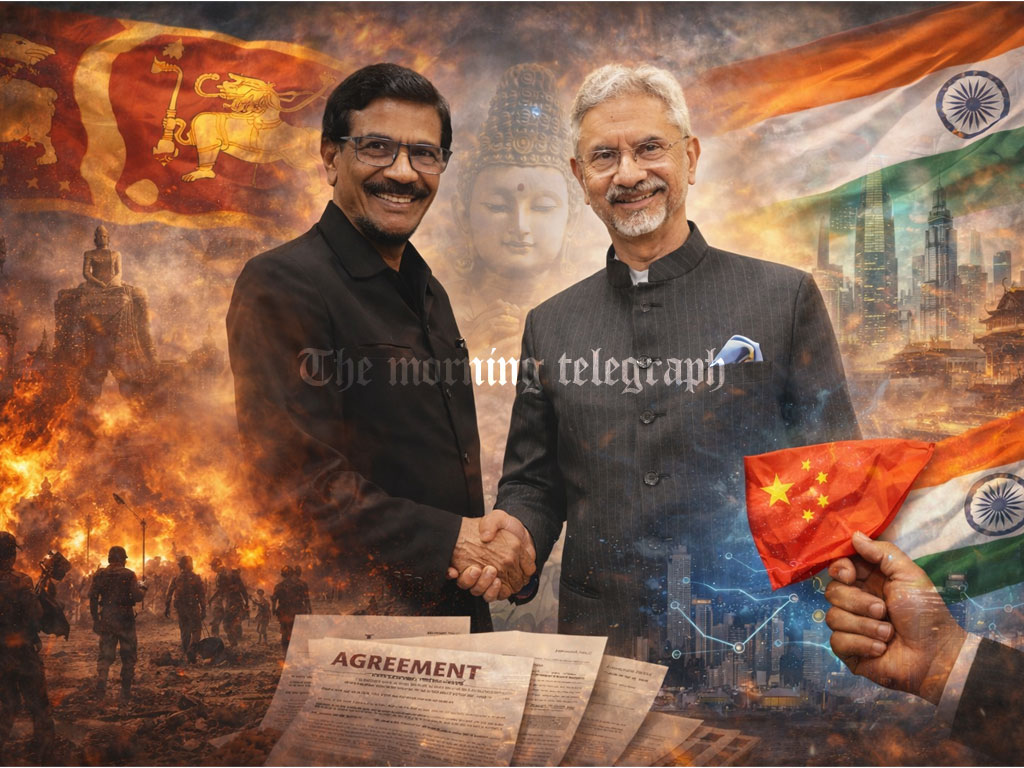
Answer: No, we do not have any such influence. When we talk to them, we are clear about our policies. Take the agreement that former President Ranil Wickremesinghe’s government signed with Amul Cooperative. We told them that this sector is an asset for us; we will not betray it and we will only seek support to develop it, and they accepted our position. We respect India; they respect us. When I met Indian External Affairs Minister S. Jaishankar, he explained that India is a close friend of Sri Lanka.
Question: Before you came to power, did you expect relations with India to proceed as smoothly as you say?
Answer: We were always confident about our foreign policy. Those in the opposition thought that our policies would fail. But we were always confident about our policies because we had developed relations with India and China even before we came to power.
Question: Were you not influenced by India regarding the resolution of the ethnic issue, the implementation of the 13th Amendment, etc.?
Answer: No such discussions were held with me on political issues.
Question: Several MoUs have been signed between Sri Lanka and India, but they have not been made public. What is the secret behind these?
Answer: No secret agreements have been signed, and all the frameworks of the agreements have been presented to Parliament. If there were secret agreements, they would have been made public by now. We came to build this country. We will not take any decision that is detrimental to the country. We will not betray the country, but we will take any assistance we can get from any country that wants to help us.
Question: Was there any displeasure in India regarding Minister Bimal Ratnayake’s Ministry of Ports and Civil Aviation? Was that the reason for his removal from those positions?
Answer: Comrade Bimal had the Ministry of Transport and Highways in addition to the subject of Ports and Civil Aviation. Meanwhile, Comrade Karu had the Ministry of Urban Development. After a year in power, we realized that the Ministry of Transport, Highways and Urban Development would work better together and that Bimal was the best person for the huge workload involved. That is the reason for making these changes. I can assure you that we are working according to what is right and not under external pressure.
Question: What is the transformation taking place in the political and economic philosophy of the JVP?
Answer: Our objectives have not changed. We want to create a just society. It should be an economically and socially just society, one where national unity and democracy prevail. That was our goal then, and that is our goal today. According to our economic philosophy, we believe that there should be economic democracy. Economic democracy means giving everyone the right to participate in the country’s economy. This includes both the public and private sectors, including those at the micro-economic level. We also believe that the benefits of such an economy should be distributed fairly in our society. We are working towards that goal. Of course, it will take some time to achieve this.
Question: Has the JVP shifted from a communist mentality to a neo-liberal mentality?
Answer: We do not adhere to a neo-liberal mentality. We cannot even explain what communism or neo-liberalism means to those who try to label us with such labels. Labels like liberal, neo-liberal, social democratic, democratic or communist are not important to us. Our goal is to develop the country economically and ensure that the fruits of that development reach the people in a fair manner. This will help reduce economic disparity and lead to a happy life. That is our goal.
Question: There are allegations that the JVP has been underestimating the role of the armed forces and even refusing to call them war heroes, right?
Answer: We do not live in the past. We learn from the past, but we do not live in the past. These are problems for those who live in the past. We do not think much about such terminology; we work for the welfare of all the people of the country.
Question: What is your party’s position on Buddhism being the state religion, and are there any steps to change it?
Answer: Have we said this anywhere? Those who say this are trying to portray us as anti-Buddhists before elections. But the truth is completely different. We organized a special exhibition of the Sri Dalada Maligawa. We have given state patronage to Buddhism. Recently, for the first time, the sacred Devnimori relics of Lord Buddha were brought to this country from India for exhibition. The President regularly visits the Temple of the Tooth and seeks blessings. I come from a Buddhist family. We live according to the teachings of the Lord Buddha.
Question: Have members of the National People’s Power Party been prevented from commenting to the media without permission from JVP headquarters?
Answer: It is not true. If MPs are unsure of facts, they should clarify before debates. Apart from that, there is no restriction.
Question: After a year in power, do you feel that you are on the right path?
Answer: We are working according to our manifesto. There are obstacles, including natural disasters and systemic challenges, but we believe we are on the path to achieving our goals.
Question: What about the promise to introduce a new constitution and abolish the executive presidency?
Answer: We have started the process. A new constitution should be a collective effort. It will take time.
Question: The general opinion is that you are the real power behind the power?
Answer: We do not like the word power. Decisions are taken collectively within the National People’s Power and the Cabinet. There is no invisible force pulling strings.