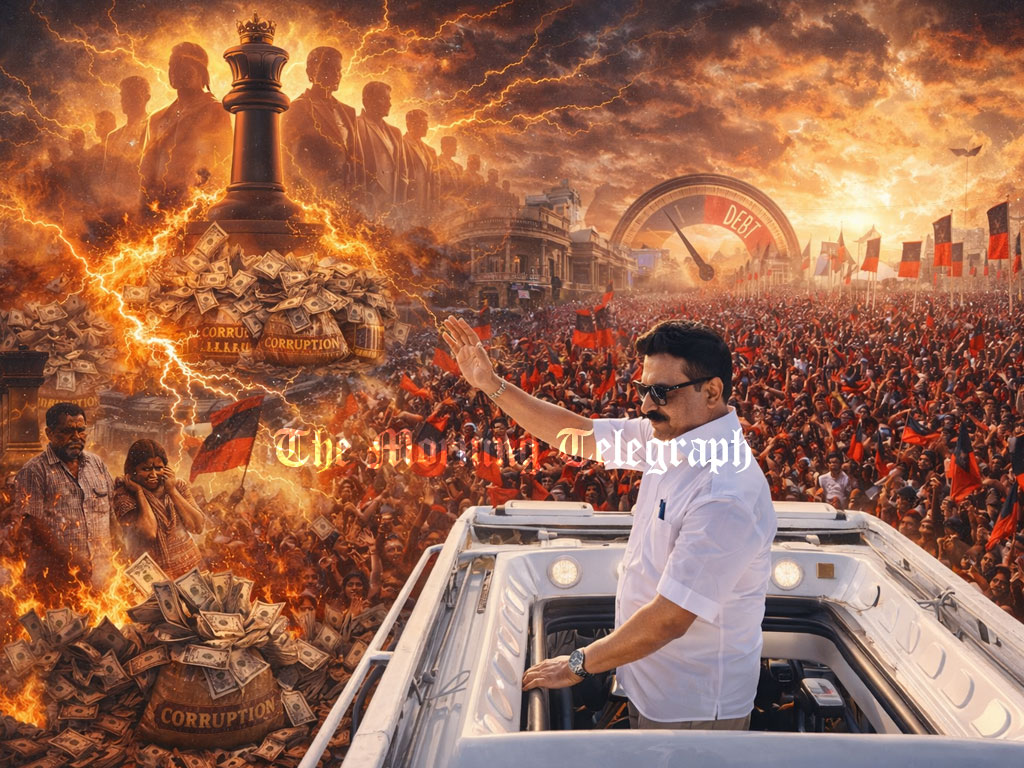
Allegations of family dominance, systemic corruption, rising public debt, industrial decline, and social instability are intensifying debate over whether Tamil Nadu faces a defining political turning point before the 2026 elections.
During the past five years, a persistent narrative has taken root across Tamil Nadu that governance has increasingly revolved around entrenched family networks. Critics argue that political influence flows downward from the family of the Chief Minister to ministers, MLAs, district secretaries, and party functionaries. At each administrative layer, these networks are said to exercise decisive control over appointments, contracts, and policy execution, shaping decision making in subtle and overt ways.

Many officials, observers claim, feel compelled to comply with these power structures to safeguard their careers. Government tenders, public contracts, and administrative approvals are widely perceived to pass through informal channels of approval. In sectors ranging from infrastructure and education to industry and local governance, maintaining proximity to influential families is seen as a prerequisite for smooth operations. Detractors describe this as a form of dynastic governance that undermines democratic accountability and institutional neutrality.
Public conversations frequently return to the issue of corruption in Tamil Nadu. Across departments, there is a common belief that routine services often require unofficial payments. Citizens suggest that obtaining permits, licenses, or government clearances without paying bribes remains the exception rather than the norm. Allegations indicate that corruption begins at senior levels and trickles down through departments, with some officials reportedly justifying illicit collections as contributions destined for higher authorities. Such claims, whether proven or not, contribute to a growing trust deficit.
The situation appears even more troubling when corruption allegedly extends within the bureaucracy itself. Reports suggest that some officials pay bribes to secure transfers, promotions, or relief from disciplinary proceedings. In this cycle, both giver and receiver become participants in a system that normalizes misconduct. Observers argue that this institutional erosion weakens governance and diminishes public confidence in state administration.
Recruitment scandals have further amplified concerns. Allegations of ministers collecting large sums during government hiring processes have surfaced repeatedly. When appointments are believed to depend on payments measured in crores of rupees, efficiency and merit inevitably suffer. Individuals who invest heavily to secure positions may attempt to recover their money through corrupt practices, creating a self sustaining cycle of exploitation. Contractors accused of paying bribes for public works contracts are similarly alleged to compromise quality, leading to poorly constructed roads and buildings that fail prematurely. Such incidents intensify public debate about maladministration and regulatory oversight.
Cultural and religious controversies also feature prominently in political discourse. Some critics accuse sections of the ruling establishment of displaying hostility toward Hindu traditions and Sanatana Dharma while projecting atheistic positions. They argue that festival greetings and public engagement appear selective, fostering perceptions of unequal treatment among religious communities. Supporters counter that governance remains secular and inclusive, yet the perception of bias continues to shape electoral conversations in a state where identity politics plays a significant role.
Beyond governance and cultural debates, social concerns are mounting. Media coverage frequently highlights cases involving ganja possession, youth addiction, and alcohol related violence. Drug abuse and liquor consumption are described as rising at alarming rates, while state revenue from liquor sales through government outlets remains substantial. Road accidents, violent crimes, and assaults in public spaces contribute to a broader narrative of deteriorating law and order. Reports of domestic abuse involving individuals under the influence of substances further deepen anxiety. Many residents express unease about public safety, particularly for women traveling after dark.
Fiscal management has emerged as another central theme. Critics argue that substantial funds have been directed toward memorials, statues, celebratory events, and politically visible projects rather than productivity enhancing investments. Welfare schemes and freebies, while popular among beneficiaries, are portrayed by opponents as tools for electoral consolidation rather than long term economic reform. Meanwhile, public debt reportedly exceeds ten lakh crore rupees, placing Tamil Nadu among the more heavily indebted states. A significant portion of state revenue is reportedly allocated toward servicing interest payments, with some borrowings allegedly used to repay existing obligations. Economists caution that such debt sustainability issues require transparent planning and fiscal discipline.
Industrial policy remains contested terrain. Government leaders frequently highlight investment summits, international visits, and memoranda of understanding aimed at attracting global capital. However, analysts question how many announced projects translate into operational facilities. While new sectors are promoted, closures in traditional industries receive less attention. Reports indicate that hundreds of textile mills have shut down in recent years. Official data shows a decline in operational textile units between 2021 and 2024. Demands for a comprehensive white paper detailing industrial output, employment generation, and sector wise performance continue to surface in policy debates.
Public sector enterprises face structural challenges as well. The Electricity Board and state transport corporations reportedly incur recurring losses despite subsidy expansions and free travel initiatives. Industrial operators complain about informal demands for payments from local intermediaries. Farmers report difficulties in paddy procurement, alleging fixed rate bribes within procurement channels. Inadequate storage facilities have led to spoilage of harvested crops, exposing vulnerabilities in agricultural supply chains. Such grievances highlight the intersection of corruption, inefficiency, and rural distress.
Amid these layered concerns, the political question looms large. Many voters believe that a change in leadership may be necessary to protect the long term interests of Tamil Nadu. Yet uncertainty persists about whether opposition parties offer a clearer governance roadmap. Some citizens reflect on earlier administrations in the post Jayalalithaa era, debating whether conditions were comparatively better or simply different. Coalition politics and shifting alliances complicate predictions ahead of the 2026 elections.
Tamil Nadu stands at a crossroads defined by dynasty politics allegations, public debt challenges, governance scrutiny, and social transformation. Whether these issues culminate in electoral change or policy recalibration remains to be seen. What is clear is that public discourse has intensified, and citizens are weighing performance, accountability, and economic direction more closely than ever. As 2026 approaches, the state’s political future will likely hinge on how convincingly leaders address concerns surrounding corruption, fiscal responsibility, industrial revival, and social stability. The coming months will reveal whether reform, renewal, or continuity defines the next chapter in Tamil Nadu’s political journey.