Prominent academics, activists and former lawmakers warn against intimidation, urging due process and protection of academic freedom as Professor Maithri Wickremesinghe faces questioning over a case linked to former President Ranil Wickremesinghe.
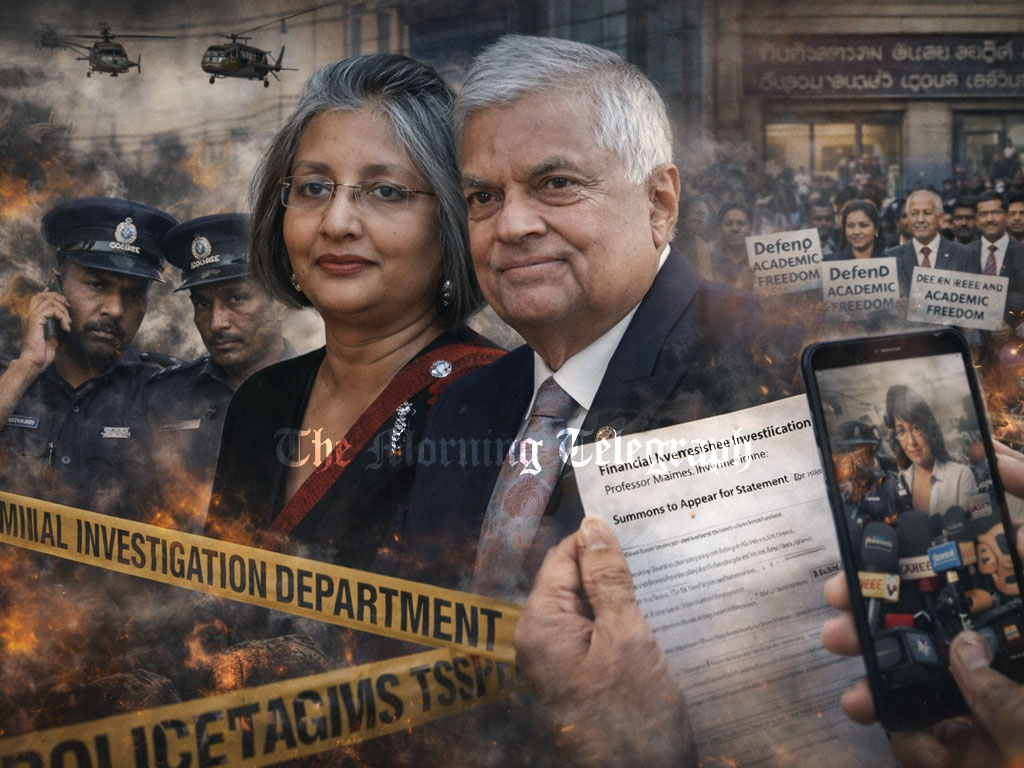
A strong and unanimous statement of solidarity has been issued in support of Professor Maithri Wickremesinghe after reports confirmed that she has been summoned to appear before the Financial Crimes Investigation Division of the Criminal Investigation Department. The summons is reportedly connected to an ongoing investigation involving her husband, former President Ranil Wickremesinghe, over the use of public funds to attend an event at the University of Wolverhampton.

Professionals working in the field of women’s rights have expressed deep concern that independent academics should not be subjected to unnecessary harassment, intimidation or reputational harm. The statement, signed by prominent intellectuals, lawyers, journalists, activists and former Members of Parliament, emphasizes that academic freedom and institutional independence must be protected in a democratic society.
Professor Wickremesinghe was awarded an honorary professorship by the University of Wolverhampton in recognition of her extensive academic research, gender equality advocacy and policy contributions. The university honoured her as a prominent Sri Lankan scholar whose work has shaped gender studies, feminist research methodology and national policy discourse.
Currently serving as Chair and Senior Professor of English at the University of Kelaniya, she is also the founding Director of its Centre for Gender Studies. Over more than three decades, she has contributed significantly to gender sensitization training, women’s rights policy development and evaluation of gender programmes both in Sri Lanka and internationally.
Her doctoral research at the Institute of Education, University of London, later published by Routledge, has been widely cited in global academic scholarship. She has also served on national and international advisory bodies including the University Grants Commission of Sri Lanka, the Association of Commonwealth Universities and the Commonwealth Secretariat. Her role in strengthening institutional frameworks for gender studies has been widely acknowledged.
The signatories argue that these achievements are a source of national pride and should not be overshadowed by political controversies. They stress that any investigation related to public accountability must follow due process, transparency and fairness, without extending scrutiny in ways that undermine the dignity and professional independence of a respected academic.
Among those supporting the statement are Deshamanya Radhika Coomaraswamy, Dr Nimalka Fernando, Dr Subhangee Herath, Dr Renuka Pathirana, Ferial Ashraf and numerous other activists and professionals.