Allegations of political interference in land administration and the sudden resignation of a state sugar company chairperson have ignited fresh concerns over public sector independence, accountability, and the balance between political authority and institutional due process in Sri Lanka.
Questions over political pressure on public officials have resurfaced following claims by the Sri Lanka Divisional Secretaries and Assistant Divisional Secretaries Association and the abrupt resignation of the chairperson of Lanka Sugar Private Limited.
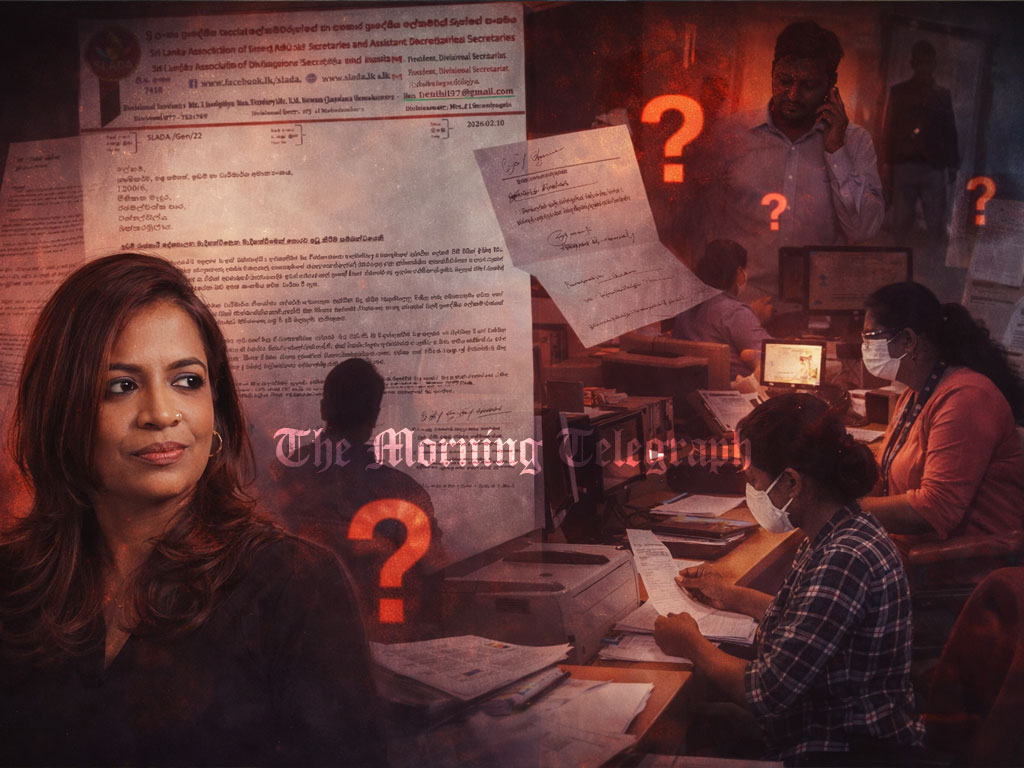
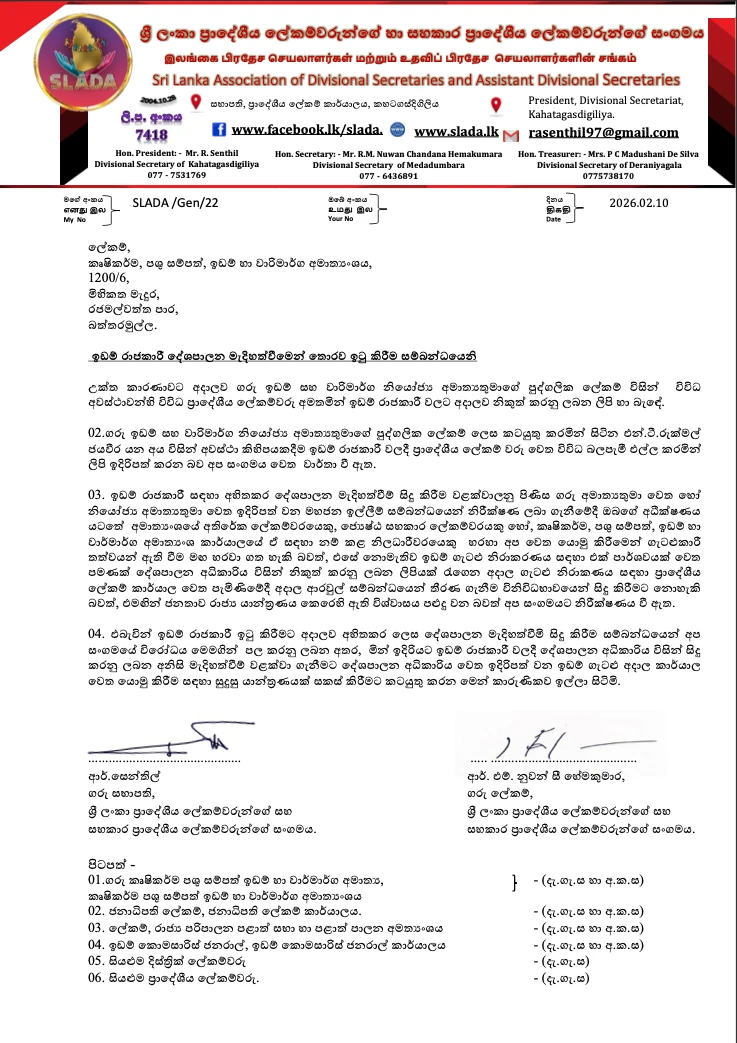
The association has formally written to the Secretary of the Ministry of Agriculture, Livestock, Lands and Irrigation regarding letters issued to Divisional Secretaries under the letterhead of the Private Secretary to the Deputy Minister of Lands and Irrigation. According to the association, these letters allegedly contained instructions relating to land duties and were sent outside the established administrative mechanism.

The association claims that an individual identified as N. T. Rukmal Jayaweera, said to be serving as Private Secretary to the Deputy Minister, had on multiple occasions sent letters that exerted pressure on Divisional Secretaries while they were carrying out official land administration responsibilities. Reports suggest that between 10 and 15 Divisional Secretaries may have received such correspondence.
Concerns have been raised that some of these letters requested reports, issued directions on specific matters, and in certain instances asked officials to reconsider or change decisions made by the Land Commissioner General. The association argues that Sri Lanka’s public administration operates within a defined government mechanism and that bypassing that structure risks politicizing land governance.
Officials say such actions create practical and ethical dilemmas. For example, in cases of land disputes, if one party produces a letter from a political office while another does not, public perception may shift toward claims of political favoritism. Divisional Secretaries maintain that this undermines confidence in neutral public service delivery and complicates the execution of lawful land duties.
Another issue raised is uncertainty regarding the official status of the individual issuing the letters. The association states that clarity is needed on whether the person concerned is formally recognized within the administrative framework.
Responding to the allegations, Deputy Minister of Lands and Irrigation Aravinda Senarath emphasized that elected representatives frequently refer public grievances to relevant institutions. He acknowledged, however, that if any letters contained improper or illegal instructions, that would be wrong. He stated that discussions are ongoing to reconsider the practice of sending such letters and to ensure that correct procedures are followed.
The Deputy Minister expressed regret if any public officials had been inconvenienced and said corrective measures would be taken. He also noted that thousands of issues had been forwarded to institutions and that only a small number had resulted in complaints. While he stressed the need to follow proper methodology, he argued that historical administrative delays require reforms in how citizen grievances are handled.
Parallel to the land administration controversy, developments at Lanka Sugar Private Limited have added another layer to the governance debate. Attorney at Law Sandamali Chandrasekara, the second chairperson appointed after the current government assumed office, resigned with immediate effect on February 17.
In her resignation letter to the Minister in charge, Sunil Handunnetti, she cited strict financial regulations governing the loss making state owned enterprise. She stated that mandatory controls and accountability requirements limited her ability to respond to certain external requests.
Chandrasekara noted that during her tenure she received numerous requests that, in her view, violated established circulars, regulations, and legal procedures. She maintained that both the Board of Directors and the Chief Executive Officer were bound by legal obligations and could not comply with requests that exceeded permissible limits. According to her letter, efforts to explain the institutional legal framework to certain individuals had led to tensions and conflict.
When questioned about claims that her resignation resulted from political pressure, Minister Sunil Handunnetti rejected the allegation. He described the change as part of broader restructuring within state enterprises and denied any undue influence behind the decision.
Together, the land administration dispute and the sugar company resignation have intensified public discourse on public sector independence, political accountability, and governance reform. At the heart of the debate lies a fundamental question: how should democratic political authority interact with career civil servants and state enterprise leadership without compromising due process, institutional integrity, and public trust?
As Sri Lanka navigates economic recovery and administrative reform, these episodes underscore the delicate balance between responsiveness to citizens and adherence to lawful procedure. The unfolding situation will likely shape broader conversations about transparency, rule of law, and the boundaries of political engagement within the country’s public administration system.