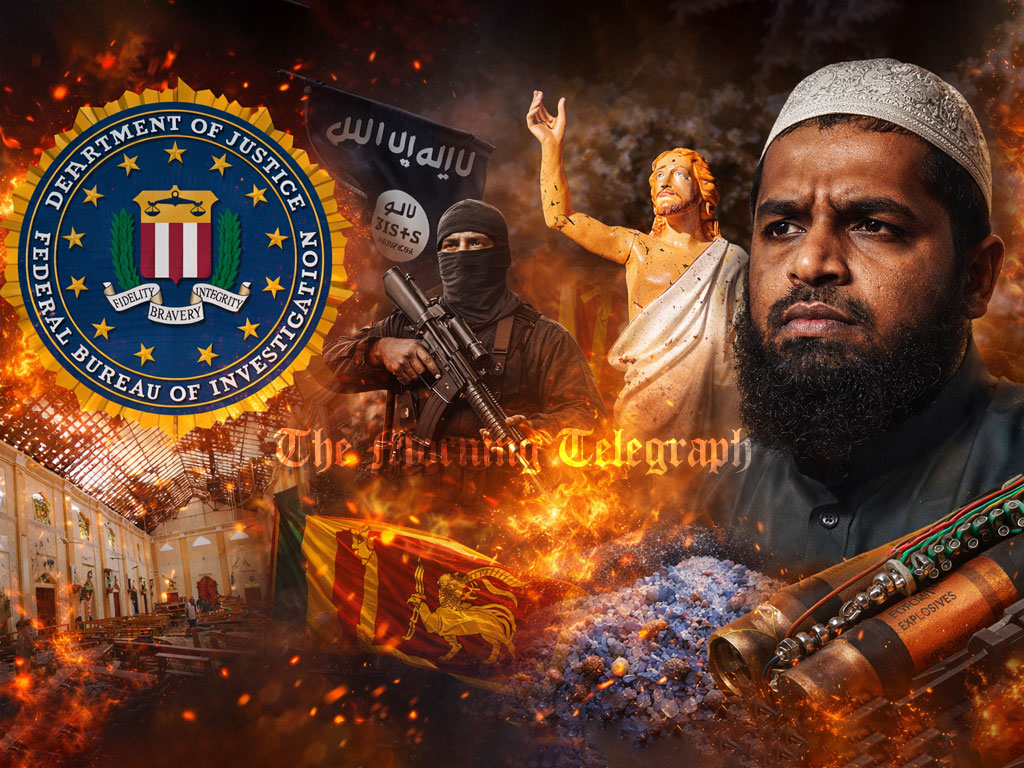
A detailed 72 page US court filing names Zahran Hashim as the architect of Sri Lanka’s 2019 Easter Sunday carnage, linking the coordinated suicide bombings directly to the global ISIS terror network.
A years long investigation by the United States Federal Bureau of Investigation has uncovered critical findings about the Easter Sunday terrorist attacks carried out in Sri Lanka on April 21, 2019. According to a 72 page affidavit filed in a California court on December 11, 2020, Zahran Hashim, also known as Zahran Mohammed Qasim, has been formally identified as the mastermind and chief planner behind the coordinated bombings that shook the nation.

The affidavit was submitted by FBI Special Agent Merilee R. Goodwin, an experienced counterterrorism investigator involved in global terrorism cases since 1998. The document outlines how Zahran established and led a local ISIS affiliated extremist cell operating under the name ISIS in Sri Lanka. Investigators confirmed that the group pledged allegiance to then ISIS leader Abu Bakr al Baghdadi and acted in alignment with the organization’s international terrorist objectives.
In addition to Zahran, the FBI identified three other key conspirators and filed charges in a United States court:
- Mohamed Naufar: He served as the group’s second emir and was responsible for ISIS propaganda, recruitment activities and ideological and weapons training.
- Mohamed Anwar Mohamed Riskan: He allegedly facilitated the purchase of chemicals used in bomb making, arranged safe houses and directly assisted in assembling explosive devices used in the Easter attacks.
- Ahamed Milhan Hayathu Mohamed: Identified as the group’s weapons trainer, he was also linked to the killing of two police officers prior to the attacks.
The affidavit details the technical methods used to execute the operation. The attackers relied on encrypted messaging applications such as Telegram and Threema for secure communication. Bombs were constructed using water gel, urea nitrate and standard detonators, with ball bearings inserted to increase lethality. Forensic examinations conducted by the FBI Explosives and Detonation Analysis Center confirmed the presence of nitrate compounds at blast sites that are not naturally occurring.
The eight principal suicide bombers were identified as follows:
- Shangri La Hotel: Zahran Hashim and Ilham Mohamed Ibrahim.
- Zeenat Mandiraya St. Anthony’s Church: Ahmed Muath Alauddin.
- Kingsbury Hotel: Mohamed Azam Mohamed Mubarak.
- St. Sebastian’s Church Katuwapitiya: Achchi Mohamed Hastun.
- Cinnamon Grand Hotel: Mohamed Ibrahim Inshaf Ahmed.
- Zion Church Batticaloa: Mohamed Nasar Mohamed Azat.
- Dehiwala New Tropical Inn: Abdul Latif Jameel Mohamed, who had earlier attempted a failed attack at the Taj Samudra Hotel.
The coordinated suicide bombings killed 268 people and injured more than 500. The affidavit also notes that Zahran’s wife died during a police raid after the attacks, while his father and brothers were killed in clashes with security forces.
The FBI emphasizes that the Easter Sunday massacre was not an isolated domestic incident but a structured international terror operation linked to ISIS global strategy. American agents arrived in Sri Lanka within hours of the attacks to assist authorities, and the affidavit represents the culmination of that intensive investigation.