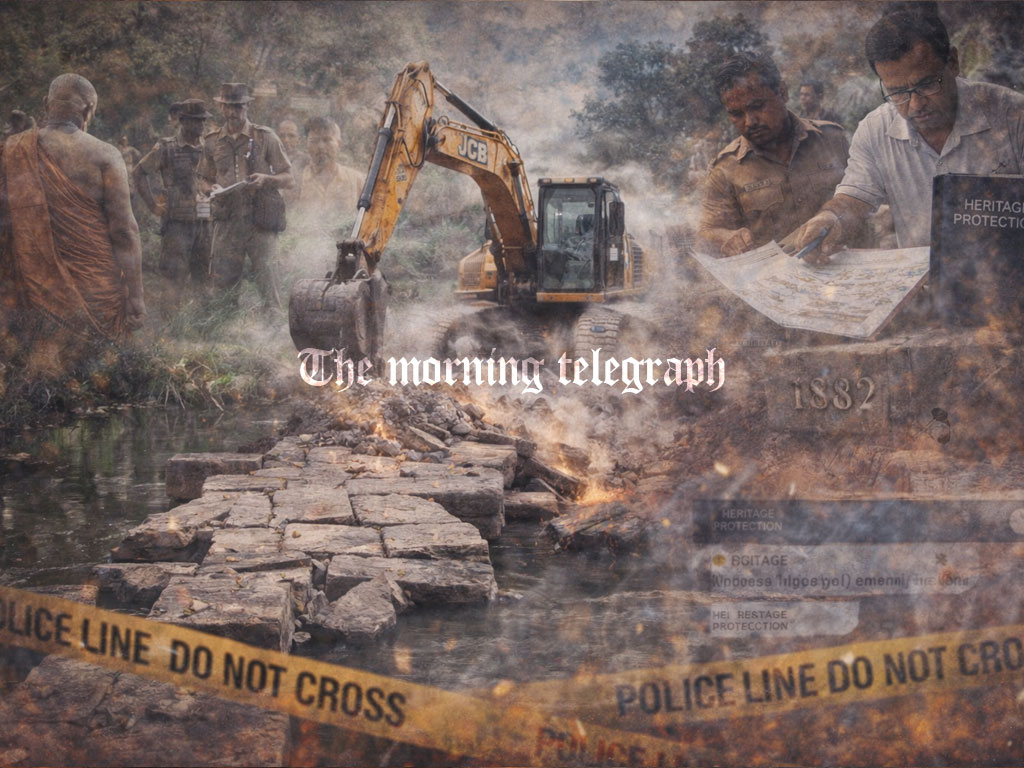
Two millennia old stone bridges in Yan Oya were reduced to rubble within days despite official warnings, exposing alarming gaps in heritage protection, law enforcement, and development accountability.
Under the banner of development, two ancient stone bridges across the Yan Oya in Padarawulla, Konwewa in Kahatagasdigiliya, have been destroyed in swift succession, raising serious concerns about heritage preservation and regulatory oversight. According to reports, heavy machinery was used to dismantle the structures, allegedly as part of the Yan Oya restoration project, despite clear instructions from archaeological authorities.

The first bridge was demolished, prompting officials from the Department of Archaeology to file a formal complaint with the Kahatagasdigiliya Police. Investigations were reportedly underway when the second bridge was torn down the following day. The sequence of events has intensified allegations that the destruction was not accidental but deliberate.
• Archaeological significance: Field investigations and observation reports confirm that these stone bridges, believed to date back thousands of years, were part of an ancient highway network linking Anuradhapura to Trincomalee. They represent rare surviving evidence of early infrastructure and cultural continuity in Sri Lanka’s dry zone civilization.
• Prior warnings ignored: According to the official complaint submitted by regional archaeology officers on Monday (23), project authorities had been informed both verbally and in writing about the archaeological value of the site at the very outset of the restoration initiative. Despite these documented warnings, the demolition proceeded.
• Legal and regulatory failure: An officer of the Archaeological Department stated that although legal action had been initiated following the destruction of the first bridge, the complete dismantling of the second structure at the same location demonstrates intentional disregard for the Archaeological Act and heritage protection laws.
So far, law enforcement authorities have neither arrested suspects nor confiscated machinery used in the bulldozing of monuments that have been listed in Archaeological Administration records since 1887. The apparent inaction has sparked public outrage and renewed debate about development versus conservation in Sri Lanka.
Officials emphasized that the repeated violation reveals a troubling lack of awareness and accountability among project implementers regarding ancient heritage management. Local residents and heritage advocates questioned the purpose of development projects that erase irreplaceable cultural assets. They argued that such historic sites could have strengthened cultural tourism and regional identity rather than being sacrificed.
The community has strongly criticized authorities for allowing national heritage, preserved for centuries, to be destroyed within two days. As reflected in the police complaint, calls are growing for expedited investigations, enforcement of heritage protection laws, and stronger safeguards to prevent similar incidents in future infrastructure projects.