A powerful tribute to Rear Admiral Udaya Bandara, the visionary Sri Lanka Navy officer whose battlefield innovation, technical brilliance, and unwavering patriotism helped turn the tide against maritime terror when conventional weapons were out of reach.
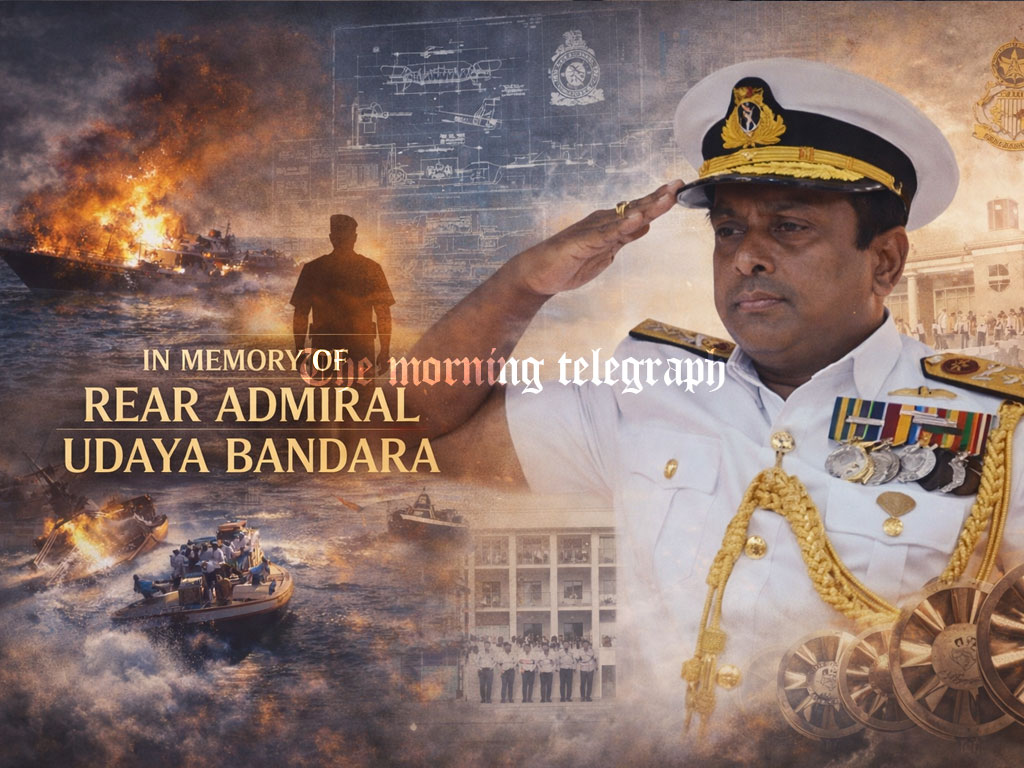
Brilliant Navy officer, no more. Rear Admiral Udaya Bandara, VSV, USP, retired, who passed away a few days ago, leaves behind a remarkable legacy of innovation, courage, and distinguished service to Sri Lanka and the Sri Lanka Navy. His story is not merely about rank or medals. It is about ingenuity under pressure, leadership in crisis, and a technical mind that refused to accept limitations when the nation needed solutions.

The defining chapter of this legacy unfolded in 2006. At the time, I was serving as Director of Naval Operations, Special Forces, and Maritime Surveillance under the then Commander of the Navy, Vice Admiral Wasantha Karannagoda. Udaya, affectionately known to many of us as Bandi, was the trusted Naval Assistant to the Commander. The war at sea had reached a dangerous intensity. The LTTE Sea Tigers were deploying explosive laden suicide boats that posed a lethal threat to our Fast Attack Crafts and elite SBS Arrow Boats operating in littoral waters.
We were fighting an unconventional maritime war. Procurement limitations and international restrictions made it difficult to acquire specialized countermeasures. The Sri Lanka Navy had to think beyond traditional military doctrine. It was during this period that Marine Engineer Commander Chaminda Dissanayake approached me at Naval Headquarters. Known for his out of the box thinking and exceptional research and development skills, he presented a blueprint for an explosive laden remotely controlled small boat. The concept was simple in structure yet revolutionary in impact. It could fit into 18 foot Arrow Boats and be deployed tactically against enemy suicide craft.
Recognizing the urgency and potential of the idea, I walked into Bandi’s office with Commander Dissanayake. Bandi’s office was next to mine, both located close to the Navy Commander’s office. As a Marine Engineer par excellence, he immediately grasped the brilliance of the design. His technical insight was sharp and instinctive. I urged him to brief the Commander of the Navy without delay.
From that moment, the burden shifted to him. Bandi took ownership of the project with characteristic determination. Within weeks, the first prototype of the explosive laden remotely controlled Arrow Boat was tested at sea off Coral Cove at the Naval Base in Trincomalee. The test was an unequivocal success. It was not merely a technological milestone. It was a strategic breakthrough in Sri Lanka’s naval warfare capability.
Bandi applied his vast engineering knowledge to refine the design. He supervised fine tuning, systems calibration, and operational adjustments. He also oversaw the training of elite SBS personnel who would operate these remote attack platforms. What began as a blueprint soon became a decisive battlefield asset.
These remotely controlled boats were deployed alongside the SBS Arrow Boat fleet. Their impact against LTTE suicide boats and small craft formations was devastating. They altered the dynamics of sea battles and significantly reduced risk to naval personnel. During those intense days, the Admiral of the Fleet often reminded us of a truth that now feels timeless. You cannot buy a Navy, you have to build one. Bandi embodied that philosophy.
Our boatyards in Welisara and Trincomalee began constructing small boat squadrons designed for agility and rapid response. The Special Boats Squadron and the Rapid Action Boat Squadron proved exceptionally effective when equipped with these explosive laden remote platforms. Sea battles that once carried heavy uncertainty began to tilt convincingly in our favor. Innovation had filled the gap where conventional procurement had failed.
Yet Bandi’s vision extended far beyond one project. He consistently advocated for a transformation in naval education. He believed deeply that the Navy is fundamentally a technical service. He argued that every Sri Lanka Navy officer should receive a technical degree at the Academy. His call for a BTech degree for all officers reflected his conviction that modern naval warfare depends on engineering excellence, systems understanding, and technological literacy.
While his proposal did not receive immediate traction locally, he often cited the Indian Navy as a model. Bandi himself had graduated as a Marine Engineer from the Indian Navy Engineering College SLNS Sivaji in Lonavala, Pune. He admired how the Indian Naval Academy at Ezhimala, the largest in Asia, integrated technical degrees into officer training across branches. For him, professional military education was inseparable from engineering knowledge.
His technical brilliance was not confined to military service. Bandi was also a pioneer of mini hydro power projects in Sri Lanka. These turbines generated electricity that was sold to the Ceylon Electricity Board, creating sustainable and profitable ventures. He once advised me, as a young officer, to invest in such projects. He said that as long as water flowed through the turbines, income would follow because electricity demand would always exist. It was a practical expression of his engineering mindset applied to civilian development. I regret not acting on his advice at the time.
Bandi’s discipline and pursuit of excellence extended into personal arenas as well. While serving as my senior Technical Officer when I was Commander Southern Naval Area, I noticed pencil marks on the walls of his chalet. Curious, I asked him about them. He explained that they were part of his pencil shooting training. This was a practice drill used by practical pistol shooters to improve reflexes and precision. He would rehearse draw and fire drills late into the night. That dedication propelled him to become a top practical pistol shooter within the Sri Lanka Navy team. He later represented the Sri Lanka National Practical Pistol Firing Team and won international championships. For him, excellence was never accidental.
In his capacity as Officer in charge of Technical Training, Bandi maintained strong professional relationships. He engaged Commander Fazal Mohammed, his Divisional Officer during cadet days, who was then serving at the Sultan of Oman Royal Naval Academy. Through this collaboration, Royal Oman Navy Engineering Artificers were trained in Sri Lanka, particularly in Fast Attack Craft main engine overhauls. The expertise imparted impressed the Royal Oman Navy Commander so profoundly that funds were donated to construct a four story accommodation building at the Sri Lanka Navy Naval and Maritime Academy in Trincomalee. Today it stands as the Oman Building, a lasting testament to Bandi’s influence and credibility.
Beyond uniforms and engineering, he was a devoted family man. His wife served as a senior judge at the Kegalle High Court before retiring. Their only son studied at the British School in Colombo and pursued a legal career, following his mother’s path. Today, he practices intellectual property law at the De Saram Law Firm. Bandi took immense pride in his son’s achievements. His home life reflected stability, dignity, and commitment.
When retirement approached in 2016, after 34 years of distinguished service, Bandi reached the age of 55 as Rear Admiral and Director General Training. I requested that he continue serving through the Naval Reserve Force. Yet he had other ambitions. He envisioned expanding his mini hydro power initiatives to East African countries, carrying Sri Lankan expertise abroad.
His passing at the age of 64 after a brief illness came as a profound shock to family, colleagues, and friends. The funeral, conducted with full military honors in his hometown of Aranayake, reflected the respect he commanded. A Rear Admiral in title, but an engineer and patriot in spirit, he leaves behind institutions strengthened by his effort and young officers shaped by his philosophy.
The Sri Lanka Navy Naval and Maritime Academy in Trincomalee, enhanced through his contributions, will continue training generations of officers and sailors. Every engine overhaul, every tactical innovation, and every technical degree earned by future cadets will carry echoes of his vision.
Rear Admiral Udaya Bandara built more than weapons. He built confidence, capability, and a culture of technical excellence within the Sri Lanka Navy. In times when weapons could not be bought, he helped design them. In moments when strategy faltered, he advanced innovation. His life stands as a testament to engineering leadership in national defense.
May dear Bandi attain the supreme bliss of Nirvana.