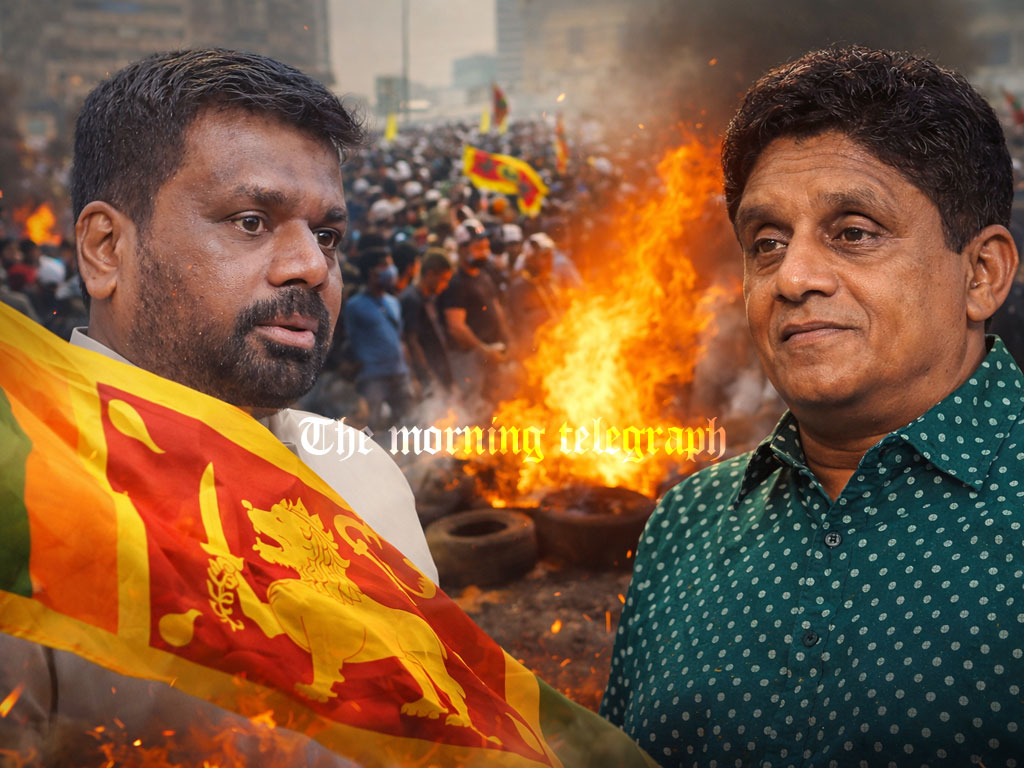
As corruption allegations intensify and Provincial Council elections draw closer, Colombo braces for a decisive Women’s Day political showdown that could redefine national power equations, test public confidence and reshape the trajectory of Sri Lanka’s fragile recovery.
Corruption Allegations Spark a Governance Crisis
One and a half years after assuming power, the government finds itself confronting a wave of serious corruption allegations that have altered the political atmosphere in Colombo. What initially appeared as routine opposition criticism has evolved into a sustained campaign that questions the integrity of procurement processes, customs procedures and energy sector management.
The most explosive claim involves the alleged release of 323 containers from the port without proper inspection. Opposition figures argue that this represents a breakdown in regulatory oversight and raises concerns about accountability within customs administration. The government has rejected accusations of wrongdoing, insisting that procedures were followed and that the narrative has been deliberately exaggerated for political gain.
Simultaneously, controversy has deepened over the importation of eight coal shipments described by critics as substandard. The opposition alleges that these imports caused financial losses amounting to Rs. 7,700 million. In a country that endured a crippling energy crisis and fuel shortages in recent years, any suggestion of irregularities in the energy procurement chain resonates strongly with the public.
Energy security remains an emotionally charged issue. Households and industries vividly recall power cuts, long fuel queues and economic contraction. Therefore, allegations connected to coal imports carry weight far beyond the accounting figures cited in parliamentary debates. They strike at memories of instability and hardship.
For a government that campaigned on promises of clean governance, efficiency and structural reform, the perception of impropriety poses reputational risks. Whether the allegations ultimately withstand investigation is one matter. The political impact of the claims, amplified through media coverage and public discourse, is another.
The administration appears aware that purely technical explanations will not suffice in a climate where public trust remains fragile. Political management, therefore, has become as important as legal rebuttal.

From Verbal Rebuttal to Street-Level Counteraction
Rather than confining its response to statements within Parliament, the government has opted to shift the battleground. Plans are underway for a major political mobilisation in Colombo on March 8, International Women’s Day.
The decision marks a strategic pivot. Instead of engaging solely in defensive messaging, the leadership intends to demonstrate visible strength through mass participation. In contemporary politics, optics matter. A large gathering in the capital can reframe narratives, particularly when opponents are attempting to depict declining popularity.
The opposition has repeatedly claimed that government approval has dropped to 20 percent, with some assertions placing it even lower. While no independent nationwide election has tested these figures recently, the repeated citation of such numbers shapes perception.
For the Janatha Vimukthi Peramuna and the National People’s Power, the absence of large rallies during the past eighteen months has created space for speculation. Critics interpret it as evidence of eroding grassroots capacity. Supporters argue that the leadership deliberately avoided excessive spectacle in order to focus on governance and stabilisation of the economy.
The March 8 mobilisation aims to answer those doubts directly. It is intended not merely as a commemorative event but as a visible statement of political resilience.
Women as the Strategic Core of Political Renewal
Women voters played a decisive role in the electoral victories that brought the JVP and the NPP into power. Campaign strategists often credit female participation for expanding the coalition beyond traditional ideological bases.
During previous elections, large scale gatherings under the theme Women Unite as One were organised across districts. Thousands attended these meetings, which emphasised social justice, economic reform and protection of family livelihoods.
According to internal party discussions, General Secretary Tilvin Silva has instructed organisers nationwide to mobilise approximately 30,000 women for the upcoming rally in Colombo. District level machinery has reportedly been activated to coordinate transportation, logistics and outreach.
Within leadership circles, debate reportedly emerged regarding the format of International Women’s Day commemorations. One option was a modest official state ceremony. The alternative was a large scale political convention under party leadership.
The compromise appears to involve both. A smaller official event would maintain institutional formality, while a mass rally would project organisational power. Although the rally may operate under the broader NPP banner, sources suggest that the JVP’s identity will remain prominent. For many within the movement, the mobilisation represents the first step toward re strengthening the party structure ahead of future electoral tests.
Provincial Council Elections Reenter the Equation
The timing of the March 8 rally cannot be separated from discussions surrounding Provincial Council elections. Following Tilvin Silva’s recent visit to India, party members were reportedly briefed on the urgency of preparing for provincial polls.
Provincial Councils have been inactive for years, and their restoration carries constitutional and political significance. From the moment it assumed office, the government is said to have assured various stakeholders, including India, that it would conduct the long delayed elections.
Although no official date has been announced, speculation suggests that elections could take place by the end of this year or early next year. This leaves a limited window to rebuild momentum, consolidate district networks and counter narratives of declining popularity.
If the March 8 rally successfully demonstrates organisational strength, it may serve as a launchpad for a Provincial Council election campaign. Political observers note that public enthusiasm often builds through sequential mobilisation events. The Women’s Day gathering may therefore function as a rehearsal for broader provincial outreach.
Popularity Debate and Political Perception
The opposition’s claim that government popularity has slipped to 20 to 30 percent has gained traction in public discussions. While such figures are difficult to verify without nationwide elections, anecdotal evidence from various districts indicates mixed sentiment.
Economic stabilisation measures have delivered incremental improvements, but living costs remain high. Many households continue to feel financial strain. In such an environment, governance controversies can amplify dissatisfaction.
The leadership reportedly did not initially react strongly to popularity claims following local government results. However, more recent feedback appears to have triggered greater concern. Political momentum, once lost, is difficult to recover. Therefore, visible mobilisation is viewed as essential.
In politics, perception often precedes reality. If the public believes momentum is fading, that belief can become self fulfilling. Conversely, a powerful display of unity can reverse narratives rapidly.
Anti Corruption Drive Gains Momentum
Alongside mobilisation efforts, the government has intensified its anti corruption drive. Campaign promises emphasised accountability and justice. Delivering on these commitments remains central to sustaining credibility.
The recent arrest of former State Intelligence Chief Major General Suresh Sallay by the Criminal Investigation Department has drawn significant public attention. As the seventh anniversary of the 2019 Easter Sunday attacks approaches, pressure has mounted for visible progress in investigations.
The arrest has triggered debate. Supporters argue it reflects a commitment to pursuing truth regardless of rank. Critics question whether timing intersects with electoral calculations. Regardless of interpretation, the move reinforces the government’s message that accountability mechanisms are active.
High profile investigations often serve dual purposes. They address legal concerns while simultaneously shaping political narratives about reform and justice.
Opposition Women’s Rally Raises the Stakes
The Samagi Jana Balawegaya is preparing its own Women’s Day rally in Colombo, reportedly at the Nelum Pokuna Theatre. Opposition Leader Sajith Premadasa aims to demonstrate organisational vitality and highlight female participation within his party.
Reports suggest that the SJB plans to bring more than 10,000 women from each electorate. If realised, the capital may witness competing mass gatherings on the same day.
Such parallel mobilisation underscores the centrality of women voters in Sri Lanka’s political equation. Both major forces recognise that women’s support can decisively influence provincial and national outcomes.
The optics of duelling rallies will shape media coverage and public perception. A larger turnout on either side may generate momentum narratives that extend beyond March 8.
Survey Data and Strategic Confidence
A recent survey released by Verité Research, headed by Nishan de Mel, claims that 65 percent of respondents approve of the government’s program. For the administration, the findings reportedly provided renewed confidence.
Opinion surveys in Sri Lanka have historically offered mixed predictive value. Previous administrations received favourable ratings prior to facing political setbacks. Nevertheless, the current leadership appears to interpret the Verité findings as validation.
Within the SJB, however, some members have questioned the neutrality of the survey. Debates over methodology and interpretation highlight how data has become integral to modern political strategy.
Numbers influence not only public perception but also internal decision making. If leaders believe they retain majority approval, they may feel emboldened to proceed with elections sooner rather than later.
International Diplomacy and Domestic Optics
The President’s recent visit to New Delhi introduced a diplomatic dimension to domestic politics. Upon arrival, enhanced protocol arrangements were reportedly extended by Indian Prime Minister Narendra Modi.
During discussions, Modi reportedly appealed to IMF Managing Director Kristalina Georgieva to support Sri Lanka’s economic recovery. Georgieva indicated that an IMF delegation would visit in March to discuss suspended loan tranches.
Such diplomatic engagement strengthens the government’s narrative of international credibility and regional partnership. For a country emerging from economic crisis, visible support from global leaders reinforces perceptions of stability.
Rajapaksa Investigations and the International Dimension of Accountability
Developments involving members of the Rajapaksa family have added further intensity to the national political debate. A Sri Lankan court has reportedly issued a warrant in connection with corruption allegations against Shamindra Rajapaksa, son of former Speaker Chamal Rajapaksa. The matter has drawn attention not only because of the family’s long standing influence in Sri Lankan politics, but also due to the cross border legal implications.
According to reports, authorities in the United States located his residence in Los Angeles and personally served the Sri Lankan court warrant. This development has elevated the issue from a domestic legal proceeding to a matter with international visibility. Legal teams have reportedly been engaged to challenge possible escalations, including the prospect of an Interpol Red Notice.
For the government, these actions are being presented as evidence that its anti corruption campaign is not selective. Supporters argue that accountability must extend beyond political boundaries and geographical borders. They frame the development as a signal that impunity is no longer guaranteed to those who once held power.
Critics, however, question whether timing plays a political role. With Provincial Council elections potentially on the horizon, high profile legal moves inevitably shape public perception. Regardless of interpretation, the intersection of law, politics and diplomacy has once again come into sharp focus.
In Sri Lanka’s recent history, corruption allegations have often triggered broader political consequences. Investigations have contributed to electoral shifts, public protests and changes in leadership. Therefore, any action involving prominent political families carries weight beyond the courtroom.
SJB and UNP Unity Talks Under Renewed Scrutiny
While the government seeks to consolidate its position, the opposition remains preoccupied with the question of unity between the Samagi Jana Balawegaya and the United National Party. Many grassroots supporters from both camps favour collaboration, arguing that fragmentation weakens the broader opposition space. However, leadership level negotiations have proven complex.
Sajith Premadasa and several senior SJB figures have consistently maintained that any formal unification must be timed strategically. Political history demonstrates that alliances are most effective when formed in proximity to decisive elections. A premature merger during a politically inactive period may generate headlines but fail to produce lasting impact.
Within the UNP, however, certain factions reportedly favour accelerated negotiations. Despite public statements about retiring from active politics, Ranil Wickremesinghe remains an influential presence in discussions. Reports from internal meetings suggest frustration regarding the pace of talks and scepticism about the SJB’s commitment to unity.
Speculation has emerged about proposals linking future economic instability to leadership arrangements. According to circulating accounts, there were suggestions that if another economic crisis forced a change in government, leadership structures could be negotiated in advance. Such manoeuvring reflects the high stakes attached to potential electoral shifts.
For many observers, the unity debate is not merely about organisational merger. It is about control, legacy and strategic positioning. The SJB has grown into a substantial political force with its own identity and grassroots base. The UNP, though diminished in parliamentary representation, retains historical legacy and experienced leadership.
Balancing these dynamics requires delicate negotiation. If unity is achieved at the wrong moment, it may dilute momentum rather than enhance it. If delayed excessively, it risks internal frustration and fragmentation.
Internal Frictions and Leadership Calculations
Within the SJB itself, internal tensions have surfaced. Allegations have circulated regarding certain figures perceived to be sympathetic to UNP interests. Dr. Harsha de Silva has been named in political discussions concerning strategic direction and leadership questions.
Following recent revelations and grassroots criticism, particularly from figures such as Kings Nelson of Polonnaruwa, internal dynamics appear to have shifted. Public criticism from within party ranks has reportedly prompted some MPs to reassess alliances and positions.
Leadership stability is critical in periods of political uncertainty. When opposition parties experience internal discord, they risk undermining their capacity to capitalise on government controversies. Therefore, the handling of these internal tensions may influence the broader opposition strategy in the months ahead.
Unity is often easier to proclaim than to implement. Competing ambitions, ideological nuances and personal histories complicate negotiations. Yet the pressure to present a coherent alternative to the electorate remains strong.
Economic Anxiety and Political Timing
Beyond personalities and rallies, the underlying economic context continues to shape political calculations. Although macroeconomic indicators show signs of stabilisation, many citizens remain sceptical. Household budgets are strained, and wage growth has not fully kept pace with cost increases.
Within opposition circles, there are murmurs about potential economic turbulence in the coming years. Some argue that fiscal pressures, debt restructuring complexities and global market uncertainties could generate renewed instability. Such concerns feed into discussions about strategic timing of alliances and leadership positioning.
For the government, maintaining economic credibility is paramount. Engagement with the International Monetary Fund and external partners serves not only financial purposes but also symbolic ones. Demonstrating steady cooperation and reform progress strengthens claims of responsible governance.
If the economy continues on a path of gradual recovery, the administration may feel confident advancing Provincial Council elections. Conversely, if new shocks emerge, political calculations could shift rapidly.
Diplomatic Signals from India and Beyond
The President’s visit to New Delhi has been portrayed as a diplomatic milestone. Enhanced protocol arrangements reportedly extended by Prime Minister Narendra Modi were widely noted. Such gestures carry symbolic weight in international relations.
During meetings involving IMF Managing Director Kristalina Georgieva, India reportedly advocated for Sri Lanka’s economic support. An IMF delegation is expected to visit to discuss suspended loan tranches, signalling continuity in engagement.
Diplomatic outreach also included discussions with French President Emmanuel Macron, who extended an invitation for an official state visit. Engagements with representatives linked to United States leadership further reinforced the administration’s commitment to diversified partnerships.
International diplomacy often intersects with domestic politics. High level meetings project stability and credibility. In a country emerging from crisis, such optics can reassure investors and voters alike.
Electoral Reform and Procedural Controversy
Debate continues regarding the electoral system under which Provincial Council elections will be conducted. A parliamentary select committee has been appointed to determine the appropriate framework. The opposition has proposed reverting to the previous system and indicated willingness to support such a motion.
A private motion introduced by Ravi Karunanayake initially sought a comprehensive review of multiple electoral systems, including presidential and parliamentary frameworks. However, objections from certain quarters led to adjustments, narrowing the scope and easing controversy.
Electoral systems shape political outcomes. Proportional representation, mixed systems and constituency based models each influence party strategies. Therefore, discussions over procedural design carry substantive political implications.
For the ruling alliance, ensuring clarity and stability in electoral procedures is essential before announcing dates. For the opposition, safeguarding fair competition remains paramount.
March 8 as a Political Litmus Test
As International Women’s Day approaches, Colombo is preparing for what may become a defining moment. The convergence of corruption allegations, anti corruption investigations, provincial election preparations and opposition unity negotiations has created a charged environment.
The March 8 rallies will serve as visible demonstrations of organisational strength. For the government, a massive turnout would counter narratives of declining popularity and reinforce confidence ahead of Provincial Council polls. For the opposition, a successful mobilisation would validate claims of dissatisfaction and demonstrate readiness to challenge the ruling alliance.
Media coverage will amplify visual impressions. Photographs of crowds, speeches delivered to enthusiastic audiences and comparative turnout figures will shape the political conversation.
In politics, momentum is often psychological. A single high visibility event can alter trajectories. Therefore, both sides are investing significant energy in ensuring a strong showing.
Sri Lanka at a Political Crossroads
Sri Lanka stands at a complex juncture. The memory of economic collapse remains fresh, yet incremental recovery is visible. Corruption allegations have reignited debates about governance, even as anti corruption actions seek to restore confidence. Provincial Council elections promise a return to democratic normalcy at the regional level, but also carry electoral risk.
Opposition unity remains unresolved, balancing ambition with caution. International diplomacy projects stability, yet domestic anxieties persist.
The coming months will test leadership on multiple fronts. Can the government convert mobilisation into durable support? Can anti corruption measures convince sceptical citizens that reform is genuine? Can the opposition transcend internal rivalry to present a coherent alternative?
The answers may begin to emerge on March 8 in Colombo, where women will gather not only to commemorate their role in society but to signal their influence in shaping Sri Lanka’s political future.