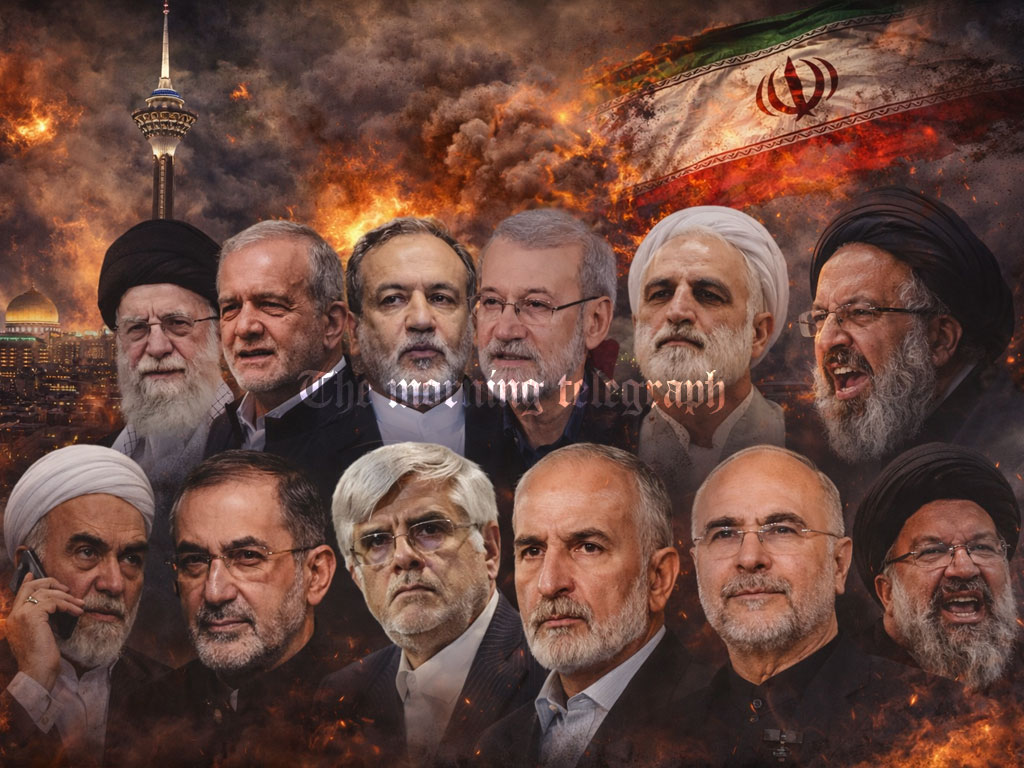
With Supreme Leader Ayatollah Ali Khamenei killed in a massive US-Israeli strike, Iran faces a pivotal power transition inside a tightly controlled Islamic system where elections exist, but ultimate authority rests with unelected clerical institutions.
The reported American and Israeli assault last Saturday marked a historic rupture in Iran’s political order. The attack killed 86-year-old Supreme Leader Ayatollah Ali Khamenei, along with Defense Minister Aziz Nasserzadeh, Army Chief of Staff General Abdolrahim Mousavi, and several senior military commanders. In the immediate aftermath, US President Donald Trump urged the Iranian public to reclaim their future from the Islamic leadership that has governed the country since the 1979 revolution.

Khamenei had served as Iran’s Supreme Leader since 1989, succeeding Ruhollah Khomeini. As commander-in-chief of the armed forces and ultimate authority on national policy and religious doctrine, he held decisive power over security, judiciary, foreign affairs, and intelligence structures. With his death, speculation has intensified around succession. Mojtaba Khamenei, his second-oldest son and a mid-level cleric closely aligned with the Islamic Revolutionary Guard Corps, is widely viewed as a leading contender to inherit the position.
Iran’s political system blends elected offices with deeply entrenched clerical oversight. The country operates as an Islamic republic where formal democratic processes coexist with strict ideological supervision. President Massoud Pesekhian, a reformist and former heart surgeon, assumed office on July 28, 2024. He works alongside First Vice President Mohammad Reza Aref. The president is elected to a four-year term, with a runoff required if no candidate secures more than half the vote in the first round. Foreign policy is directed by Foreign Minister Abbas Araghchi, known internationally for his role in negotiating the 2015 nuclear agreement.
Legislative authority lies with the 290-member Islamic Consultative Assembly, commonly known as parliament. Its current speaker, conservative figure Mohammad Bagher Qalibaf, was re-elected on May 27, 2025. The judiciary is overseen by Chief Justice Gholam Hossein Mohsenei, a hardline cleric associated with the Islamic Revolution’s legal doctrine. Beyond these visible institutions, policymaking is shaped by influential advisers including Ali Larijani on state strategy, Ali Akbar Velayati on international affairs, Kamal Qarazi on foreign policy direction, and Mohammad Golpayeghani, who served as Khamenei’s chief of staff.
Yet the most powerful institutional gatekeeper is the Guardian Council. This 12-member body, headed by Ahmad Jannati, consists of six clerics appointed by the Supreme Leader and six legal scholars approved by parliament. Figures such as Tehran Friday prayer leader Ahmad Khatami represent its conservative core. The Guardian Council vets every candidate for president, parliament, local government, and the Assembly of Experts. It also reviews legislation and can veto bills that conflict with Islamic law or constitutional principles. Critics argue that this vetting mechanism limits political pluralism, disqualifying reformist candidates and contributing to low voter turnout, particularly during the 2024 elections following President Raisi’s death.
With Khamenei gone, the constitutional responsibility for selecting a new Supreme Leader falls to the Assembly of Experts, currently chaired by Mohammad-Ali Movaheddi Kermani. This 88-member body of Islamic jurists functions somewhat like a conclave. Although its members are elected for eight-year terms, they too must first pass Guardian Council scrutiny before standing for office. The Ministry of Interior administers elections nationwide, but oversight mechanisms remain firmly anchored in clerical authority.
The selection of a new Supreme Leader will determine not only religious leadership but also control over Iran’s military, intelligence, and foreign policy trajectory. The Revolutionary Guard Corps, a dominant force in both security and economic spheres, is expected to play a significant role in shaping consensus around succession. Stability within the clerical establishment will be critical in preventing factional fragmentation.
Administratively, Iran maintains a four-tier governance structure designed to balance central oversight with local administration. The country is divided into 31 provinces, each led by a governor appointed by the Ministry of Interior. These provinces are further subdivided into hundreds of counties centered on major cities, which are managed by regional governors. Beneath them are districts encompassing urban and rural communities, and finally thousands of rural districts and independent municipalities.
While provincial and district administrators are generally appointed, city and village councils have been directly elected every four years since 1999. These local councils manage municipal affairs and community development. However, strategic authority remains centralized, particularly in matters of national security, judiciary oversight, and foreign relations.
Iran’s system therefore presents a dual reality. On paper, elections, parliament, and a presidency create the appearance of participatory governance. In practice, clerical oversight bodies such as the Guardian Council and the Assembly of Experts hold decisive leverage. The death of Ali Khamenei introduces uncertainty into this carefully calibrated structure.
Whether succession consolidates hardline authority or opens limited space for reform will shape Iran’s domestic trajectory and its relations with the United States, Israel, and Gulf Arab states. For now, the Islamic Republic stands at a defining crossroads, balancing electoral mechanisms with entrenched religious power in a region already marked by geopolitical tension and strategic recalibration.