A sharp reflection on Sri Lanka’s protest politics, elite power networks, and the widening gap between political promises and lived reality.
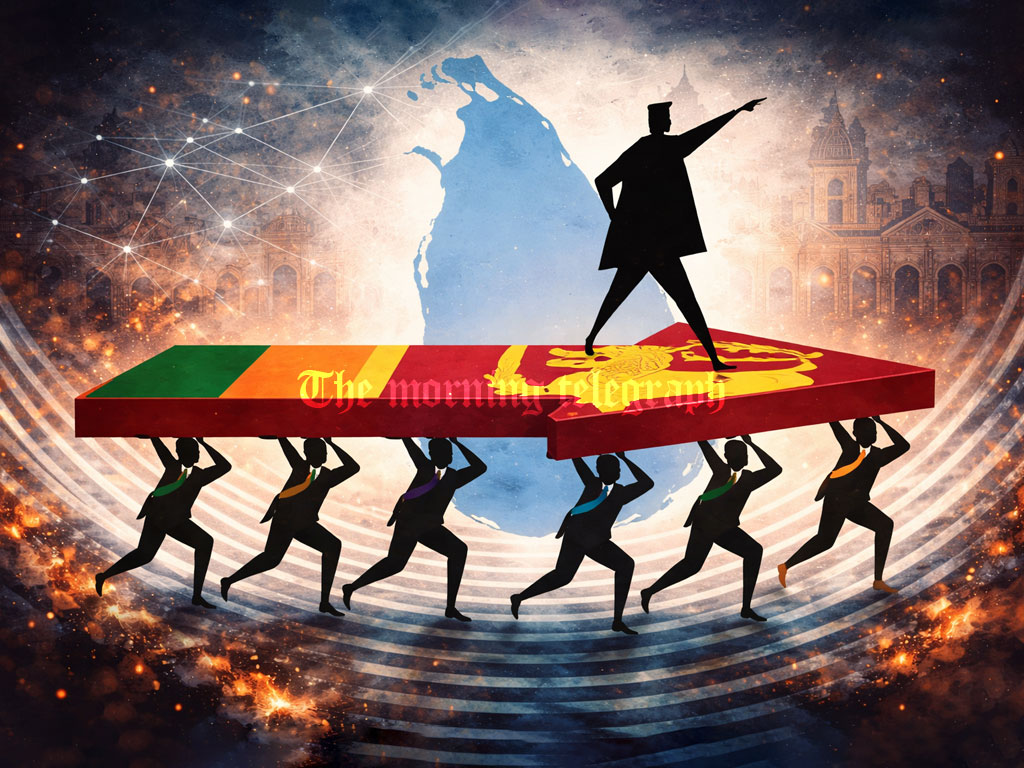
In Sri Lanka, the distance between the protest stage and the government stage is remarkably short. At times it is so narrow that the same figures move between both arenas with little more than a change in tone and posture. When seated in opposition, the script demands anger, urgency, and the language of resistance. Once elevated to power, the mood softens. The rhetoric fades. In its place emerges a quieter political drama of handshakes, familiar alliances, and relationships that appear older than the protests that once denounced them.

This is not the conventional narrative of politicians defeating rivals in open confrontation. Such a story would at least imply decisive conflict. What Sri Lanka increasingly witnesses is more layered. Public political battles unfold before cameras and cheering crowds, while private understandings often continue behind closed doors. The contest that dominates headlines is not always the contest that determines policy outcomes or governance direction.
Sri Lankan political culture has long displayed mastery of this dual performance. The public arena resounds with speeches about corruption, justice, accountability, economic reform, and solidarity with ordinary citizens. Rallies swell. Slogans echo across streets. Leaders present themselves as champions of reform and symbols of change. Yet once those leaders step into office, the faces most comfortably positioned near power are rarely the activists, workers, or grassroots supporters who filled the squares. Instead, experienced administrators, corporate stakeholders, and long connected insiders navigate the corridors of authority with practiced ease.
This dynamic raises an uncomfortable but necessary question. Were these alliances formed overnight after electoral victory, or were they quietly sustained long before the public drama reached its peak? While voters absorb the spectacle of protest politics and campaign promises, deeper networks of influence may already be shaping the eventual distribution of power.
In Sri Lanka, opposition politics often functions less as rupture and more as rehearsal. It builds narratives, mobilizes public emotion, and constructs legitimacy. It sharpens critique and channels frustration toward those in office. However, once authority is secured, governance frequently leans on the same institutional frameworks and elite networks that existed prior to the transition. New ministers may replace old ones. Cabinets may shift. Yet the underlying architecture of political influence remains resilient and remarkably consistent.
This helps explain why each election is framed as historic and every victory marketed as transformative. Campaign messaging emphasizes renewal, reform, and a decisive break from the past. But for many citizens, daily life remains largely unchanged. Economic hardship persists. Cost of living pressures continue. Institutional culture adapts slowly, if at all. The promise that this time will be different begins to resemble a familiar ritual repeated every five years, rather than a credible roadmap for structural reform.
None of this pattern belongs to a single party, ideology, or personality. It reflects a systemic feature of Sri Lanka’s governance ecosystem. Governments change, but elites often rotate within a shared network of influence. Politicians who speak most forcefully outside the system may govern most cautiously once inside it. Constraints arise not only from fiscal realities or geopolitical pressures, but from alliances that were never entirely severed.
The deeper tragedy is not political evolution itself. Adaptation is natural in governance and sometimes necessary. The real concern is the widening gap between political storytelling and political practice. Citizens are encouraged to believe they are central actors in a democratic transformation. Yet when critical policy decisions unfold, many find themselves reduced to spectators rather than participants.
Sri Lanka thus continues its familiar cycle. The rallies ignite hope. Transitions unfold with high drama. Expectations climb. But when the dust settles, the stage appears strikingly similar, occupied by figures who seem long accustomed to their roles.
Perhaps the challenge facing the country is not merely selecting new leaders. It is cultivating a political culture where public performance aligns with private action, and where power does not quietly return to the same hands once applause fades.