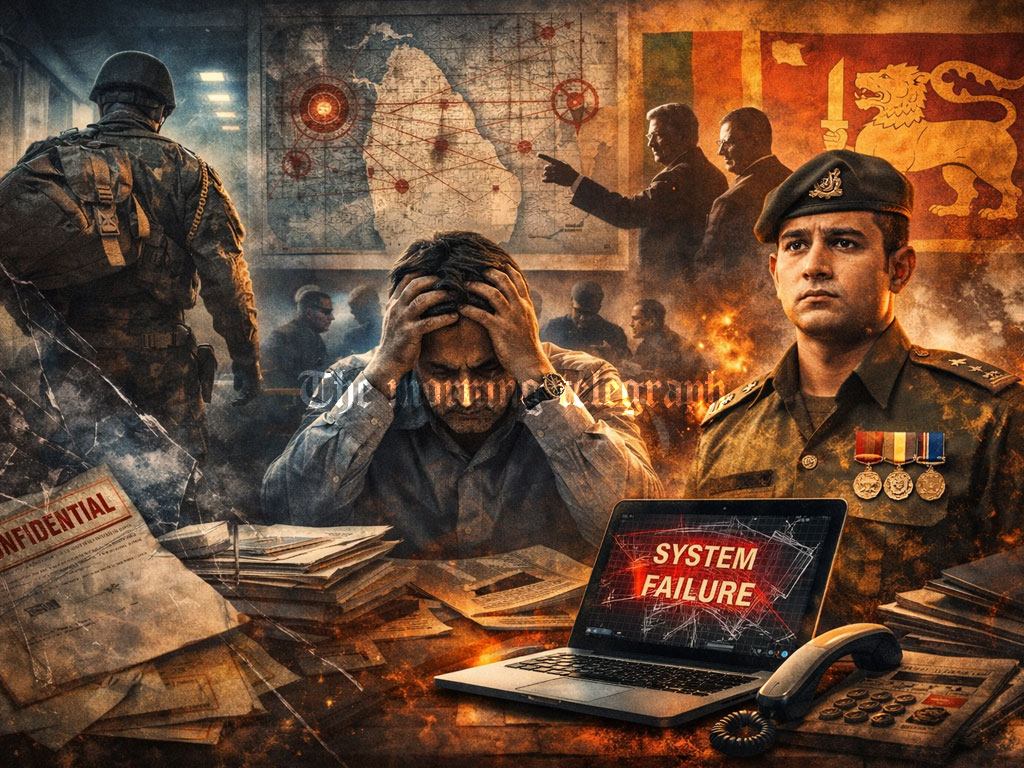
A sweeping political overhaul inside Sri Lanka’s Military Intelligence Corps is dismantling decades of hard-earned expertise, raising urgent questions about national security, institutional integrity, and the future of intelligence leadership.
The Military Intelligence Corps of Sri Lanka, also known as the Directorate of Military Intelligence, has long stood as one of the most critical pillars of the country’s national security architecture. Established in 1990, the Corps represented a decisive evolution in Sri Lanka’s ability to confront insurgency, internal security threats, and clandestine operations. Its emergence strengthened the state’s strategic depth during one of the most turbulent periods in the nation’s history. During the protracted civil war against the LTTE, the Military Intelligence Corps became a central force in operational planning, battlefield coordination, and high-level strategic decision making. Through expertise in human intelligence, signals intelligence, and counter-intelligence operations, the Corps enabled the armed forces to achieve operational superiority over one of the most sophisticated insurgent organisations in the world at that time.

Years of operating under extreme pressure shaped the institution into a resilient and disciplined intelligence body. The assassinations of senior officers, infiltration attempts by hostile actors, and constant exposure to high-risk missions forged a culture of vigilance and adaptability. The doctrines, training systems, and operational discipline refined during those conflict years evolved into institutional knowledge. This knowledge safeguarded national interests and laid a strong foundation for post-war intelligence operations. The Corps developed into a professional security institution whose internal credibility and operational reliability were widely acknowledged within the national security framework.
Following the end of hostilities in 2009, the Military Intelligence Corps entered a period of structural stabilisation. The transition from wartime operations to peacetime security priorities shifted focus toward intelligence collection, inter-agency coordination, and the gradual integration of advanced technological capabilities. Infrastructure was modernised, particularly at the regimental centre in Karandeniya, where dedicated facilities for intelligence analysis, operational planning, and inter-service training were established. Training programmes were formalised, professional development was emphasised, and systems were created to ensure that intelligence gathering remained systematic, evidence-based, and effective.
During this period, the Corps maintained a careful balance between operational readiness and institutional integrity. Senior officers who had completed the Intelligence Staff Course and demonstrated operational competence formed the backbone of the organisation. Their decades of experience ensured continuity, professionalism, and credibility. Institutional memory was preserved, and intelligence expertise was deployed efficiently across the broader military and security apparatus. The Corps was not merely a tactical entity but a strategic institution grounded in discipline, merit-based promotion, and national service.
However, this long-standing institutional strength now faces what many observers describe as one of the most severe internal crises in its history. The political transition following the 2024 presidential election, which brought the NPP and JVP alliance into office, initiated a sweeping restructuring of the Military Intelligence Corps. This transformation has been unprecedented in both scale and consequence. Officers with specialised intelligence training and decades of professional experience have been transferred out of the Corps and reassigned to roles that bear little relation to their expertise. The magnitude of these changes exceeds previous restructurings that followed earlier political transitions.
The restructuring has not been limited to administrative adjustments. It has introduced mechanisms that effectively subordinate the intelligence core not only to the executive branch but also to political party structures. Such developments represent a fundamental shift in how intelligence authority is exercised. Critics argue that this shift risks politicising intelligence operations and weakening institutional independence, a cornerstone of effective national security governance.
At the centre of the controversy is the officer currently serving as Colonel Commandant of the Military Intelligence Corps, who is poised to ascend to the position of Director of Military Intelligence. Concerns have been raised regarding his qualifications and professional background. Despite allegations, disciplinary proceedings, and questions about prior conduct, he has reportedly benefited from political patronage. Observers point to previous assignments in Trincomalee, Mullaitivu, and Kaluwaggala, where accusations of misconduct, misuse of state resources, and failure to adhere to professional standards were documented. Although disciplinary inquiries remain unresolved, his career trajectory has advanced rapidly.
Reports suggest that personal and political connections have facilitated this rise. Family ties to influential members of the ruling party have been cited as a decisive factor. Critics argue that the absence of formal intelligence training, completion of the Intelligence Staff Course, and operational commendations should have disqualified such advancement under established norms. The situation has sparked concerns that merit-based criteria are being overridden by political considerations.
Simultaneously, appointments at the highest levels of the Military Intelligence Corps and the broader national intelligence structure reveal a pattern of prioritising political alignment over professional competence. Major General A.H.A.D. Ariyasena, appointed as head of the Military Intelligence Corps, comes from the Mechanised Infantry Regiment and lacks a traditional intelligence background. His tenure has coincided with the reassignment of numerous senior intelligence officers, thereby consolidating authority in ways that critics view as politically motivated.
Similarly, the position of Chief of National Intelligence is now held by Major General Nalinda Niyangoda, who also does not possess prior intelligence experience. Observers note that his spouse’s involvement in political activities aligned with the ruling party further complicates perceptions of institutional neutrality. Collectively, these appointments have weakened the institutional knowledge base and operational cohesion that are essential for effective intelligence operations.
The reassignment of senior officers has been extensive and highly visible. Maj. Gen. T.T.P. Siriwardena, one of the most senior and decorated officers within the Corps, was transferred to the Southern Campus of Kotelawala Defence University and later attached to Army Headquarters without a defined operational mandate. Other brigadiers with proven intelligence expertise were reassigned to rehabilitation roles, administrative divisions, hospitality management, and cultural oversight functions. These moves have effectively removed experienced intelligence professionals from positions that directly influence operational capability.
Such systematic redeployments signal a restructuring that many interpret as clearing space for politically favoured leadership. Intelligence institutions depend heavily on continuity, expertise, and accumulated field knowledge. Removing seasoned officers disrupts institutional memory and reduces strategic depth. The resulting vacuum may compromise counter-intelligence operations, threat assessments, and regional security monitoring.
Institutional safeguards have also reportedly been weakened. The Redress of Grievance procedure, designed to ensure accountability through formal oversight structures, has allegedly been bypassed. Letters of grievance have been routed outside the established chain of command. Such deviations from protocol highlight concerns that political influence is superseding operational norms. When oversight mechanisms are diluted, institutional checks and balances erode, increasing the risk of administrative abuse and reduced transparency.
The operational and ethical consequences of these developments are far-reaching. Military intelligence is not merely a bureaucratic entity but a strategic instrument of statecraft. It relies on specialised training, discipline, and adherence to professional standards. Elevating unqualified individuals while sidelining experienced officers risks undermining both tactical precision and strategic foresight. Intelligence failures often emerge gradually, through weakened processes rather than dramatic breakdowns.
Regional security dynamics further intensify these risks. South Asia and the broader Indian Ocean region face complex security challenges, including transnational crime, maritime threats, cyber warfare, and geopolitical competition. In such an environment, institutional competence within military intelligence is critical. Any erosion of capability could expose vulnerabilities that adversaries may exploit.
The succession dynamics within the Corps add another layer of uncertainty. With Major General Ariyasena scheduled to retire in March 2026 and the Army Commander’s tenure extension nearing expiration, leadership transitions are imminent. Reports indicate that the anticipated successor has not completed certain professional requirements traditionally associated with intelligence leadership. Questions regarding physical training benchmarks, international exposure, and operational commendations have amplified concerns about precedent being disregarded.
Leadership within the Military Intelligence Corps has historically been contingent upon demonstrated operational competence and professional education. Departing from these standards represents a historic deviation. Such deviations may affect morale within the ranks. Officers who dedicated decades to intelligence service may perceive the restructuring as a signal that professional merit is no longer the primary determinant of advancement.
The broader ramifications extend beyond individual careers. Intelligence credibility influences inter-agency cooperation, international partnerships, and diplomatic trust. When political interference becomes visible, foreign intelligence counterparts may reassess collaboration frameworks. Trust, once diminished, is difficult to restore. Institutional integrity is a strategic asset that underpins national security cooperation.
Morale within the Corps may also be affected. Experienced officers reassigned to unrelated duties may feel marginalised, reducing motivation and weakening cohesion. Institutional cohesion is vital for coordinated intelligence analysis and rapid response. Disruptions to this cohesion can slow decision-making and reduce operational agility.
Historically, the Military Intelligence Corps demonstrated resilience in the face of severe adversity. It endured targeted assassinations, infiltration attempts, and sustained wartime pressures. Those crises tested operational strength but ultimately reinforced institutional solidarity. The current challenge differs fundamentally. It is rooted not in external threat but in internal restructuring driven by political transformation.
Where previous crises demanded tactical adaptation, the present situation tests institutional autonomy. The systematic removal of experienced officers, elevation of politically aligned individuals, and weakening of procedural safeguards collectively create structural vulnerabilities. Over time, such vulnerabilities may diminish the Corps’ ability to anticipate emerging threats and respond effectively.
Long-term consequences may include erosion of inter-agency trust, diminished analytical depth, and increased susceptibility to both internal and external security challenges. National security institutions function best when insulated from partisan politics. Safeguarding institutional integrity ensures continuity across political cycles.
Sri Lanka’s security landscape remains complex and fluid. Maritime security in the Indian Ocean, cyber intelligence, regional geopolitical shifts, and domestic stability all require a robust intelligence apparatus. The Military Intelligence Corps historically fulfilled that role with professionalism and discipline. Preserving those standards is essential for sustaining operational effectiveness.
The unfolding restructuring has therefore become more than an administrative reform. It represents a pivotal moment in the evolution of Sri Lanka’s military intelligence framework. Whether the institution can retain its professional core while navigating political transition will determine its trajectory in the years ahead. The stakes extend beyond internal personnel decisions. They encompass the credibility of national security governance and the resilience of intelligence capability in an increasingly volatile regional environment.