As Suresh Sallay’s arrest reignites Easter Sunday tensions, an old Court of Appeal petition by Vijitha Herath resurfaces, exposing unanswered questions about K.P., political narratives, and the fragile line between law and power in Sri Lanka.
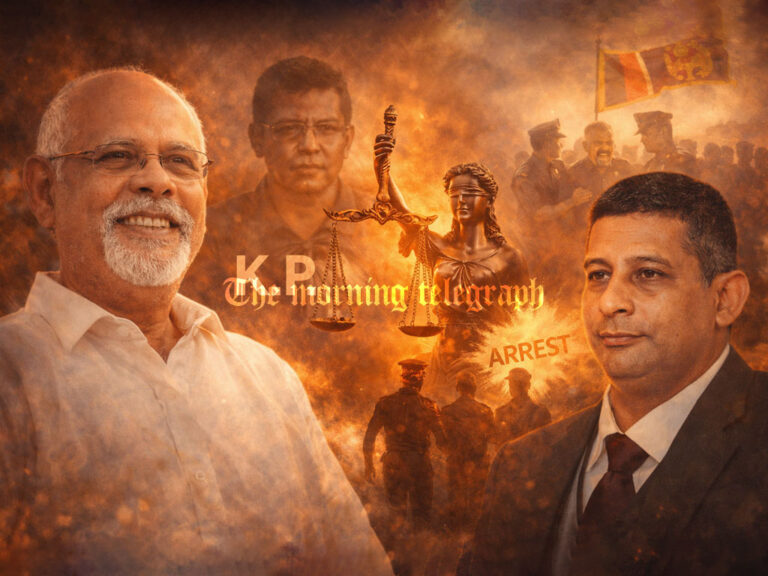
The arrest of retired Major General Suresh Sallay has reopened old wounds in Sri Lanka’s political and security landscape, reviving memories of the Easter Sunday attacks and triggering fierce debate across party lines. Yet buried beneath the loud political rhetoric is an older legal episode that now demands renewed attention. That episode concerns a 2015 petition filed before the Court of Appeal by then Member of Parliament Vijitha Herath, questioning why Kumaran Pathmanathan, widely known as K.P., had never been brought to trial despite his alleged role in financing and procuring weapons for the LTTE.

The resurfacing of that petition has complicated the narrative advanced by those who portray Sallay as a decisive figure in dismantling the LTTE’s international network. For years, supporters have highlighted his alleged role in the arrest of K.P. in Malaysia and his supposed efforts to suppress the remnants of the insurgency. However, the legal reality tells a different story. In 2015, Herath sought a mandamus order compelling authorities to initiate legal proceedings against K.P., arguing that the failure to prosecute him undermined national security and justice. The Attorney General’s Department responded by informing the Court of Appeal that there was insufficient evidence to file charges. In 2017, the petition was dismissed on those grounds.
This legal outcome stands in stark contrast to the current political arguments being made in defense of Sallay. Following his arrest by the Criminal Investigation Department in connection with the Easter Sunday bombings, supporters aligned with the Sri Lanka Podujana Peramuna have framed him as a patriot unfairly targeted. They argue that he rendered invaluable service during the military campaign against the LTTE and that his arrest insults those sacrifices. Some go further, alleging that elements of the Tamil diaspora influenced the move as retaliation for his alleged role in capturing K.P.
These claims, however emotionally charged, remain political statements. The arrest itself is a legal matter that must be examined within the framework of evidence and judicial procedure. It cannot be resolved through partisan slogans or historical mythmaking. The contradiction becomes evident when one considers that if the arrest of K.P. was such a landmark achievement in safeguarding the state, why did no prosecution follow during the tenure of former President Mahinda Rajapaksa? The 2015 petition directly confronted that question, yet it ended with the Attorney General asserting a lack of evidence.
The controversy surrounding Sallay’s arrest has grown steadily. Critics allege that the move is politically motivated, designed either to deflect attention from domestic economic scandals such as alleged coal import irregularities or to signal to Catholic voters that progress is being made on the Easter Sunday investigation as another anniversary approaches. Others suggest that the arrest is part of a broader attempt by the National People’s Power government to demonstrate that it is fulfilling its election promises regarding accountability for the 2019 attacks.
In assessing these claims, it is crucial to separate legal processes from political speculation. The Easter Sunday bombings of April 21, 2019, in which approximately 270 people were killed, remain one of the darkest chapters in Sri Lanka’s post war history. Investigations have been marked by competing narratives, institutional mistrust, and allegations of intelligence failures. The arrest of a former intelligence chief inevitably carries enormous symbolic weight. Yet symbolism cannot replace due process.
The National People’s Power administration has faced considerable pressure to produce tangible progress in the investigation. During a public meeting in Deiyandara in March of the previous year, President Anura Kumara Dissanayake promised a new revelation before April 21. Opposition figures later accused him of pledging to expose the mastermind of the attacks by that date, a claim that remains contested. In practice, investigators were unable to deliver a breakthrough within the timeline suggested.
Parallel developments have further complicated the picture. Sivanesathurai Chandrakanthan, widely known as Pillayan and a former Chief Minister of the Eastern Province, was arrested in connection with an earlier disappearance case. Subsequent parliamentary statements by Public Security Minister Ananda Wijepala suggested that investigations indicated Pillayan had prior knowledge of the Easter Sunday attacks. The Minister also referenced the arrest of an intelligence officer linked to the killing of two police officers in Vavuniya in November 2018, months before the bombings.
The narrative expanded when a British television documentary aired allegations by Hansir Azad Maulana, a former coordinating secretary to Pillayan. Maulana claimed that he had organized a meeting in January 2018 involving Zahran Hashim and Sallay, and alleged that Sallay had spoken about creating insecurity in the country to influence the upcoming presidential election. According to Maulana, the National Thowheed Jamaat, with alleged support from intelligence elements, planned the Easter attacks as part of a broader political strategy.
These allegations created a national uproar. Former President Ranil Wickremesinghe appointed a three member committee headed by retired Supreme Court Justice S.I. Imam to investigate the claims. The committee concluded that Maulana’s statement lacked credibility. Sallay himself maintained that he was serving at the Sri Lankan High Commission in Malaysia on the date in question and invited verification through passport records. The documentary’s producers later acknowledged that they had no evidence beyond Maulana’s testimony.
Despite these findings, the issue did not fade. After the 2024 presidential election, the renewed focus on Easter Sunday investigations led the CID to record fresh statements from Pillayan. His subsequent arrest in April added another layer to the unfolding drama. Within this context, Sallay’s arrest appears as part of a broader reexamination of unresolved threads from the 2019 tragedy.
Yet even at the press conference announcing his arrest, authorities refrained from presenting detailed charges. Officials indicated that disclosing specifics might hinder ongoing investigations. This restraint has fueled both suspicion and speculation. Supporters see a lack of transparency as evidence of weakness in the case, while critics argue that premature disclosure could compromise sensitive intelligence inquiries.
Returning to the earlier K.P. petition, its dismissal in 2017 now stands as a reminder of the limits of political rhetoric. If there was insufficient evidence to prosecute K.P. despite allegations of decades long involvement in weapons procurement, what does that say about the evidentiary thresholds required in complex national security cases? The petition sought judicial intervention precisely because of perceived inaction. The Court of Appeal’s decision underscored that legal standards cannot be bypassed for symbolic satisfaction.
The Podujana Peramuna has been accused since mid 2020 of benefiting politically from the climate of fear following the Easter Sunday attacks. Some opposition figures argued that those who gained electoral advantage from the tragedy should be scrutinized. However, such arguments were often framed in general terms without naming specific individuals. It was Maulana’s allegations that directly linked individuals to a conspiracy narrative, though those claims were subsequently questioned by official inquiries.
The current moment thus represents a critical juncture. Whether the arrest of Sallay ultimately leads to prosecution or exoneration, it will test the credibility of investigative institutions. The government has little room for retreat. If investigators substantiate their suspicions with compelling evidence, the administration could emerge strengthened, having demonstrated commitment to accountability. If the case collapses for lack of proof, the political consequences could be severe.
For the public, the overlapping narratives of Sallay, K.P., Pillayan, and the Easter Sunday investigation illustrate the complex intersection of intelligence operations, political power, and judicial process. The 2015 petition by Vijitha Herath is not merely a historical footnote. It highlights an enduring question about how Sri Lanka handles allegations of grave national security offenses. It also reminds observers that the absence of prosecution does not necessarily equate to vindication, nor does arrest equate to guilt.
As proceedings unfold, the courts will once again serve as the arena where competing claims must be tested against evidence. The rule of law demands nothing less. The Easter Sunday victims and their families deserve clarity grounded in fact rather than partisan narrative. The country’s democratic institutions depend on the integrity of that process.
In the end, the fate of Suresh Sallay will not be determined by propaganda, social media campaigns, or political loyalty. It will hinge on whether investigators can present credible, admissible evidence linking him to criminal wrongdoing. Likewise, the unresolved legacy of K.P.’s non prosecution continues to echo as a cautionary tale about the gap between public expectation and prosecutorial reality.
Sri Lanka now stands at a decisive moment. The outcome of this legal saga will shape not only the reputations of individuals but also public confidence in the justice system itself. The stakes are immense. There is no easy exit from this path. Whether it leads to accountability or disillusionment will define the next chapter in the nation’s ongoing struggle to reconcile security, politics, and the rule of law.