By Marlon Dale Ferreira
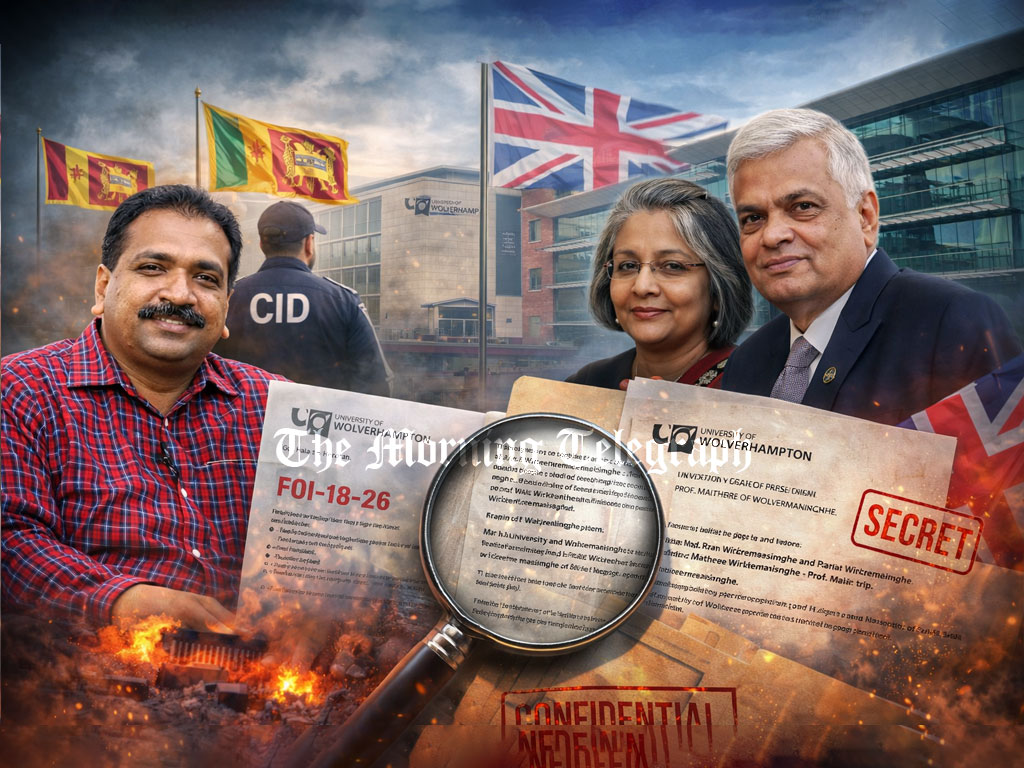
A remarkable episode has unfolded in Sri Lanka’s ongoing debate about transparency and public accountability, after independent activist Oshala Herath succeeded in obtaining official information from the University of Wolverhampton regarding the controversial September 2023 visit by former Sri Lankan President Ranil Wickremesinghe to the United Kingdom, something the Criminal Investigation Department of Sri Lanka reportedly failed to do despite dispatching officers overseas at significant cost to the taxpayer.
Who Is Oshala Herath?
Oshala Herath is known in Sri Lanka as a civil society activist and public accountability campaigner who has frequently used legal mechanisms and public information laws to scrutinise government decisions and public expenditure. Rather than relying on political influence or state resources, Herath has often pursued information through documentary evidence and formal requests under transparency laws.

The Controversial UK Visit
The controversy stems from the visit made by Ranil Wickremesinghe to the UK in September 2023, when he attended a graduation ceremony at the University of Wolverhampton where his wife, Maithree Wickramasinghe, was recognised during the university’s graduation events.
At the time, several media reports suggested that the visit involved high-level engagements between the Sri Lankan President and university leadership, potentially including discussions on academic cooperation, student exchanges and research collaboration.
However, questions soon arose over whether the trip was an official diplomatic engagement undertaken in his capacity as Sri Lanka’s Head of State or a personal visit connected to his spouse’s recognition.
CID’s Expensive Overseas Investigation
Amid the controversy, Sri Lanka’s Criminal Investigation Department reportedly sent officers to the United Kingdom to obtain clarification regarding the circumstances of the visit.
Critics have argued that the mission imposed a substantial financial burden on taxpayers, covering travel, accommodation and operational costs for investigators sent overseas.
Yet despite this expenditure, the CID reportedly returned to Sri Lanka without securing clear documentary confirmation regarding several key aspects of the visit.
Oshala Herath’s FOI Requests
While the CID struggled to obtain answers through an expensive overseas mission, Oshala Herath pursued a far simpler route.
On 30 January 2026, Herath submitted two formal requests under the UK Freedom of Information Act 2000 to the University of Wolverhampton seeking clarification regarding the nature of the invitation extended to Ranil Wickremesinghe.
The requests asked the university to confirm several critical points:
- Whether a letter dated 1 September 2023, signed by Vice-Chancellor Professor John Raftery, inviting Ranil Wickremesinghe and Maithree Wickramasinghe to a graduation luncheon on 22 September 2023 was authentic.
- Whether the invitation was extended to Wickremesinghe in his official capacity as President of Sri Lanka or in a personal capacity as the spouse of the honorary award recipient.
- Whether the invitation was communicated through the Sri Lankan High Commission in London, which is standard diplomatic protocol for official visits.
- Whether Wickremesinghe attended as a special guest of the university or simply as a family member accompanying the honouree.
- Whether the university had conferred an Honorary Professorship upon Maithree Wickramasinghe during the September 2023 graduation period.
University Response
The University of Wolverhampton responded on 27 February 2026, with Information Rights Manager Sophie Esson confirming that the information requested by Herath was held in full by the university and would be disclosed.
The response was issued through two formal decision notices:
- FOI-18-26 – relating to authentication of the invitation letter.
- FOI-19-26 – relating to the nature of the invitation and claims of official engagements.
Both responses confirmed that the requested information existed within the university’s records and could be released under the Freedom of Information Act.
Questions Raised by the Correspondence
The questions posed by Herath reveal why the issue has generated controversy in Sri Lanka.
The key issue is whether the visit was:
- An official presidential engagement, potentially involving diplomatic discussions and institutional cooperation between Sri Lanka and the University of Wolverhampton.
or
- A personal visit, where the President attended primarily as the spouse of an award recipient during a graduation ceremony.
The distinction is significant because official visits normally require diplomatic coordination through the Sri Lankan High Commission and often involve official meetings, agendas and documented outcomes.
Herath’s second FOI request specifically asked the university to confirm whether any formal meeting minutes, agendas or Memorandums of Understanding (MoUs) existed for the purported discussions mentioned in media reports.
A Stark Contrast
What makes the episode particularly striking is the contrast between two approaches.
The CID deployed investigators overseas at public expense in an attempt to gather information about the visit.
Oshala Herath, by contrast, obtained official documentation simply by submitting two formal Freedom of Information requests online—without spending a single rupee of taxpayer money.
Legal and Accountability Implications
The incident raises broader questions about government transparency, investigative efficiency and the use of public funds.
If the relevant information could be obtained through formal information requests within weeks, critics argue that sending investigators abroad may have been unnecessary and wasteful.
It also highlights the growing power of Freedom of Information laws and public accountability mechanisms in exposing facts that might otherwise remain buried in bureaucratic processes.
A Lesson in Transparency
Whether the Wolverhampton visit was ultimately official or personal, one fact now stands out clearly.
An individual citizen armed with the right legal tools managed to obtain answers that a state investigative agency—despite significant expenditure—failed to secure.
In a country where public trust in institutions has been repeatedly tested, the episode serves as a powerful reminder that transparency sometimes depends less on authority and more on persistence.