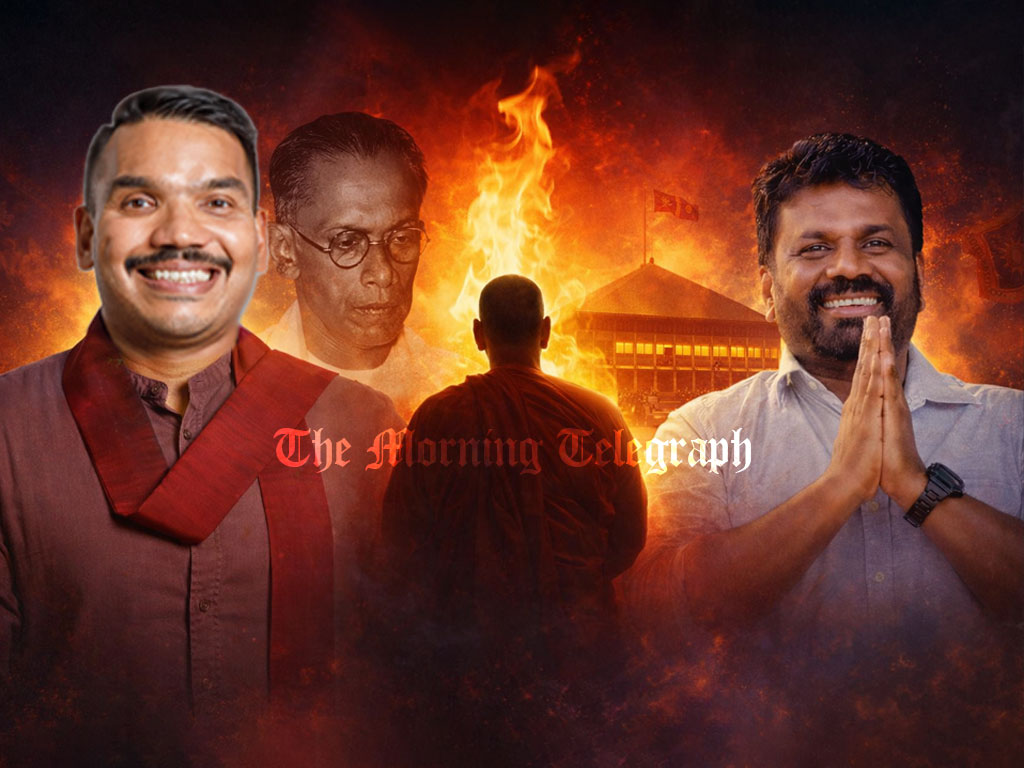
A deep political review reveals how Sinhala Buddhist majoritarianism, once the most powerful electoral force in Sri Lanka, is rapidly losing relevance as voters grow weary of racial politics and demand a new political direction.
The rallying cry of Sinhala Buddhist nationalism has echoed across Sri Lanka’s political landscape for decades. It has functioned as both slogan and strategy, shaping electoral outcomes and defining political identities since the early years after independence. Few political movements in Sri Lanka’s modern history have carried the same emotional force or political utility. Yet today, many observers question whether that once dominant formula has run out of momentum. The country’s political environment appears to be changing, and the same narrative that once guaranteed electoral success may now struggle to resonate with a more politically aware electorate.

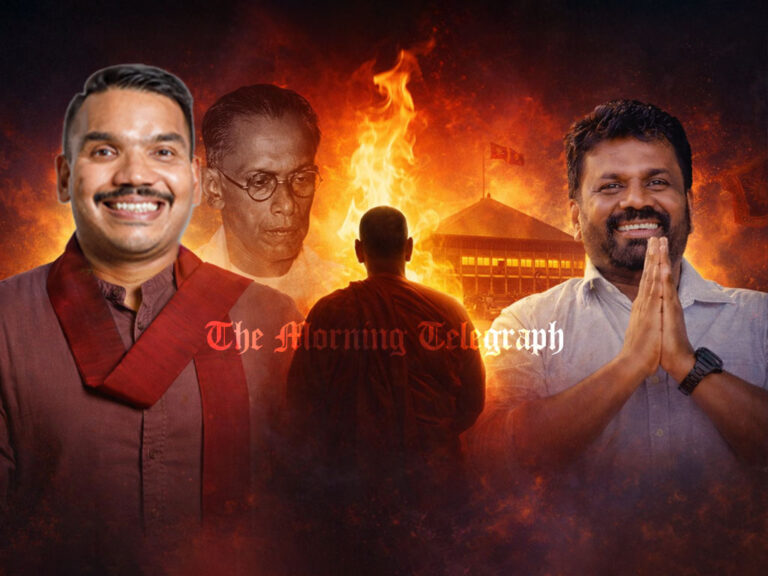
The roots of Sinhala Buddhist majoritarian politics stretch back to the historic election of 1956. It was S.W.R.D. Bandaranaike who first harnessed the idea with decisive effect, presenting himself as the champion of the Sinhala Buddhist majority. That campaign propelled his newly formed Sri Lanka Freedom Party into power and reduced the long dominant United National Party to a small parliamentary presence. The electoral earthquake of 1956 reshaped Sri Lankan politics overnight and demonstrated the powerful emotional appeal of identity based political messaging. Ironically, the story carried a tragic turn. Just three years after his sweeping victory, Bandaranaike was assassinated by a Buddhist monk, an event that shocked the nation and introduced a deep irony into the history of Sinhala Buddhist politics.
In the years that followed, Bandaranaike’s political legacy continued through his widow Sirimavo Bandaranaike and the Sri Lanka Freedom Party. The party largely maintained a pro majority political stance, reinforcing policies that were widely perceived as favoring the Sinhala Buddhist electorate. One of the most controversial examples was the introduction of the district based university admission system. Supporters argued that it created educational opportunities for rural students who had historically been disadvantaged. Critics, particularly within the Tamil community, viewed it as discriminatory and as a policy that further deepened ethnic divisions. The consequences were profound. Many Tamils who had the means to leave the country migrated abroad. Others turned toward militant politics. Those developments eventually contributed to the long and devastating ethnic conflict that followed.
A different direction emerged during the presidency of Chandrika Bandaranaike Kumaratunga, the daughter of S.W.R.D. and Sirimavo Bandaranaike. Kumaratunga attempted to reposition the Sri Lanka Freedom Party as a more inclusive political force. With the support of figures such as Mangala Samaraweera, she tried to promote a vision of national reconciliation that extended beyond ethnic identity politics. One of the most striking moments of that period came when Kumaratunga considered appointing Lakshman Kadirgamar as Sri Lanka’s first Tamil Prime Minister. That proposal, however, never materialized. Strong protests from sections of the Buddhist clergy and political maneuvering by Mahinda Rajapaksa forced Kumaratunga to abandon the plan. Rajapaksa soon rose to become Prime Minister and later President, and after the defeat of the Liberation Tigers of Tamil Eelam, the Sri Lanka Freedom Party returned to an assertive majoritarian political posture.
During Mahinda Rajapaksa’s presidency, a group of influential Buddhist monks became powerful allies within the political system. These religious figures publicly celebrated Rajapaksa as the leader who had defeated terrorism and preserved the unity of the nation. Rajapaksa’s leadership during the final phase of the civil war was widely acknowledged as decisive. Yet the political environment that developed afterward also carried serious consequences. Critics argue that the Rajapaksa family was granted enormous political power and influence, eventually shaping a system of governance marked by allegations of corruption, concentration of authority, and economic mismanagement. The financial crisis that erupted during Gotabaya Rajapaksa’s presidency in 2022 symbolized the ultimate collapse of that political model.
Throughout this period the United National Party maintained a reputation as the more moderate political force in Sri Lanka. Historically the party cultivated alliances with minority communities and projected a more pluralistic approach to governance. Ranil Wickremesinghe, despite facing numerous criticisms regarding economic policy and political strategy, was rarely accused of promoting ethnic polarization. In fact, he frequently became the target of nationalist attacks. Opponents accused him of betraying national interests and even alleged that he was sympathetic to the LTTE during the peace process years. Such accusations contributed to his defeat in the 2005 presidential election, demonstrating once again how powerful nationalist narratives could be during that period.
Election results over several decades reveal a clear pattern in Sri Lanka’s political geography. Tamil political parties consistently dominated voting in the Northern Province and parts of the Eastern Province. Meanwhile the southern regions of the country, with their overwhelming Sinhala Buddhist majority, largely determined the outcome of national elections. Political parties that embraced majoritarian messaging often performed strongly in those regions. Only a few elections broke this pattern, most notably the victories of Chandrika Kumaratunga in 1994 and the coalition that defeated Mahinda Rajapaksa in 2015. Rajapaksa himself famously lamented that his defeat in 2015 was due to the overwhelming support Maithripala Sirisena received from Tamil speaking areas.
The presidential and parliamentary elections of 2024 therefore represented an extraordinary shift in Sri Lanka’s political history. The National Peoples Power movement secured an overwhelming mandate, winning a two thirds majority and achieving electoral breakthroughs even in the Northern and Eastern provinces. For many observers the result reflected the powerful political energy unleashed by the Aragalaya protest movement. Citizens frustrated by economic collapse, corruption scandals, and political dynasties demanded a new political direction. President Anura Kumara Dissanayake repeatedly emphasized that the era of racial politics should come to an end and that Sri Lanka must move toward a more inclusive democratic framework.
Despite this shift, attempts to revive the old nationalist formula are already visible. Namal Rajapaksa and several of his political allies have begun invoking familiar themes about protecting Sinhala Buddhist identity. Their rhetoric suggests that the majority community faces threats under the current government. Several Buddhist monks who were prominent supporters of Mahinda Rajapaksa have joined these campaigns, presenting themselves as guardians of religion and culture. Among them are figures such as Balangoda Kassapa, who recently attracted controversy by installing a Buddha statue within a protected beach area in Trincomalee. The episode led to legal action and further intensified political debate.
Veteran monks including Muruttetuwe Ananda and Walawahengunuweve Dhammarathana have also contributed to the chorus of criticism directed at the government. Together they create a familiar narrative that echoes earlier decades of Sri Lankan politics. For Namal Rajapaksa the strategy appears clear. By invoking the language of religion and majority identity he hopes to mobilize a base of voters ahead of the presidential election expected in 2029. The message has changed little from the rhetoric used during his father’s political dominance.
What has surprised many political observers, however, is the response of the Samagi Jana Balavegaya and its leader Sajith Premadasa. Instead of presenting a distinct alternative vision, some members of the party appear to be echoing similar nationalist themes. The political calculation behind this strategy is difficult to understand. The Sinhala Buddhist nationalist vote is already largely associated with the Rajapaksa political brand. By competing for the same narrow audience, the opposition risks alienating moderate voters as well as minority communities who once formed an important component of the party’s support base.
There is increasing evidence that the political environment in Sri Lanka has changed significantly since the end of the civil war. During the years when the country faced an armed separatist conflict, nationalist rhetoric easily mobilized public sentiment. Today that context has largely disappeared. Many voters appear more concerned about economic stability, governance reforms, and corruption. The dramatic protest movement that forced the resignation of President Gotabaya Rajapaksa illustrated the depth of public frustration with traditional political elites.
Recent events also suggest that overtly nationalist campaigns no longer attract the same level of enthusiasm. In Trincomalee the protest organized by Balangoda Kassapa generated little national momentum. The event quickly faded from public attention. Such developments indicate that the electorate may have become more skeptical about political theatrics built around identity politics.
Another revealing episode occurred during a Sangha convention organized by Muruttetuwe Ananda. The gathering was promoted as a major mobilization of Buddhist clergy protesting alleged insults against Buddhism. Organizers predicted that ten thousand monks would attend. In reality fewer than five hundred monks appeared, a stark contrast to the dramatic expectations that had been announced. The modest turnout suggested that even within the Buddhist clergy there may be limited enthusiasm for overt political agitation.
The convention also produced an unexpected moment of controversy. One of the speakers, Kotapitiye Rahula, attempted to argue against sex education in schools. In doing so he made an inaccurate historical claim regarding Robert Knox describing train travel in Sri Lanka centuries ago. Historians quickly pointed out that railways did not exist during Knox’s time. The episode generated widespread mockery on social media and overshadowed the political message the convention had hoped to deliver.
Political symbolism continued to unfold through other events as well. Galagoda Aththe Gnanasara held a press briefing where he appealed publicly for financial donations, claiming that he lacked the funds to defend himself against critics. For a monk who once wielded enormous political influence during the Rajapaksa years, the request was striking. It suggested that the financial and political networks which once supported aggressive nationalist campaigns may have weakened considerably.
Another gathering that attracted attention was the elaborate birthday celebration of Pitiduwe Siridhamma of the Umandawa monastery. The monk, who now refers to himself as Samanthabhadra, is a controversial figure known both for entrepreneurial activities and for claiming spiritual attainment while living a highly luxurious lifestyle. His celebration drew a range of political personalities including former Presidents Mahinda Rajapaksa and Ranil Wickremesinghe. Discussions at the event reportedly centered on the possibility of opposition forces joining together to challenge the government in future elections.
Such developments indicate that the political battle lines for the next presidential election are already being drawn. Critics of the government are likely to frame their campaigns around allegations that the administration is undermining the interests of the majority community and the Buddhist religion. Whether those arguments will resonate with voters remains uncertain. The political landscape that existed during Mahinda Rajapaksa’s peak years may no longer exist in the same form.
Ranil Wickremesinghe’s role within this evolving dynamic is particularly intriguing. Throughout his long political career he rarely relied on ethnic nationalism as a campaign strategy. However, his current call for a broad opposition alliance against the National Peoples Power government raises new questions. If such an alliance includes political groups that promote majoritarian rhetoric, Wickremesinghe may face difficult strategic choices.
Public sentiment suggests that many Sri Lankans have grown weary of divisive identity politics. Social media discussions, civil society activism, and recent election results all indicate a desire for governance focused on economic recovery, accountability, and national unity. The memory of the economic collapse that triggered the Aragalaya movement remains vivid in the public consciousness.
If political parties ignore these signals and return to the familiar language of ethnic mobilization, they risk alienating an electorate that has become more politically aware and more skeptical of traditional political narratives. The coming years will reveal whether Sri Lanka’s political leadership has truly learned from the country’s turbulent history.
For decades Sinhala Buddhist nationalism shaped the nation’s political direction. It delivered electoral victories, influenced public policy, and defined political loyalties. Yet the evidence emerging from recent elections and public reactions suggests that its power may be fading. Voters appear increasingly determined to move beyond the politics of identity and toward a political culture grounded in accountability and inclusive governance.
The central question therefore remains unresolved. Will Sri Lanka’s political parties continue to repeat strategies rooted in the past, or will they adapt to the changing expectations of a more politically conscious electorate. The answer will determine not only the outcome of the next election cycle but also the long term direction of Sri Lankan democracy.