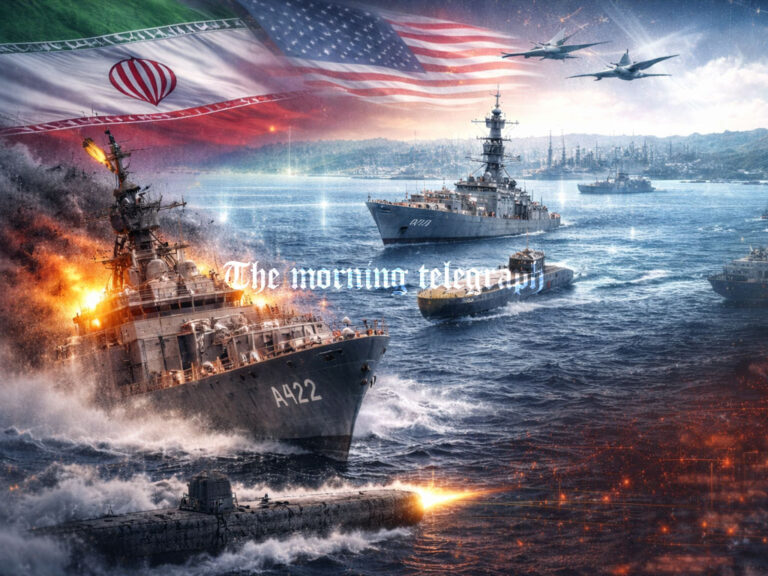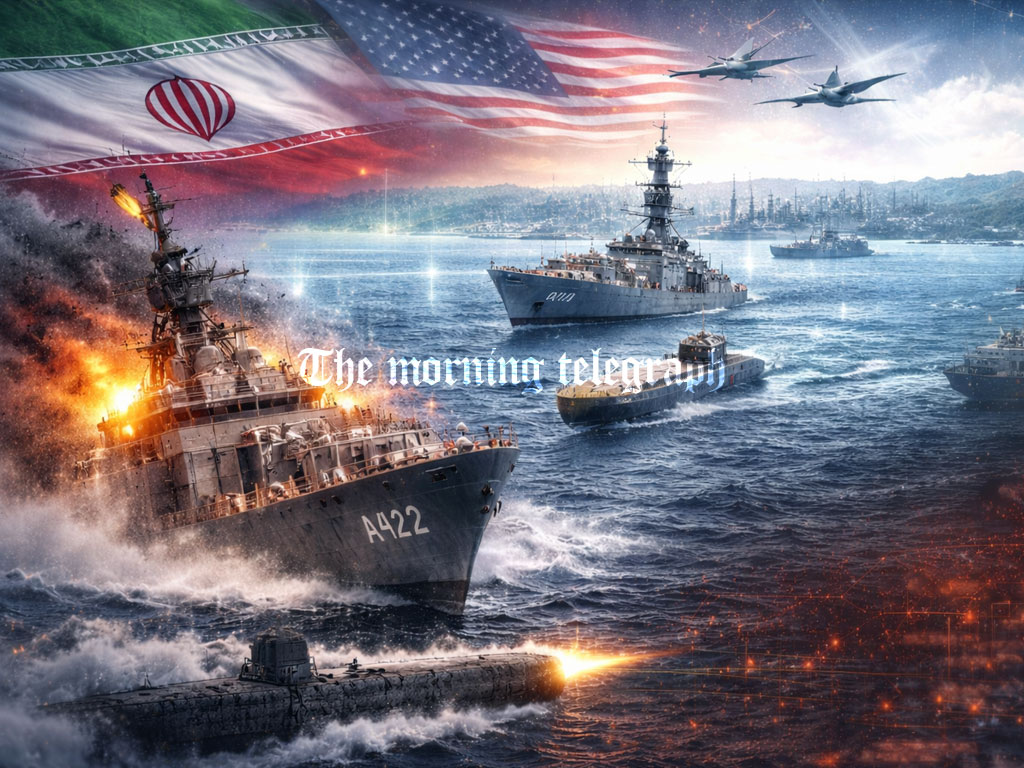
A mysterious submarine attack near Sri Lanka has thrust the island into the center of a dangerous geopolitical struggle between the United States, Iran, and competing global powers, while raising urgent questions about maritime law, neutrality, and the growing strategic importance of Trincomalee in the Indian Ocean.
That moment was more than a simple naval incident. It was a high stakes geopolitical maneuver unfolding in waters that carry some of the busiest shipping traffic in the world. More than twenty four hours after the dramatic events at sea, President Anura Kumara Dissanayake summoned journalists to his office in Colombo. The carefully managed briefing that followed was broadcast live across most television channels in the country, ensuring that the government’s version of events reached the public immediately.

The President spoke calmly and deliberately as he recounted the unfolding drama. According to him, every decision taken during the crisis had been guided by humanitarian principles and the responsibility of a neutral state. “Humanity is our priority,” he declared, adding that Sri Lanka would not hesitate to take any step necessary to protect lives and uphold international obligations. His remarks were followed by a tightly controlled question and answer session that revealed both the gravity of the situation and the sensitivity surrounding it.

The background to the crisis had begun days earlier. Two days before joint United States and Israeli air strikes on Tehran killed an Iranian leader on February 26, the Iranian government formally requested permission for three of its naval vessels to visit Sri Lankan ports. The visit, scheduled between March 9 and March 13, was described as a goodwill mission. Two of the ships were expected near Colombo while a third vessel was already operating close to Indian waters.
President Dissanayake insisted that Sri Lanka had approached the request in accordance with international law and the country’s long standing non aligned foreign policy. As a neutral state, he explained, Sri Lanka must respond to such requests based on global conventions such as the 1982 United Nations Convention on the Law of the Sea. The principle of neutrality meant that the island nation could not arbitrarily deny access or assistance without legitimate cause.
Events soon took an unexpected turn. On February 27, Iranian officials informed their Sri Lankan counterparts that a sailor aboard the IRINS Bushehr required urgent medical treatment after suffering an accident on board. Sri Lanka’s Navy and Air Force coordinated a rapid evacuation operation. The injured sailor and another crew member were airlifted to receive medical care, demonstrating the humanitarian role Sri Lanka frequently plays in international maritime incidents.
However the situation escalated dramatically several days later. At around 5.30 in the morning on March 4, distress signals were detected approximately nineteen nautical miles off the southern coast near Galle. The signals came from the Iranian naval frigate IRIS Dena. Within minutes, Sri Lanka’s naval and air units were mobilized to respond to the emergency.
Rescue teams arriving at the scene encountered a chaotic and tragic picture. Survivors were clinging to lifeboats and floating debris while patches of oil spread across the water. Officials later confirmed that thirty two sailors were pulled from the sea during the first phase of rescue operations. Several bodies were also recovered as naval vessels continued searching through the wreckage.
One Sri Lankan Navy spokesman described the scene in stark terms during a live press briefing. He explained that only a handful of lifeboats were visible when the first responders arrived. Dead bodies could be seen floating among scattered debris while dark oil patches marked the place where the warship had sunk beneath the waves.
During that same briefing the spokesman insisted that the incident was not the result of an attack. According to the initial narrative, there had been no assault on the vessel. The cause of the sinking remained unclear, and officials urged the public not to speculate.
Yet that narrative quickly unraveled. Within hours of the briefing, United States authorities released footage showing a submarine strike that destroyed the Iranian frigate. Washington publicly acknowledged responsibility for the attack, contradicting earlier statements suggesting the incident might have been accidental.
Throughout the unfolding crisis Sri Lanka’s Navy appeared either poorly informed or deliberately cautious. Senior officers avoided direct engagement with journalists, and reporters were repeatedly told that the Ministry of Foreign Affairs was handling the matter. This silence contrasted sharply with earlier maritime incidents when the Navy had been more open with information. The lack of clarity forced observers to rely on indirect statements from government sources.
Despite the confusion, the strike itself represented a historic moment. The attack was reported as the first publicly acknowledged submarine strike by the United States against a surface warship since the Second World War. According to U.S. Defense Secretary Pete Hegseth, an American submarine fired a torpedo at the IRIS Dena while the vessel was returning to Iran after participating in multinational naval exercises in India.
The strike reportedly occurred around 4.30 in the morning Colombo time. The location was about nineteen nautical miles south of Galle, well beyond Sri Lanka’s territorial waters though still inside its Exclusive Economic Zone. The frigate carried roughly one hundred and eighty crew members and transmitted distress signals moments before it sank.
The IRIS Dena belonged to the Moudge class of Iranian naval frigates and had recently taken part in the International Fleet Review 2026 and Exercise MILAN held in Visakhapatnam, India between February 15 and February 25. Security sources indicated that the warship was traveling across the Indian Ocean after completing these exercises when it was intercepted and attacked.
Initial speculation pointed to a torpedo strike launched from beneath the surface. Neither Iran nor Sri Lanka immediately confirmed this theory, but the later admission from Washington placed the United States squarely at the center of an escalating geopolitical crisis.
The attack occurred within one of the world’s most heavily used maritime corridors. Hundreds of commercial ships pass through this region every day as they travel between Asia, the Middle East, and Europe. The location of the strike therefore raised concerns among maritime security experts about the risks of military confrontation in such a crowded shipping lane.
A senior security official explained that the attack took place in the middle of a major east west trade route. More than two hundred vessels cross that corridor daily, many of them enormous oil tankers transporting energy supplies to global markets. To manage this traffic, Sri Lanka established a Traffic Separation Zone south of Dondra Head lighthouse decades ago.
According to the official, the attack suggested that the American submarine had been tracking the Iranian vessel for a considerable period of time. Only after identifying the ideal location did it launch the torpedo that ultimately destroyed the ship.
Sri Lankan authorities emphasized that the incident occurred outside the country’s territorial waters. Even so, naval and air units continued search and rescue operations throughout the day, demonstrating Sri Lanka’s commitment to maritime humanitarian responsibilities. Aircraft and patrol ships combed the waters while officials struggled to determine the full scale of the disaster.
The destruction of a frontline Iranian frigate by a United States submarine is widely viewed as an extraordinary and provocative development. With more than one hundred and forty sailors believed dead, the attack is certain to intensify diplomatic tensions across the region. Analysts believe it could reshape the strategic balance of power in the Indian Ocean.
Military historians have drawn comparisons with the sinking of the Argentine cruiser ARA General Belgrano during the Falklands War in 1982. That ship was torpedoed by the British submarine HMS Conqueror, marking one of the most famous naval attacks of the modern era. The Pentagon confirmed that the IRIS Dena was destroyed by a single Mk 48 heavyweight torpedo, a weapon originally designed during the Cold War that remains one of the most powerful torpedoes in service today.
Secretary of Defense Pete Hegseth described the strike as a quiet death delivered in international waters. The Chairman of the Joint Chiefs of Staff, General Dan Razin Caine, later confirmed that the Mk 48 torpedo had been fired from a United States fast attack submarine. Infrared footage released by the Pentagon showed a massive explosion at the rear of the frigate before the vessel disappeared beneath the sea.
Sri Lankan authorities initially reported eighty four fatalities, thirty two survivors, and sixty four sailors missing. Later estimates suggested that the death toll could exceed one hundred and forty. The IRIS Dena, derived from the Alvand class design, was considered one of Iran’s most capable surface combat ships. Its loss occurred during Operation Epic Fury, a broader United States campaign targeting Iranian naval capabilities across several regions.
At the same time Iran sought additional port access for the IRINS Bushehr on March 4 and March 5. Sri Lankan officials warned that docking such vessels in Colombo could create security risks for the capital. Instead the ships were redirected to the deep water harbor at Trincomalee. The vessels carried more than two hundred personnel including officers, cadets, and sailors.
President Dissanayake reiterated that Sri Lanka’s foreign policy remains independent and non aligned. The country, he said, acts according to its own interests rather than serving as an instrument of any external power. Nevertheless the government avoided discussing details about the weapon systems carried aboard the Iranian ships.
Another unusual detail concerned a third vessel that might otherwise have escaped attention. In February 2024 the IRINS Bushehr had visited Colombo together with the IRINS Tonb, a large landing ship capable of carrying hundreds of crew members. The visit formed part of a maritime cooperation mission. During the latest crisis the President declined to comment on the status of that third vessel.
Professor Rohan Gunaratna of Singapore’s International Center for Political Violence and Terrorism Research offered a legal perspective on the incident. According to him, if a state of armed conflict exists between the United States and Iran, the attack on the IRIS Dena inside Sri Lanka’s Exclusive Economic Zone does not necessarily violate international law.
Gunaratna explained that warships are legitimate military targets during armed conflict. Under international humanitarian law they can be attacked without warning. Restrictions primarily apply to merchant ships, hospital vessels, or ships operating in neutral territorial waters. Because the IRIS Dena was a military vessel, the attack could fall within accepted rules of naval warfare.
He also noted that Sri Lanka’s response in rescuing survivors fulfilled an important obligation under international maritime law. Coastal states and passing ships have a duty to assist people in distress at sea regardless of nationality or circumstances.
Gunaratna further explained that coastal states possess sovereign rights within their Exclusive Economic Zones mainly for economic activities such as fishing and resource exploration. Foreign vessels retain freedom of navigation. For that reason military actions in the EEZ are usually governed by the broader rules of the high seas.
Former Foreign Minister Ali Sabry praised Sri Lanka’s decision to assist the injured sailors and allow safe passage for the remaining vessels. According to him the response reflects the country’s tradition of principled neutrality and commitment to peace in the Indian Ocean.
The crisis has also revived attention on the strategic significance of Trincomalee. For centuries the natural harbor has been regarded as one of the most valuable naval bases in the region. During colonial times France and Britain fought fiercely for control of the port because its deep waters could shelter entire fleets.
Today the harbor lies close to the major sea lanes that carry energy supplies from the Middle East to Asia. Control of Trincomalee offers the ability to monitor shipping routes, observe naval activity around southern India, and project influence across the Indian Ocean.
Sri Lanka recently signed a trilateral agreement with India and the United Arab Emirates to develop the oil storage facilities near the port. The decision to host an Iranian naval vessel in the same harbor could complicate that partnership.
Admiral Ravindra Wijegunaratne, a former Chief of Defense Staff, suggested that the government likely consulted several international partners before allowing the port visit. He expressed confidence that the arrangement had been carefully considered within the context of Sri Lanka’s diplomatic relationships.
The regional picture remains tense. Iran recently carried out attacks against targets in the United Arab Emirates following the United States and Israeli strikes. As a result the confrontation between these powers continues to deepen. How Sri Lanka manages these pressures in the coming months may set an example for other small states navigating competition among global powers.
Historical echoes also linger in the background. Decades ago the LTTE leader Velupillai Prabhakaran spoke about the strategic importance of Sri Lanka and its harbor at Trincomalee. In an interview in 1986 he argued that global powers would inevitably compete for influence over the island because of its position in the Indian Ocean.
Today those predictions seem remarkably relevant. The waters around Sri Lanka remain calm on the surface, yet beneath them powerful geopolitical currents continue to collide.
SOURCE :- SRI LANKA GUARDIAN