After a submarine strike sank Iran’s IRIS Dena off Sri Lanka’s southern coast, exhausted doctors, forensic specialists, naval crews, police officers, and hospital staff were forced into a grim mission that exposed both the country’s humanitarian decency and the fragility of its disaster response system.
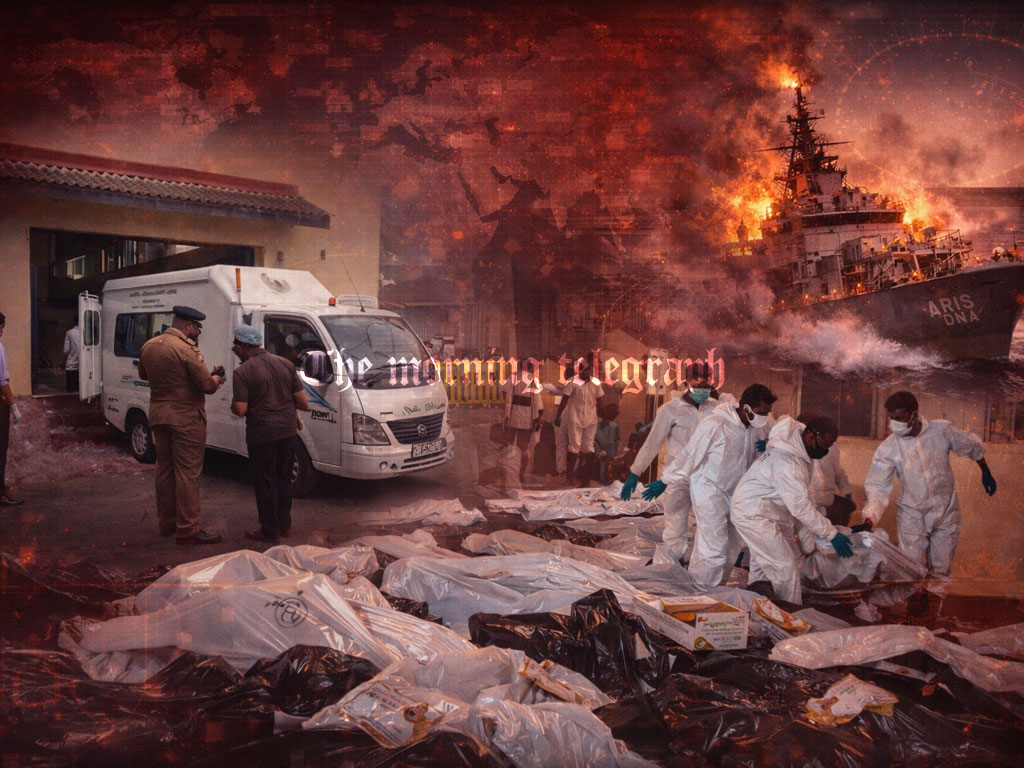
What unfolded in the waters south of Sri Lanka during the first week of March 2026 was not just another chapter in the history of conflict at sea. It became an unsettling episode that pushed a small island nation, far removed from the geopolitical engines of war, into the painful role of managing the immediate human cost of a major naval strike. The Iranian frigate IRIS Dena, returning home after multinational naval exercises in India involving more than seventy countries, never made that journey back. Instead, it was hit in a submarine attack later acknowledged by the United States. The warship was badly damaged, then sank, leaving more than 140 sailors dead or missing. What followed was not a military response or a diplomatic spectacle, but a quiet humanitarian operation carried out by Sri Lankan doctors, forensic pathologists, naval officers, and support staff. Nothing about it was remotely simple.

For nearly three days after the attack, the response unfolded behind a wall of silence. No photographs emerged. No footage circulated. Even basic operational information was withheld from the public until the first round of rescue, recovery, and identification had been completed. That silence was deliberate. It reflected the diplomatic sensitivity of the incident and the ethical weight attached to handling the dead with dignity. At a time when global media systems thrive on instant images and constant spectacle, Sri Lankan authorities imposed an information blackout. The result was rare. A mass fatality event of major geopolitical importance was managed without the usual noise and visual intrusion that often turns human tragedy into public consumption.
The scale of the catastrophe created immediate pressure. More than a hundred sailors had been aboard the Iranian vessel when it was attacked. The survivors were few, and many of them arrived with severe injuries linked to blast trauma, structural collapse, and sudden immersion in seawater. Yet most of those recovered were already dead. In such a situation, the duty of any responding state becomes painfully clear. It must try to save whoever can still be saved, while also treating the dead with respect and maintaining a proper medico legal record. Sri Lanka, a country of about twenty two million people with limited forensic infrastructure, had rarely been confronted by such a sudden influx of foreign military casualties.
The response was coordinated mainly through naval command and the leading medical institutions in southern Sri Lanka, especially the hospital at Karapitiya, which had recently been elevated and renamed the New National Hospital in Galle. Crucial support also came from the Department of Forensic Medicine at the Faculty of Medicine, University of Ruhuna. The first formal warning arrived on Wednesday, 4 March 2026. At around 9.30 a.m., naval authorities contacted the hospital administration and informed them that a maritime incident had taken place about twenty nautical miles off the coast of Galle. The message was urgent but sparse. What it did make clear was alarming enough. A large number of casualties were expected, and both survivors and bodies would soon be arriving.
Sri Lankan naval units had already reached the stricken area by then. Rescue teams began pulling the few surviving sailors from the water while at the same time recovering bodies from the sea. A naval medical team on site carried out the first round of triage, trying to distinguish between those who might still be resuscitated and those who had already died. In maritime explosions, the clinical pattern is often brutal and mixed. Victims can suffer blast injuries, blunt trauma from collapsing structures, internal bleeding, and drowning. Naval medics did what they could, attempting resuscitation where possible, but the cruel mathematics of the disaster revealed itself with terrible speed.
By early afternoon, preparations were underway in Galle. Hospital administrators activated emergency protocols, relying in part on a disaster rehearsal that had been conducted only two weeks earlier. Exercises often dismissed as paperwork suddenly became important. Doctors were called in. Nurses were summoned. Mortuary attendants, orderlies, administrators, and other staff were brought into action. Equipment was gathered, wards were cleared, and operating theatres were prepared for an influx of badly injured survivors. A system that usually handled ordinary medical pressure now had to brace itself for the human fallout of modern naval warfare.
One senior medical officer later described those opening hours with stark honesty. He said he could not sleep for three days. It was not a dramatic line. It was a simple reflection of the pace and pressure of what followed. The humanitarian response demanded unbroken labour from hundreds of individuals whose shifts blended into one another without rest. Doctors, forensic specialists, naval personnel, police officers, harbour officials, attendants, and volunteers came together in an improvised but disciplined structure. There was only duty, urgency, and the burden of dealing with lives shattered far from home.
The first vessels carrying both survivors and bodies reached Galle harbour that afternoon. At that point, a key medical decision was taken. Hospital teams insisted that the injured should be transported first, before the dead were moved inland. In disaster medicine, preserving life always comes before examining death. The survivors needed immediate assessment, scans, surgery, and rapid intervention for bleeding, fractures, and internal damage. Some required urgent operative procedures the moment they arrived.
Hospital reports suggested that some survivors had unexpectedly light injuries, something that can happen in maritime explosions when individuals are protected by structural parts of the vessel. Remarkably, around four sailors were rescued without visible wounds or fractures and appeared to be in good condition. Others were more critical. Blast waves produce complicated trauma patterns. Skulls fracture. Internal organs rupture. Spines are damaged. Soft tissue is torn. Several of the rescued sailors had to be rushed into emergency surgical care without delay, reminding everyone that even in a mass fatality event, the line between survival and death remains painfully thin.
Meanwhile, the bodies stayed temporarily at the harbour. That choice served two urgent purposes. First, it prevented public chaos that could erupt if large numbers of corpses were moved through ordinary spaces without preparation. Second, it gave hospital authorities time to prepare an orderly reception and storage process for the dead. Even at the height of disaster, forensic work cannot descend into confusion. Each body must be identified, labelled, recorded, and preserved before examination. Without that discipline, truth disappears quickly, and the dead lose both legal identity and human dignity.
The forensic team soon confronted a blunt reality. The hospital mortuary had been designed for ordinary clinical deaths, not the sudden arrival of war dead. Its cooling system had forty compartments, but only ten were functioning because of repairs. There was no realistic way to fit eighty or more bodies into that space. From that moment onward, improvisation became the only path forward.
As darkness fell on 4 March, the navy began transporting the first bodies to the hospital. Then another shortage appeared. There were almost no body bags. The hospital had only two. The navy, despite its capacity at sea, did not have extra supplies ready for an event of this scale. Eventually, a limited stock of American made body bags stored in the forensic department of the medical faculty was found and brought into use. Even that was nowhere near enough. The scale of the disaster exceeded the material readiness of the system.
Space quickly became the next crisis. With the mortuary overwhelmed, the forensic team converted a nearby psychiatric ward into a temporary holding area. Windows were taken out, doors were forced open, and the interior was cleared to make room for rows of bodies awaiting examination. The measures sounded rough, but such decisions reflected the realities of sudden disaster medicine. In these moments, institutions do not respond with elegance. They respond with whatever can still function.
Preserving the bodies created yet another problem. Refrigeration was limited, and Sri Lanka does not routinely maintain large reserves of dry ice, which is commonly used in major mass fatality operations elsewhere. Importing dry ice would have taken too long. The staff therefore turned to a nearby fisheries harbour in Galle. There, blocks of commercial ice used in fish storage were purchased with money collected by hospital staff themselves. The first load cost about 25,000 rupees. That detail was telling. A national emergency was being stabilized partly through the personal contributions of exhausted public servants.
Those ice blocks were cut into smaller pieces and packed between the body bags to slow decomposition. The method was improvised, but scientifically sound. Lower temperatures slow the processes that break down tissue after death. More ice was bought the next day for a similar amount. The temporary hall where the bodies were kept became an austere, dimly lit place of waiting, lined with death, wet floors, and melting ice. It was also a reminder of how underprepared systems cope under pressure.
By the morning of 5 March, the judicial process had to begin. Under Sri Lankan law, any violent or suspicious death requires medico legal investigation through autopsy. The fact that the victims were foreign military personnel did not remove that obligation. A magistrate came to the hospital to authorize the post mortem examinations. Law had now entered the same room as medicine, diplomacy, and grief.
At that point, tensions surfaced. Representatives connected to the Iranian victims reportedly objected to invasive examinations, since Islamic tradition often discourages autopsy unless required by law. There were disagreements and heated exchanges. But the forensic team stood firm. Sri Lanka’s legal system required examination. The cause of death, the mechanism of injury, and the circumstances surrounding each body had to be documented, especially because future international proceedings could depend on that evidence.
Eventually, permission was granted. The post mortems began late on the evening of 5 March under the supervision of Professor Clifford Perera, one of the country’s leading forensic authorities at the University of Ruhuna and president of the Sri Lanka College of Legal Medicine. He was joined by Professors Ajith Ratnaweera and Janaki Warushahennadi, along with postgraduate trainees in forensic medicine. It was a heavy responsibility.
Three main teams took part in the wider operation. The forensic team included fifteen doctors and healthcare professionals. The police contingent, including Scene of Crime Officers tasked with documentation and fingerprint work, included around forty officers. The navy handled the transport of survivors and bodies, while hospital staff oversaw reception and internal movement under the legal supervision of the Chief Magistrate of Galle. Altogether, more than one hundred people became part of the machinery of response.
The examination teams split into three groups, each handling three bodies at a time. Every autopsy followed methodical procedure. External injuries were documented first. Skull fractures, broken limbs, cervical damage, bruising, and blunt force trauma were recorded carefully. Internal examinations followed, with the thoracic and abdominal cavities opened to assess organ injury, haemorrhage, and signs of drowning. There was nothing theatrical about the work. It was exact, repetitive, clinical, and emotionally draining.
The findings were grimly consistent. Many sailors had suffered devastating blunt force trauma associated with blast impact and structural collapse inside the ship. Broken skulls and damaged cervical vertebrae were common. Several bodies showed major internal bleeding in the chest and abdomen. In many cases, the lungs contained frothy fluid and signs of aspiration, suggesting drowning after the initial explosion. The forensic picture that emerged was one of layered violence. The ship had become a trap.
These findings led pathologists to conclude that most deaths were caused by a combination of trauma and drowning. Some sailors almost certainly died instantly. Others seemed to have survived the first blast only to die later after flooding and immersion. That pattern is tragically familiar in naval disasters, where fire, collapse, entrapment, and water combine into one lethal sequence. In that sense, the autopsies were not merely medical tasks. They were the final reconstruction of what the dead had endured.
The work continued without interruption through the night of 5 March and into the early hours of the next day. Shift followed shift. Sleep became marginal. Fatigue spread across the teams, but the process had to continue. Late in the night, confirmation came that two refrigerated containers were being sent to the hospital. Each was forty feet long and designed to operate as a mobile freezer. One reportedly cost around 3.5 million rupees. One was funded by the state, while the other came as a donation from members of Galle’s Muslim community. That showed how disaster response in Sri Lanka still often depends on a blend of state effort, community intervention, and improvisation.
By dawn on 6 March, the containers had arrived. Bodies that had been stored among ice in the improvised ward were carefully moved into these refrigerated units. The last autopsy ended at around 4.45 a.m. By then, eighty four bodies had undergone full medico legal examination. For the forensic team, that marked a moment of relief, but not closure. Documentation had been completed. Preservation had been secured. Yet the larger questions remained unanswered. Would the bodies be sent back to Iran? Would they be buried in Sri Lanka? How would diplomacy now shape the fate of the dead?
Sri Lanka was not entirely unfamiliar with mass death. The Indian Ocean tsunami of 2004 killed more than thirty five thousand people across the island, including over five thousand in Galle district alone. That catastrophe forced the country to create laws, protocols, and administrative structures for disaster management. Yet the events of March 2026 showed how wide the gap still is between official policy and actual readiness. Systems exist on paper. Real capacity is thinner.
Professor Perera reportedly expressed frustration at exactly that contradiction. Disaster management units exist throughout the country, but many effectively function only during office hours. A crisis at night, during a holiday, or outside ordinary routines still requires hurried phone calls, improvised mobilization, and personal intervention. Permanent readiness remains more an aspiration than an established fact. That is a dangerous weakness for any state positioned along vital maritime routes and exposed to regional instability.
So the operation in Galle revealed two truths at once. On one side stood the dedication of Sri Lankan medical professionals, forensic teams, naval responders, and support staff. With limited resources and inadequate infrastructure, they managed to conduct eighty four autopsies in a single night while also treating the injured. Their work reflected discipline, competence, and deep ethical seriousness. On the other side stood the country’s structural vulnerability. Mortuary space, emergency coordination, disaster logistics, and long term preparedness remain far below what a mass casualty event demands.
Perhaps the most striking feature of the entire response was its insistence on dignity. The sailors who died were not Sri Lankan. Their state occupies a contested place in global politics and maintains strained relations with Western powers and with others in the region. Yet Sri Lankan authorities did not treat them as symbols, propaganda tools, or remote geopolitical pieces. They treated them as dead human beings whose bodies deserved to be documented carefully and handled with respect.
In that sense, the humanitarian response in Galle became an unusual intersection of medicine, law, diplomacy, and conscience. A war that began far from Sri Lanka’s shores forced itself into the country’s hospitals, harbours, court procedures, and mortuary halls. The doctors and forensic specialists who worked through those nights had no control over the violence that created the casualties. Their responsibility began only after the explosions stopped.
And what they faced then was the most basic truth of war: the bodies left behind. Their labour was not heroic in the theatrical language politicians often prefer. It was methodical, exhausting, quiet, and often grim. But because of that work, every sailor, whether friend, foe, or stranger, was examined, recorded, and preserved with a level of care that war narratives rarely acknowledge.
SOURCE :- SRI LANKA GUARDIAN