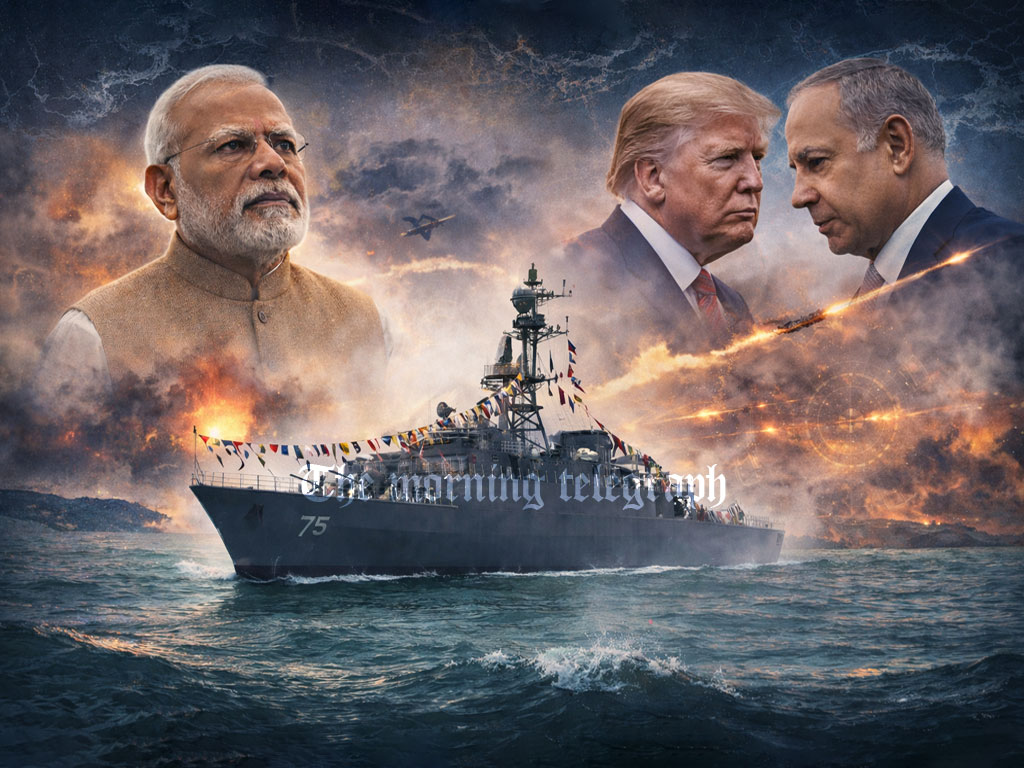
India’s long celebrated doctrine of strategic autonomy now faces a defining test as geopolitical pressure from Washington, regional conflicts, and shifting alliances challenge New Delhi’s ability to pursue an independent global strategy.
Within the span of a single year, India appears to have been compelled to reconsider its long standing aspiration to exercise strategic autonomy rooted in its own strength and diplomatic influence. Instead of acting independently in world affairs, critics argue that New Delhi increasingly finds itself operating within a framework shaped largely by American strategic priorities. What once looked like a confident global posture now resembles a cautious alignment with a US led geopolitical order.

This reality is sharply different from the era of Prime Ministers Jawaharlal Nehru and Indira Gandhi. During those decades India championed non alignment while maintaining considerable moral and political influence on the world stage. New Delhi was vocal in criticizing unlawful actions by major powers, particularly Western countries, and often took initiatives aimed at promoting peace across several conflict zones.
India also managed to cultivate productive relationships with both sides of the Cold War divide. Cooperation from the Soviet Union, the United States, and Western nations contributed to the country’s early economic development. Non alignment was presented not simply as neutrality but as a principled pathway toward peace and sovereign decision making.
In contrast, the modern articulation of “strategic autonomy” under Prime Minister Narendra Modi has drawn mixed reactions internationally. While the phrase signals ambition and confidence, critics argue that it sometimes carries the tone of an emerging power eager to assert itself before fully consolidating the economic and military influence necessary to sustain such independence. This posture has occasionally unsettled neighboring states and generated skepticism among established powers.
India’s External Affairs Minister S. Jaishankar offered a confident vision of India’s role in global affairs during the Raisina Dialogue Middle East conference in January 2025. Addressing an international audience, he described India as a country with expanding interests, growing capabilities, and a renewed engagement with regions stretching from the Middle East to Africa and beyond.
According to Jaishankar, the Middle East represented a vital strategic neighborhood with which India had rekindled deep partnerships. He emphasized that the region served as an important gateway to wider global connections, including trade routes linking Africa and the Atlantic. Greater dialogue, stronger partnerships, and sustained engagement were presented as key pillars of India’s evolving global strategy.
However, the tone of India’s diplomatic messaging appeared to change noticeably during the Raisina Dialogue held in New Delhi in March 2026. The geopolitical context had shifted dramatically following escalating tensions across Iran and the Middle East. In his remarks Jaishankar adopted a far more cautious tone, highlighting the need to reassess assumptions, diversify partnerships, and adapt to rapidly changing global realities.
Observers noted that the speech avoided explicit references to the ongoing confrontation involving the United States, Israel, and Iran. This omission was significant given that the conflict carries serious implications for energy markets, maritime trade routes, and the safety of millions of Indian citizens working in the Middle East. Nearly nine million Indians live and work across the region, making stability there a critical national concern.
The absence of any reference to the killing of Iran’s Supreme Leader Ayatollah Ali Khamenei also attracted attention. Khamenei had been supportive of India’s development of the Chabahar Port project in Iran, a strategic initiative designed to give India access to Central Asia while bypassing Pakistan and reducing reliance on unstable transit routes through Afghanistan. The silence suggested a delicate diplomatic balancing act by New Delhi.
Turning Points That Signaled a Strategic Shift
Several events in recent years illustrate how India’s strategic space has gradually narrowed. One of the earliest indicators occurred in April 2021 when the US Navy destroyer USS John Paul Jones conducted a freedom of navigation operation roughly 130 nautical miles west of the Lakshadweep Islands. The vessel sailed within India’s exclusive economic zone without seeking prior approval.
India has long maintained that foreign military operations within its exclusive economic zone require consent from New Delhi. The United States rejected this interpretation, arguing that international maritime law permits such actions. Washington framed the operation as part of its global Freedom of Navigation program aimed at challenging what it considers excessive maritime claims.
Ultimately India had little practical choice but to accept the American position, demonstrating the limitations of its ability to enforce maritime rules against a far more powerful naval force.
Lessons From the India Pakistan Confrontation
Another moment that reshaped perceptions of India’s strategic capabilities came during the brief but intense air confrontation with Pakistan in May 2025. The four day conflict revealed that India’s expectations of its military dominance over its neighbor might have been overly optimistic.
Pakistan, supported by its close strategic relationship with China, proved capable of sustaining the confrontation despite India’s larger economy and military resources. The crisis eventually ended through mediation by US President Donald Trump.
Trump’s public commentary added to India’s discomfort. He repeatedly claimed that India had lost several advanced aircraft during the conflict and praised Pakistan’s army chief Asim Munir. By framing the confrontation as a contest between equals, Trump effectively undermined India’s long standing effort to present itself as a far stronger regional power.
Trade Pressures and Economic Realities
Economic leverage has also influenced India’s diplomatic maneuvering. At one stage the United States imposed tariffs of up to fifty percent on certain Indian exports as a penalty for continuing to purchase Russian oil despite American sanctions.
Although the tariffs were later reduced, the dispute forced India to accept a broader trade arrangement that opened its markets to American agricultural products and committed it to purchasing large volumes of US goods over the coming years. These concessions raised concerns among Indian farmers and domestic industries about long term economic consequences.
Notably the agreement did not formally prohibit India from buying Russian energy. Nevertheless American officials have repeatedly encouraged New Delhi to increase imports of US oil instead. At the same time Russian shipments of crude oil to India have reportedly continued, highlighting the delicate balance India must maintain between competing economic interests.
The Iranian Warship Incident
Another sensitive episode involved the reported sinking of the Iranian naval vessel IRIS Dena roughly forty kilometers from Galle in Sri Lanka. The ship had earlier taken part in India’s Fleet Review near Vishakhapatnam before beginning its return journey.
Indian officials responded by stating that once the naval review concluded, the participating vessels were no longer considered official guests of the Indian Navy. They also stressed that the incident occurred outside Indian territorial waters.
Critics argue that this explanation contradicts India’s frequent assertion that it acts as the principal security provider in the Indian Ocean region. If India seeks recognition as a leading maritime power, analysts say it cannot easily distance itself from events involving naval vessels operating near its strategic sphere of influence.
India’s Delayed Response to Khamenei’s Death
India’s cautious diplomacy was also evident in its reaction to the death of Ayatollah Ali Khamenei. Prime Minister Narendra Modi had earlier pledged strong cooperation with Israel in combating terrorism during an address to the Israeli parliament. Within that context New Delhi appeared hesitant to immediately acknowledge the killing of Iran’s leader.
India eventually issued a condolence message four days later. The gesture was delivered by Foreign Secretary Vikram Misri, who visited the Iranian embassy to sign the condolence book on behalf of the government.
The official statement released afterward was brief and carefully worded. It conveyed condolences from the people and government of India and expressed prayers for peace for the departed soul. The restrained language reflected the complex diplomatic terrain India must navigate between its partnerships with Israel, the United States, and regional actors in the Middle East.
Taken together, these developments suggest that India’s room for maneuver in international affairs has become increasingly constrained. Economic dependencies, military realities, and geopolitical rivalries now shape New Delhi’s choices in ways that challenge the traditional concept of strategic autonomy.
India still aspires to maintain an independent role in world politics. Yet the realities of great power competition and regional instability appear to be forcing the country to adopt a more cautious approach. Rather than loudly proclaiming strategic autonomy, New Delhi may now prefer to quietly adapt to a changing global order while preserving as much flexibility as circumstances allow.