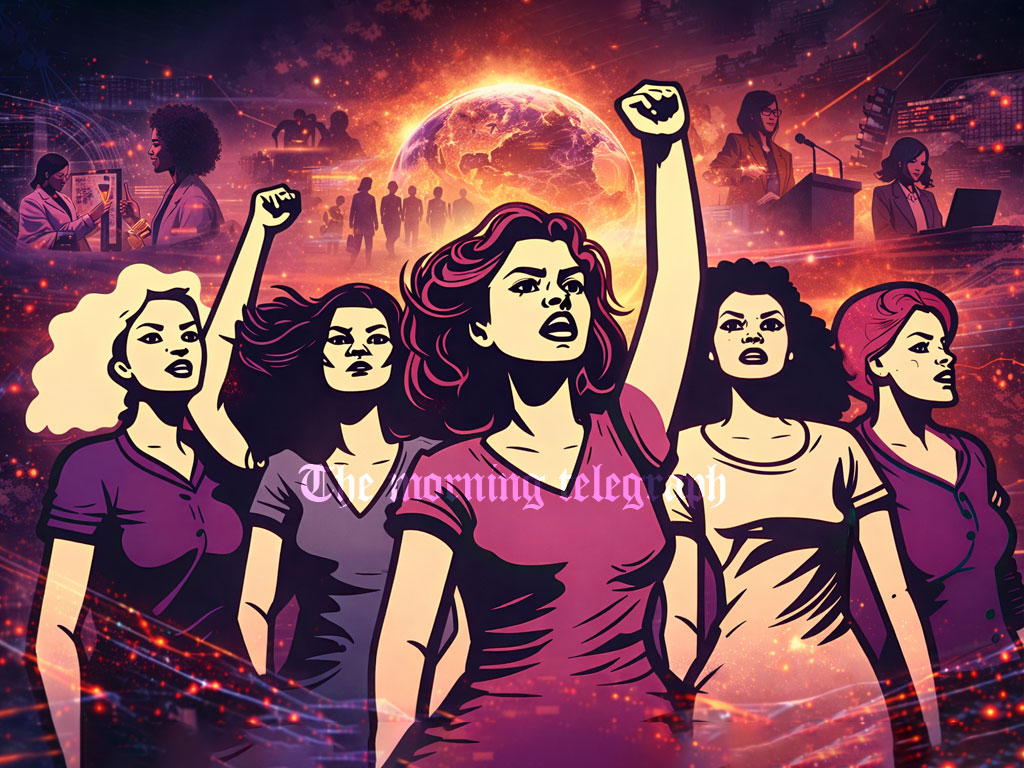
A thoughtful exploration of the intellectual, historical, and political struggle for gender equality, and why the advancement of women remains one of the most decisive forces shaping the future of civilization.
“There is no limit to what we, as women, can accomplish.” – Michelle Obama.
Historical Foundations
The eighth day of March has gradually evolved into far more than a date on the calendar. In modern global consciousness it represents a moment of reflection for humanity itself. International Women’s Day invites societies across continents to pause and consider how deeply the progress of civilization has depended on the contributions of women. Across centuries, women have served not only as caregivers and cultural transmitters but also as innovators, thinkers, leaders, and agents of transformation in every sphere of human life.
This recognition lies at the heart of the global observance now known as International Women’s Day. The celebration is not merely ceremonial. It reflects an important historical truth. Women have consistently shaped the moral direction of societies, strengthened cultural continuity, and helped guide intellectual development across generations. Their participation in public life has often been the catalyst that drives social reform, political change, and economic growth.

The United Nations formally acknowledged this historical reality in 1975 when it declared March 8 as International Women’s Day. That year was also proclaimed International Women’s Year, symbolizing a turning point in global awareness regarding women’s rights and gender equality. The declaration signaled that the advancement of women was no longer to be treated as a peripheral issue. Instead, it was recognized as an essential pillar of peace, development, and human dignity.
Two years later, in December 1977, the United Nations General Assembly strengthened this commitment by adopting a resolution encouraging all Member States to observe a United Nations Day for Women’s Rights and International Peace. Countries were invited to commemorate the day in ways consistent with their own historical traditions and cultural identities. In doing so, the observance became embedded within diverse civilizational contexts, making it both universal and locally meaningful.
Over the decades that followed, International Women’s Day developed into an annual moment of global reflection. Governments, institutions, and civil society organizations use the occasion not only to celebrate achievements but also to examine the ongoing barriers that continue to affect women’s rights and opportunities.
Each year the Secretary General of the United Nations delivers a message emphasizing the importance of gender equality. These statements often highlight both the progress that has been achieved and the challenges that remain. The observance therefore serves as a reminder that the journey toward equality is ongoing and requires sustained effort from governments, institutions, and individuals alike.
The theme adopted for International Women’s Day in 2026, “Rights. Justice. Action. For ALL Women and Girls,” reflects the enduring relationship between women’s empowerment and the advancement of humanity. Gender equality is not simply a social aspiration. It is a fundamental condition for sustainable development and democratic stability. Societies that provide equal opportunities for women consistently demonstrate stronger economic growth, more resilient political institutions, and richer cultural life.
The year 2025 carried additional symbolic importance in this global narrative. It marked the thirtieth anniversary of the Fourth World Conference on Women held in Beijing in 1995. That historic gathering produced the Beijing Declaration and Platform for Action, one of the most comprehensive international frameworks ever created to advance women’s rights.
The Beijing Platform outlined twelve critical areas requiring global attention. These included poverty reduction, access to education, healthcare equality, participation in political decision making, and the elimination of violence against women. Its vision was ambitious yet clear. It envisioned a world where women could participate equally in all aspects of society without facing discrimination or exclusion.
Three decades later, the principles articulated in Beijing continue to influence international policy discussions and development strategies. They remain a central reference point for governments and institutions working to strengthen gender equality worldwide.
Global Dialogue at the United Nations
Thirty years after the Beijing Conference, the international community continues to grapple with the challenge of translating its commitments into lived reality. One of the most important forums for this work is the United Nations Commission on the Status of Women.
The sixty ninth session of the Commission convened at the United Nations Headquarters in New York from March 10 to March 21, 2025. This gathering represented a significant moment in the continuing global conversation about women’s empowerment and gender equality.
The Commission has long served as the principal intergovernmental body dedicated to advancing the status of women worldwide. It brings together representatives from governments, United Nations agencies, and civil society organizations accredited by the Economic and Social Council. This diverse participation reflects the broad international commitment to addressing gender disparities and expanding opportunities for women.
The primary task of the Commission during its sixty ninth session was both reflective and forward looking. Delegates undertook a comprehensive review of the progress made in implementing the Beijing Declaration and Platform for Action. The goal was to assess whether the commitments made by governments three decades earlier had translated into meaningful change for women across different societies.
The review also examined the outcomes of the twenty third special session of the United Nations General Assembly, which had previously evaluated progress toward gender equality at the turn of the millennium.
Such assessments inevitably reveal both achievements and continuing obstacles. In many regions of the world women now enjoy greater access to education, healthcare, and professional opportunities than ever before. Female participation in politics and leadership roles has expanded significantly in several countries.
Yet these advances coexist with persistent structural inequalities. Women remain underrepresented in many political institutions and corporate leadership positions. Economic disparities between men and women continue to affect income levels and employment opportunities. In numerous societies women still encounter cultural expectations that limit their autonomy and participation in public life.
Violence against women remains one of the most troubling global challenges. Despite international legal frameworks and advocacy campaigns, millions of women continue to experience domestic abuse, harassment, and other forms of gender based violence.
These realities demonstrate why the Commission’s work remains vital. The discussions held at the United Nations are not simply theoretical exercises. They help shape international policy frameworks and encourage governments to adopt reforms aimed at protecting women’s rights.
Another key dimension of the Commission’s work involves examining how gender equality intersects with the broader objectives of the 2030 Agenda for Sustainable Development. The Sustainable Development Goals recognize gender equality as both a distinct objective and a foundation for achieving other goals.
Efforts to reduce poverty, improve public health, protect the environment, and strengthen democratic governance all depend on the active participation of women. Empowering women therefore strengthens the entire framework of sustainable development.
The recognition of women’s contributions also extends to the realm of international peace and security. Throughout history women have played important roles as mediators, community leaders, and advocates for reconciliation. In many conflict situations women’s organizations have helped rebuild communities and promote dialogue where formal political institutions struggled to succeed.
International Women’s Day thus functions as a global platform for reflection and action. It encourages societies to review progress, strengthen networks of solidarity, and renew commitments to building a more inclusive world.
Philosophical Reflections on Women’s Role
The question of women’s role in society has occupied philosophers, psychologists, and social thinkers for centuries. Throughout history this intellectual inquiry has often been marked by contradiction.
On one hand, women have frequently been portrayed as central to the moral and cultural fabric of civilization. Literature, religion, and philosophy have celebrated women as sources of compassion, wisdom, and social stability.
On the other hand, many intellectual traditions historically framed women within restrictive definitions of social roles and capacities.
Ancient Greek philosophy provides one of the earliest examples of this ambivalence. Aristotle, whose ideas profoundly shaped Western intellectual history, argued that women possessed less rational capacity than men. According to his concept of natural hierarchy, women occupied a subordinate position within society. Their primary responsibilities were associated with reproduction and domestic life.
These views reflected the social assumptions of ancient Greece. Yet Aristotle’s intellectual authority ensured that his ideas influenced philosophical discourse for centuries.
Not all ancient thinkers accepted this perspective. The Stoic philosophers advanced a more egalitarian view of human nature. They argued that rationality was a universal attribute shared by all individuals regardless of gender. Moral virtue, according to Stoic philosophy, was accessible to anyone capable of exercising reason.
The Enlightenment era introduced new ideas about human rights and individual liberty. Philosophers emphasized the importance of reason, autonomy, and universal moral principles. Yet even within this intellectual movement contradictions persisted.
Immanuel Kant, one of the most influential philosophers of the Enlightenment, expressed reservations about women’s rational autonomy. He suggested that women were guided more by emotion than by intellectual reasoning.
In contrast, the nineteenth century philosopher John Stuart Mill produced one of the most powerful arguments for gender equality in modern political thought. His book The Subjection of Women challenged the belief that women were naturally inferior to men.
Mill argued that women’s perceived limitations resulted not from biological differences but from social structures that restricted their opportunities. According to his analysis, society had never truly allowed women to demonstrate their full intellectual and professional potential.
He maintained that genuine equality required the removal of institutional barriers preventing women from participating fully in public life. Mill’s arguments became foundational for later movements advocating women’s rights.
A Turning Point in Feminist Thought
The twentieth century witnessed a major transformation in the intellectual discourse surrounding gender equality. Scholars in psychology, sociology, and philosophy began to challenge earlier theories that defined women primarily through male perspectives.
Karen Horney emerged as a pioneering figure in feminist psychology. She challenged the assumptions of Sigmund Freud, particularly the theory that women experienced envy toward male biological characteristics. Horney proposed an alternative interpretation.
Her concept of womb envy suggested that male domination in society might reflect an unconscious envy of women’s ability to give birth and create life. This provocative argument shifted attention away from biological determinism and toward social and cultural influences shaping gender relations.
Carol Gilligan further advanced feminist psychological thought through her research on moral development. In her influential book In a Different Voice she argued that traditional theories of moral reasoning were based primarily on male patterns of thinking.
Gilligan observed that women often approached ethical decisions through frameworks emphasizing relationships, care, and responsibility rather than abstract principles of justice. Her work expanded the understanding of moral reasoning by highlighting alternative perspectives that had long been overlooked in academic discourse.
Personal Reflection and Contemporary Insights
Modern research in psychology, neuroscience, and sociology continues to deepen our understanding of gender differences and similarities. Large scale studies involving hundreds of thousands of participants have revealed patterns suggesting that women often demonstrate strong empathy and greater attentiveness to social relationships.
Researchers have linked these tendencies to the empathy systemizing framework, which proposes that individuals vary in how they process emotional and structural information. Women may often show greater sensitivity to emotional cues and interpersonal dynamics.
Another concept explored in recent research is mentalizing, the ability to interpret the thoughts and feelings of others. Many studies suggest that women frequently display strong aptitude in this domain, allowing them to navigate complex social interactions effectively.
Biological factors may also play a role. Neurological studies indicate that pregnancy and motherhood can produce measurable changes in brain structure. These adaptations appear to enhance emotional responsiveness and memory, illustrating the intricate relationship between biology and behavior.
At the same time scholars emphasize that gender identity and experience cannot be reduced to biology alone. Cultural influences, social expectations, and economic conditions all shape the opportunities available to individuals.
The concept of intersectionality has become particularly important in modern discussions about women’s experiences. Introduced by legal scholar Kimberlé Crenshaw, intersectionality highlights how gender interacts with other social categories such as race, class, and culture.
Understanding these overlapping dimensions is essential for developing inclusive policies that address the diverse realities faced by women around the world.
Today women occupy leadership positions in politics, science, law, business, and international diplomacy that would have seemed unimaginable in earlier centuries. Their achievements demonstrate the transformative power of education, opportunity, and social reform.
Yet the legacy of historical exclusion continues to shape many aspects of contemporary society. Wage disparities persist in many industries. Political representation remains uneven in numerous countries. Cultural stereotypes still influence perceptions of leadership and authority.
These challenges remind us that the quest for gender equality is not a completed chapter in human history but an ongoing process requiring constant vigilance and commitment.
International Women’s Day therefore serves a purpose that extends beyond celebration. It invites societies to reflect on their progress while recognizing the work that remains ahead.
The advancement of women ultimately strengthens the foundations of civilization itself. When women are empowered to participate fully in economic, political, and cultural life, societies become more resilient, more innovative, and more just.
The message behind International Women’s Day is therefore simple yet profound. A world that values the voices, talents, and leadership of women moves closer to realizing its highest ideals of equality, dignity, and human flourishing.
SOURCE:- SRI LANKA GUARDIAN