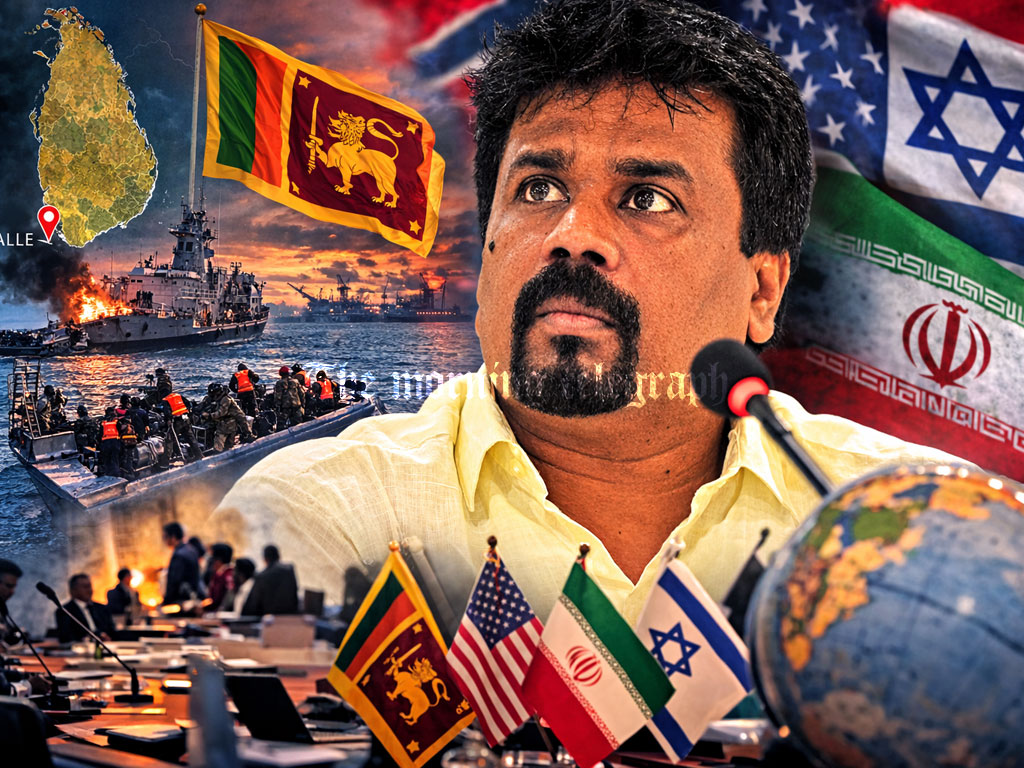
Sri Lanka unexpectedly found itself at the center of a tense geopolitical crisis involving the United States, Iran and Israel, and President Anura Kumara Dissanayake’s careful diplomatic handling briefly placed the island nation under intense global scrutiny.
A few weeks earlier, President Anura Kumara Dissanayake had earned praise from supporters after helping convince Pakistan to send its cricket team to play India in Colombo during the T20 Cricket World Cup. Loyalists celebrated the move as a diplomatic success and portrayed him as a regional peacemaker. In reality, the episode was relatively minor and carried little strategic cost for either India or Pakistan. Yet the praise was loud and enthusiastic.

Soon afterward, however, the President faced a far more serious challenge. A naval confrontation erupted in the Indian Ocean when the United States sank an Iranian naval vessel outside Sri Lanka’s maritime boundary near Galle. Surviving sailors sent a distress call requesting assistance. Around the same time, another Iranian vessel also sought help, possibly fearing a similar attack. Sri Lanka suddenly found itself entangled in a sensitive geopolitical crisis involving Washington, Tehran and Israel.
Sri Lanka maintains friendly relations with all three parties. The United States remains one of Sri Lanka’s most significant export markets. Iran is a major buyer of Sri Lankan tea and an important energy partner supplying oil. Meanwhile, Israel has recently become a destination for Sri Lankan migrant workers and an emerging contributor to tourism revenue. In such a complicated economic and diplomatic environment, antagonizing any one of these nations carried risks.
Faced with this delicate situation, the government initiated intense diplomatic engagement. Sri Lankan officials communicated closely with the Iranian Embassy in Colombo while it coordinated with authorities in Tehran despite wartime communication difficulties. Legal experts and advisers studied international maritime law and humanitarian obligations while government officials debated possible responses.
Eventually a workable consensus emerged. Sri Lanka would adhere strictly to international conventions, respond to the distress call, provide humanitarian assistance to the rescued Iranian sailors and redirect the second vessel to Trincomalee rather than Colombo. The decision was explained as a logistical necessity because Colombo port was heavily engaged in commercial activity.
After hours of consultations, President Dissanayake personally addressed the media and outlined the government’s decisions. For roughly two days Sri Lanka became a focus of international attention as global media followed developments surrounding the incident. Opposition parliamentarian Harsha de Silva later remarked that Sri Lanka had simply done what it needed to do.
Critics in the opposition predicted that the United States and Donald Trump would retaliate against Sri Lanka for assisting Iran. Instead, the US State Department publicly acknowledged Sri Lanka’s sovereignty and respected its right to manage the situation involving Iranian sailors and the repatriation of bodies.
The episode therefore became one of the rare occasions when the National Peoples’ Power government appeared to manage a crisis effectively. Negotiations were conducted discreetly and decisions were taken after careful deliberation. The President directly supervised the process and made key final decisions, leading to what many considered a diplomatic success for Sri Lanka.
Yet the incident also exposed uncomfortable realities. India, which had hosted the Iranian vessels in the region, appeared unable to manage the fallout after the US strike. Despite claims of being the guardian of the Indian Ocean, New Delhi could only observe events unfold while Sri Lanka stepped in to address the humanitarian dimension of the crisis.
The episode also highlighted weaknesses within Sri Lanka’s opposition. Sajith Premadasa attempted to question the government about national security failures but was widely criticized for misunderstanding the geopolitical context. Meanwhile figures such as Namal Rajapaksa and Champika Ranawaka offered measured responses.
Finally, the situation reinforced the perception that the administration operates as a one man leadership structure. Foreign Minister Vijitha Herath faced criticism after an uncomfortable interview with Indian journalist Palki Sharma. The episode renewed debate about whether the government needs stronger and more competent voices in key diplomatic roles.