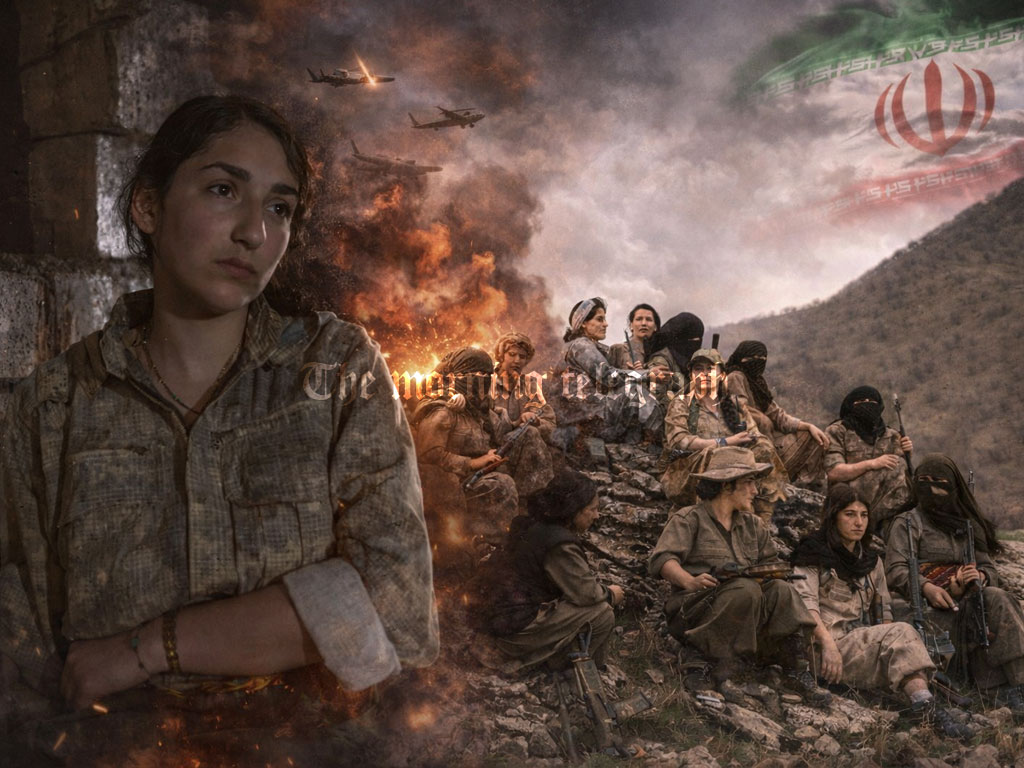
Hidden inside remote mountains and underground tunnels, a covert Kurdish all-female fighting force is preparing for a potential conflict with Iran as regional tensions escalate following United States and Israeli military strikes.
As United States and Israeli air strikes continue across Iranian territory, a new concern has emerged in the region. Armed Iranian Kurdish groups based in northern Iraq may soon attempt to cross the border and join the fight against the Islamic Republic. Tehran has already responded with force. Iranian authorities launched attacks on several Kurdish militant groups and one fighter was killed in a ballistic missile strike.

At the same time, United States President Donald Trump signaled uncertainty about Kurdish involvement. On March 7 he said he did not want Kurdish fighters to enter Iran and complicate the war.
Against this volatile background, journalists were given rare access to one of the most secretive units operating in the region. It is an all female Kurdish militant force that lives deep inside caves and underground tunnels in the mountains of northern Iraq.
Hidden bases in the mountains
Gaining access to these underground bases required days of negotiation and waiting. The camps are located in isolated mountain regions within the semi autonomous Kurdistan region of Iraq. Fighters operate in secrecy, relying on hidden communication networks and strict security procedures.
The militants live cut off from the outside world. Only one photographer was permitted to enter the complex and remain inside for several days. The tunnels serve as living quarters, training areas and operational command centers.
For decades several Kurdish militant groups opposing Tehran have relocated to mountainous regions along the Iraqi border. From these remote locations they avoid Iranian intelligence operations while also remaining cautious of Iraqi militia groups allied with Iran and the Turkish military presence in the area.
Recently several major Iranian Kurdish organizations formed a loose coalition in northern Iraq. Rumors quickly spread that American officials had contacted Kurdish leaders and encouraged them to join a broader campaign against Iran.
Trump signals mixed messages
In a telephone interview with Reuters on March 5, Donald Trump suggested he would support Kurdish forces launching attacks against Iran. He said it would be positive if Kurdish fighters could challenge the Iranian government.
Yet only days later his tone changed. Speaking to reporters he clarified that he did not want Kurdish ground forces crossing into Iranian territory because it could complicate the already expanding conflict.
Despite these statements the fighting environment continued to escalate. Iran responded by targeting Kurdish militant groups based in Iraq. One missile attack killed a fighter belonging to a Kurdish organization operating near the border.
Among the most organized groups is the Kurdistan Free Life Party, widely known as PJAK. The organization claims it has spent years preparing to re establish its presence inside Iran.
Young fighters driven by identity
Many of the fighters inside these camps are young women who say they joined the armed struggle after experiencing discrimination as Kurds inside Iran.
Aryan, a 21 year old member of the PJAK women’s security force, says she joined the group after feeling marginalized and oppressed in Iranian society.
She says her decision was motivated by both personal and political reasons. She believes Kurdish communities inside Iran have faced years of discrimination and repression. Joining the movement, she says, felt like the only way to defend her people and protect her family’s future.
Aryan joined PJAK two years ago and has since trained as a fighter within the women led security force.
Inside the underground training camps
The mountain tunnels function as fortified bases where militants store food, money and ammunition. These underground complexes are designed to withstand air strikes and surveillance operations.
PJAK keeps its exact number of fighters secret, but commanders say around sixty militants have received training in the camp since tensions with Iran escalated. A majority of these recruits are women.
Training programs are intense. Fighters undergo daily military exercises along with ideological education sessions. They learn sniper tactics, drone surveillance, border infiltration techniques and guerrilla warfare strategies.
Medical examinations are also conducted to ensure fighters are ready for potential deployment. Many recruits are now positioned closer to the Iranian border as the situation between Tehran and Western allies grows increasingly tense.
Gelavej Evrin, a veteran member of PJAK who joined the movement two decades ago, says the possibility of war had long been anticipated.
She abandoned her university studies in geography in the Iranian city of Urmia at the age of twenty to join the armed struggle. Over the years she rose through the ranks and eventually became a media spokesperson for the group.
A life spent in resistance
Speaking from the underground cave base, Evrin reflects on the personal sacrifices she has made. She says she has spent nearly half her life in the mountains and has not seen her family since leaving home many years ago.
She believes the political system in Iran was already weakened by widespread protests led by women in recent years.
Her comments refer to the nationwide demonstrations that erupted after the death of Mahsa Amini, a 22 year old Kurdish woman detained by Iranian morality police for allegedly violating mandatory headscarf laws.
Those protests quickly evolved into the Women Life Freedom movement and spread across the country. Although Iranian authorities cracked down harshly on the demonstrations, the movement inspired many young Kurdish activists.
A difficult choice for young women
The protests also motivated some of the newest recruits inside the camps.
Began, now eighteen years old, says she participated in street protests as a teenager. She also openly refused to wear a headscarf in school despite government rules requiring it.
Sitting quietly while braiding a fellow fighter’s hair, she explains why she ultimately joined the armed movement.
According to Began, Kurdish women in Iran often face two painful choices. One path leads to domestic violence, social restrictions and limited opportunities. The other leads to resistance and revolution.
Kurdish militant groups have often been accused of recruiting underage fighters. Began acknowledges she was still a student when she first joined the group three years ago.
Stories of sacrifice
Other members share similar stories of sacrifice and determination.
Delal, once a practicing dentist, abandoned her career at the age of twenty three to become a guerrilla fighter. She believes armed resistance is necessary to secure a better future for the next generation of Kurds.
She argues that Kurdish communities across the Middle East have faced centuries of political repression and cultural suppression. In her view the current struggle is part of a much longer fight for identity and freedom.
The PJAK organization was founded in 2004 and later developed links with the Kurdistan Workers Party, a separatist movement in Turkey that fought the Turkish state for decades before announcing a ceasefire last year.
Although PJAK welcomed that decision, its leaders insist Kurdish resistance against Iran will continue. Both Turkey and Iran classify PJAK as a terrorist organization. Turkish authorities regularly accuse the group of promoting separatism and destabilizing the region.
Fears of a wider conflict
The fighters themselves understand the risks ahead. If Kurdish forces cross into Iran they could face direct confrontation with the powerful Iranian military.
Gelavej Evrin says the possibility of a civil war remains deeply worrying. She hopes Kurdish forces will instead contribute to ending the conflict and preventing internal divisions among Iranian communities.
She believes the Middle East is undergoing major transformation and that the future of Iran will ultimately depend on decisions made by its own citizens.
Opposition groups hope that the current conflict could eventually weaken Iran’s ruling system and create opportunities for democratic reforms. Others fear the situation could spiral into greater instability if nationalist forces dominate the political landscape.
Waiting at a critical crossroads
Kurds represent roughly ten percent of Iran’s population of ninety million people. Many Kurdish activists argue their communities have faced decades of political marginalization.
As tensions escalate, Tehran has increased military pressure on Kurdish militant groups based in Iraq. Leaders of the newly formed Kurdish coalition declined to discuss reports about conversations with Donald Trump and denied claims that their fighters had already crossed into Iran.
However PJAK representatives say they maintain an armed presence inside Iranian territory and are waiting for the right moment to act.
One leader explained that any military intervention would depend entirely on how the situation evolves in the coming days.
Other Kurdish opposition organizations say they are still evaluating their options. Mustafa Hijri, leader of the Kurdistan Democratic Party of Iran, urged supporters to focus on maintaining security in Kurdish regions during any potential transition period.
Some fighters remain skeptical about relying on American support in a future conflict. Sources familiar with Kurdish militant networks say opposition groups would hesitate to launch a large scale ground offensive without guarantees of United States air support.
They warn that the Iranian military remains powerful and capable of delivering severe retaliation.
Meanwhile fighters like Delal are already moving closer to the border, preparing for a possible turning point.
If Kurdish forces ultimately enter the conflict against Iran, no one can predict how long the fighting might last or what shape the region will take afterward.