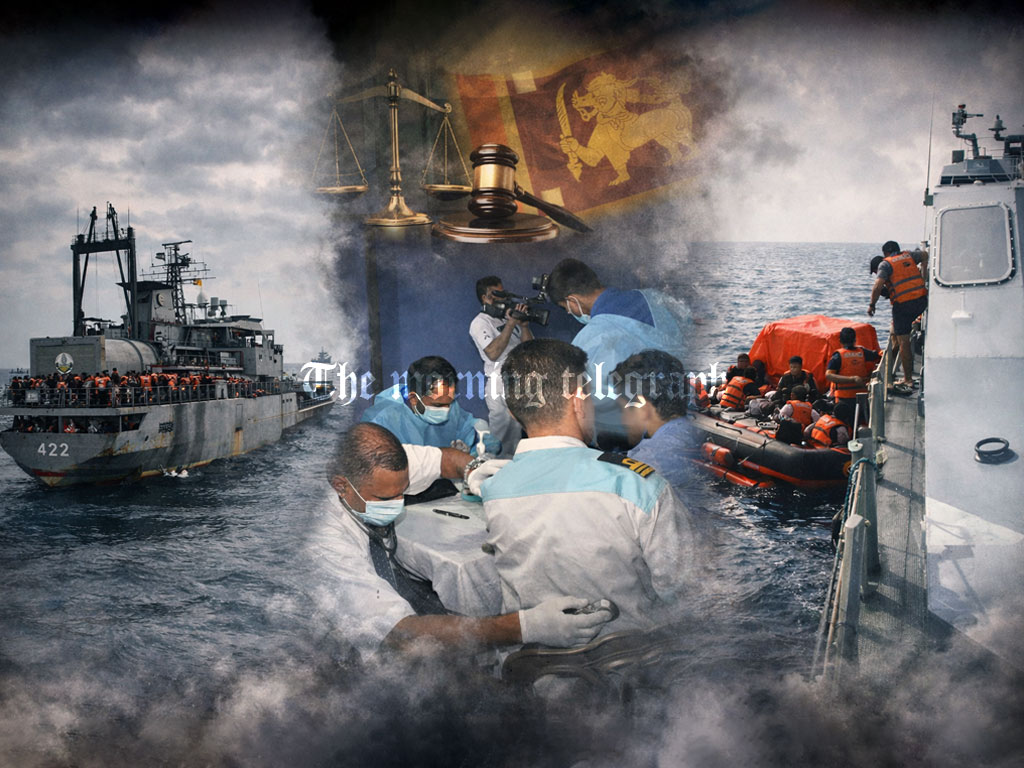
Amid rising global tensions, Sri Lanka’s decision to rescue and detain Iranian sailors has sparked debate. Legal experts now explain how international maritime law, humanitarian law, and neutrality obligations shaped the country’s response.
The Sri Lankan government’s decision to take Iranian sailors into custody following the destruction of the IRIS Dena naval vessel and the subsequent arrival of the IRIS Bushehr ship has generated widespread legal discussion. Many observers are questioning the legal framework used by Sri Lanka when dealing with the Iranian nationals who were brought under its control after the maritime incident near its waters.

Foreign Minister Vijitha Herath recently addressed the issue at a conference in India, explaining that the Sri Lankan government acted in accordance with the United Nations Convention on the Law of the Sea. His statement aimed to reassure both domestic and international audiences that Sri Lanka’s response was guided by established international legal principles.
However, some analysts have raised doubts about whether those conventions still apply once foreign nationals enter Sri Lanka’s territorial jurisdiction. Others are closely watching how the government plans to handle the detained Iranian sailors in the future, particularly as the broader conflict in the region continues.
Initially, the Sri Lanka Navy reported that the IRIS Dena vessel had experienced an accident approximately forty nautical miles from the port of Galle. Later, President Anura Kumara Dissanayake issued a statement clarifying that the ship had actually been attacked about nineteen nautical miles from Galle and that a distress signal had been transmitted from that location.
Investigations confirmed that the incident occurred in the sea area close to Sri Lanka’s national waters. This development placed Sri Lanka in a complex legal situation that required immediate action under international maritime obligations.
Below is a detailed legal explanation addressing four important questions about the Iranian sailors currently under Sri Lankan custody.
Which legal framework applied after the Iranian sailors entered Sri Lankan waters?
International law is largely based on a fundamental principle that agreements between states must be fulfilled in good faith. Under this principle, Sri Lanka was obligated to respond when a naval vessel encountered distress near its maritime jurisdiction.
Sri Lanka is a signatory to the 1982 United Nations Convention on the Law of the Sea, which is the primary legal framework governing maritime conduct. According to Article 98 of this convention, coastal states must conduct rescue operations when vessels or individuals face danger at sea within the relevant maritime zones.
In addition to this obligation, Sri Lanka is also a member state of the International Maritime Organization. Through that membership it is a party to the 1979 International Convention on Maritime Search and Rescue. This treaty requires countries to assist vessels in distress and to coordinate rescue operations when emergencies occur at sea.
Legal scholar Kusal Kavinda Amarasinghe explains that these international treaty commitments formed the basis for Sri Lanka’s decision to rescue the Iranian sailors who were stranded near its waters. He also notes that the handling of the second vessel followed rules established under international humanitarian law.
International humanitarian law governs conduct during armed conflict. Within this framework the Second Geneva Convention of 1949 sets out rules that apply to naval warfare and maritime rescue obligations.
Article 5 of the convention defines the responsibilities of neutral states during maritime conflict situations. These rules guided Sri Lanka’s actions when it responded to the distress signal and took control of the sailors.
What legal rules apply once the sailors are under Sri Lankan custody?
Once the sailors entered Sri Lankan custody, their legal status became subject to provisions under the Third Geneva Convention of 1949.
Although the Iranian nationals are not technically classified as prisoners of war, they are entitled to protections similar to those granted to prisoners of war. These protections include humane treatment, safety and legal safeguards while they remain in the custody of a neutral state.
Under Article 118 of the Third Geneva Convention, neutral states have a duty to prevent detainees from rejoining active hostilities. This means that Sri Lanka must ensure the sailors do not return to combat while the conflict remains ongoing.
Because of this obligation, neither side involved in the conflict can legally demand that Sri Lanka release the detained sailors until the hostilities have ended completely.
What if Sri Lanka faces pressure regarding the detainees?
International law gives Sri Lanka clear authority over individuals currently under its custody as a neutral state. No country involved in the conflict has the legal right to demand the release of those detainees while the fighting continues.
If any state attempts to exert pressure or influence that threatens Sri Lanka’s sovereignty, the government has the right to raise the issue through international channels. These options include notifying the United Nations or submitting a complaint to the International Court of Justice.
Legal experts note that such steps would only become necessary if external pressure interferes with Sri Lanka’s lawful responsibilities under international conventions. At present there is no indication that such interference has occurred.
What could happen to the Iranian sailors in the future?
According to international humanitarian law, the fate of the detained sailors will ultimately depend on the duration and outcome of the ongoing conflict.
Under the Third Geneva Convention, individuals who are taken into custody by a neutral state must remain interned until active hostilities between the warring parties have fully ceased. This requirement ensures that they cannot return to the battlefield while the war continues.
Once the conflict ends, the neutral state is expected to return those individuals to their country of origin.
Therefore, Sri Lanka’s long term responsibility is to maintain custody of the Iranian sailors until the fighting concludes and it becomes legally appropriate to repatriate them.
SOURCE :- BBC SINHALA