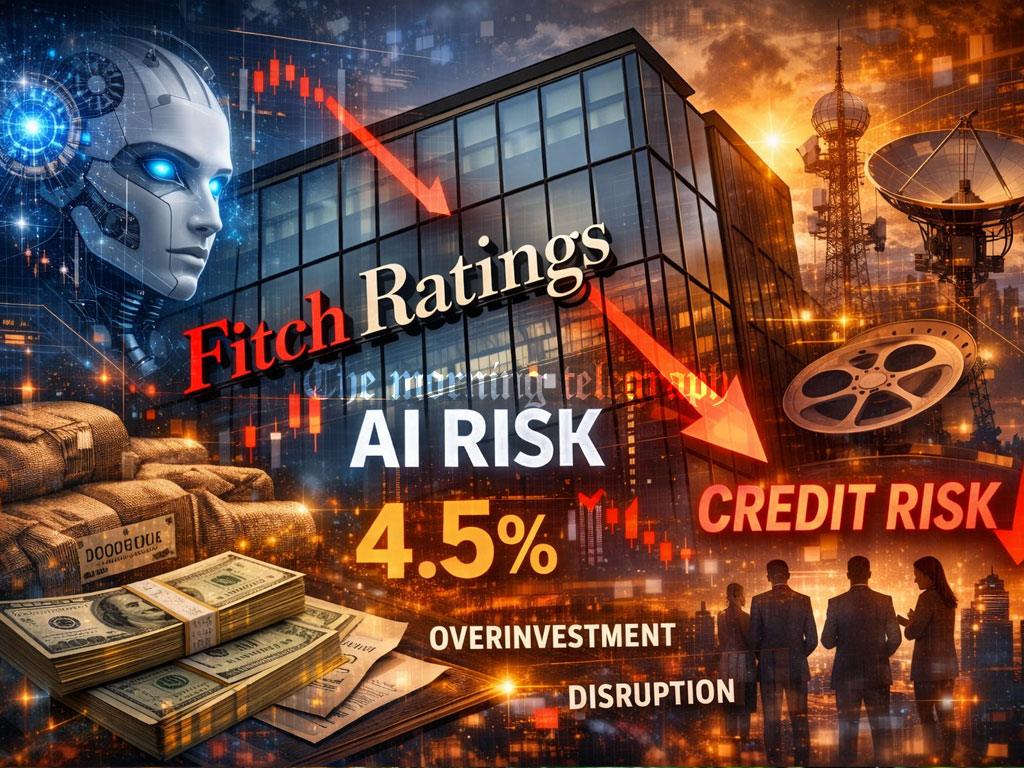
A new Fitch analysis warns that the global rush toward artificial intelligence investment may reshape industries while quietly creating credit risks in technology, media, telecommunications, and cloud infrastructure sectors.
Artificial intelligence is rapidly transforming corporate strategy and global business models, yet Fitch Ratings has cautioned that credit risks linked to AI adoption are still concentrated in specific industries. According to the rating agency, the technology, media, and telecommunications sectors remain the most exposed to potential financial pressure created by the rapid expansion of artificial intelligence infrastructure and AI driven innovation.

Fitch explained that two major financial threats could influence corporate credit profiles in the coming years. These include disruption risk and overinvestment risk. Despite the growing influence of AI across industries, the agency believes that for most sectors artificial intelligence will not immediately lead to significant credit rating changes in the near term.
Overinvestment risk refers to the possibility that companies may allocate excessive capital spending toward artificial intelligence infrastructure without achieving proportional financial returns. If firms aggressively invest in AI data centers, semiconductor capacity, and cloud computing networks without strong revenue generation, their balance sheets and credit quality could weaken.
Disruption risk, in contrast, focuses on the possibility that AI technology could fundamentally change existing business models. Artificial intelligence tools may allow new competitors to emerge rapidly or provide alternative services that replace traditional processes and labor.
Fitch highlighted that these risks are particularly visible in asset light sectors such as software development, media platforms, and service industries. In these sectors, company value is often built on intangible assets including intellectual property, proprietary data, brand influence, and highly skilled human capital rather than heavy physical infrastructure.
The report also noted that the current surge in AI related capital expenditure is concentrated among a limited number of global hyperscale technology firms and cloud service providers. These companies are leading the massive investment wave in artificial intelligence infrastructure.
According to Fitch estimates, the technology giants Alphabet, Microsoft, Amazon, and Meta plan to collectively spend nearly 650 billion dollars in 2026 on AI infrastructure, data centers, and advanced computing systems. This spending level almost matches their combined investment between 2020 and 2024.
However, the broader corporate landscape appears more cautious. Fitch observed that most companies outside the hyperscaler group are maintaining disciplined investment strategies. Their capital spending is largely directed toward meeting clear market demand rather than speculative AI expansion.
Data from Fitch Global Corporate Cash Flow Monitor, which tracks more than 1,500 non financial companies, indicates that capital expenditure intensity among North American corporates excluding hyperscalers is projected to rise slightly to about 7.4 percent of revenue during 2025 and 2026. This compares with roughly 6 percent to 7 percent recorded over the previous five years.
These moderate increases in capital spending are generally supported by strong operating cash flows and are not expected to significantly weaken corporate free cash flow levels.
Outside the technology industry, electricity and power utilities remain among the largest investors in infrastructure. However, their spending priorities are largely unrelated to artificial intelligence.
Fitch said these companies are investing primarily in aging infrastructure upgrades, renewable energy integration, power grid modernization, climate resilience, and extreme weather protection rather than AI driven data center demand.
Most utilities have avoided committing to long term expansion projects solely to support artificial intelligence growth. Instead they are adopting cautious investment strategies designed to preserve balance sheet stability and financial flexibility.
The report also emphasized that supply chain limitations may slow the pace of artificial intelligence expansion. Bottlenecks in semiconductor manufacturing, data center construction, and power grid infrastructure remain significant barriers.
Lead times for memory chips, storage components, and semiconductor fabrication capacity remain tight across the global technology supply chain. At the same time, regulatory approvals and power grid interconnection delays are extending timelines for new data center facilities.
These constraints could keep hyperscaler investment levels elevated even if operational capacity grows more slowly. Companies may face higher costs as they pursue expedited procurement strategies or temporary infrastructure solutions.
While the threat of overinvestment is concentrated mainly among hyperscale technology companies, disruption risk is more widespread in industries where artificial intelligence can easily replace repetitive processes or human labor.
Fitch identified software, services, and media companies as the sectors most exposed to this type of transformation.
In the software industry, artificial intelligence can accelerate the development of simpler applications such as workflow automation tools and customer service interfaces. However, enterprise software platforms that perform mission critical functions remain relatively protected because they involve high switching costs and strict regulatory integration.
These protections are particularly strong in industries such as healthcare systems, financial services, and public sector technology infrastructure where reliability and compliance requirements limit rapid technological substitution.
In service industries, artificial intelligence could replace certain functions such as outsourced customer support, data analysis, and routine administrative processes. Companies that rely heavily on standardized workflows face higher exposure to automation driven disruption.
Nevertheless, firms that control proprietary data sets, maintain long term contracts, operate within regulated frameworks, or benefit from strong customer ecosystems are less vulnerable to rapid displacement.
Within the media industry, artificial intelligence is already lowering production costs through automated content creation and editorial tools. Although fully AI generated media has not yet reached the quality standards of major studios, incremental technologies such as automated summaries and algorithm driven content production are already influencing digital advertising markets and search traffic patterns.
Fitch also pointed out that companies offering mission critical services or possessing proprietary technology assets tend to show stronger resilience. Firms with regulatory integration, exclusive data resources, and flexible financial structures are better positioned to adopt artificial intelligence capabilities while managing transition costs.
Despite widespread enthusiasm surrounding artificial intelligence, Fitch warned that the technology’s positive impact on corporate credit ratings remains limited for now.
AI adoption may improve operational efficiency, streamline workflows, and reduce operating costs across several industries. However, significant new revenue streams linked directly to artificial intelligence are still emerging and remain difficult to measure.
For example, pharmaceutical companies may accelerate research and development processes using AI assisted drug discovery tools. Media companies could increase production speed for digital content. Retailers might enhance targeted marketing strategies through predictive analytics. Healthcare providers may improve billing efficiency, while automobile manufacturers may introduce AI enabled subscription features.
Although these developments may generate incremental benefits, Fitch believes they are unlikely to produce meaningful rating upgrades in the near future.
The agency concluded that most corporations are proceeding cautiously with artificial intelligence investments. Companies continue to prioritize visible demand signals and financial balance sheet stability when making capital allocation decisions.
Even in sectors directly linked to AI growth, including semiconductor manufacturing and cloud computing services, diversified customer bases and broad end market exposure help reduce credit risk if AI related demand growth slows in the future.