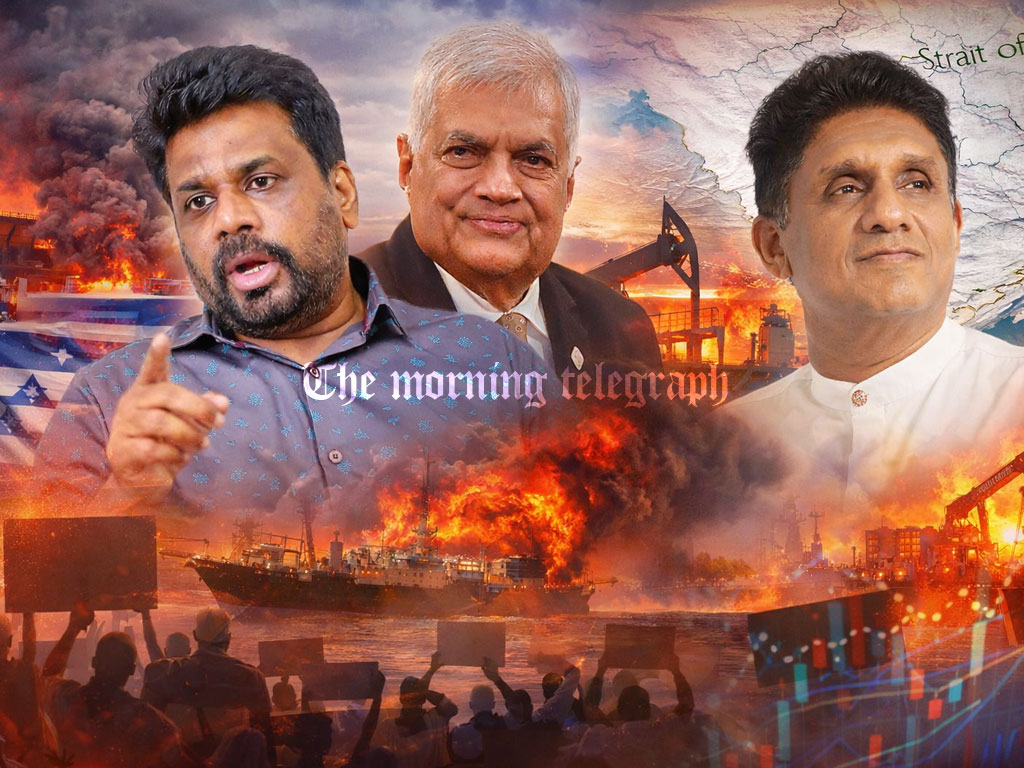
Sri Lanka stares into the abyss as Iran threatens to close the Strait of Hormuz and global crude prices explode past $120. With Gotabaya’s ghost haunting the presidency, Anura Dissanayake battles the IMF, secures a secret Indian oil deal, and prays the war ends before the queues return.
The main crisis that consumed the Dissanayake administration last week was the sudden explosion in global fuel prices. When American and Israeli forces launched military operations against Iran, the immediate shockwave hit Colombo within 48 hours. Crude oil prices breached the $100 per barrel mark almost overnight, and the situation deteriorated rapidly when Tehran threatened to close the Strait of Hormuz. This narrow waterway carries nearly one-fifth of the world’s daily oil consumption. When Iran declared it would attack all fuel tankers belonging to US-allied nations traversing the strait, global crude prices skyrocketed past $120 per barrel. Both petroleum and cooking gas prices were dragged upward in an inexorable spiral, creating a potential catastrophe for import-dependent Sri Lanka.
The government realized within days that a new fuel emergency could trigger the same public uprising that toppled Gotabaya Rajapaksa, and the President moved urgently to prevent history from repeating itself. The memories of 2022 remain seared into the national consciousness, with citizens still recalling the agony of spending nights on roadsides waiting for fuel that never arrived. For a government that rode to power on the waves of that very protest movement, allowing a repeat would be politically fatal.

Presidential Crisis Management
By last week, President Anura Dissanayake found himself trapped in the same nightmare that destroyed his predecessor. The 2021 dollar shortage had crippled fuel imports, forcing citizens to spend four or five days in queues stretching for kilometers. That public fury sparked the Aragalaya protest movement, ultimately driving Rajapaksa from power. The memory remains brutally fresh. It has barely been four years since those protests ended, and that very struggle propelled the JVP from three percent support to executive power after 76 years. The President understood immediately that repeating history would be politically fatal.
Dissanayake launched emergency discussions with Finance Ministry officials and Ceylon Petroleum Corporation chiefs as the week began. Their briefing was grim. Existing fuel stocks would last approximately 40 days. Payments had cleared for several incoming shipments purchased earlier at lower prices, but every future procurement would carry the new wartime premium. The officials painted a stark picture of what lay ahead, warning that without immediate intervention, the country could face empty pumps within weeks.
The President convened multiple meetings at the Presidential Secretariat, pulling in economic advisors, treasury officials, and energy sector experts. These were not the routine bureaucratic consultations that typically characterize government decision making. These were urgent, sometimes heated discussions where every participant understood the gravity of the moment. The ghost of Gotabaya hovered over every conversation, a constant reminder of what happens when leaders lose touch with the public’s daily struggles.
The Shocking Price Tag
Officials delivered the mathematical reality to the President. Fuel prices would require an immediate increase of around Rs. 80 per litre to cover the new global rates. Observers noticed Dissanayake’s visible shock at the proposal. Such a staggering hike would crush the public and could ignite a political firestorm that his young administration might not survive. The President directed his team to prepare a comparative analysis of global prices versus domestic requirements. Within 24 hours, officials returned with the same conclusion. The government faced an impossible choice between economic survival and political suicide.
The numbers told a terrifying story. With crude oil jumping from $70 to $120 per barrel, the arithmetic was inescapable. Every shipment arriving after the current stocks were exhausted would cost nearly double what previous shipments had cost. The Ceylon Petroleum Corporation, despite its recent profitability, could not absorb such massive increases without passing them to consumers. Yet passing the full increase would mean petrol at previously unimaginable prices, triggering immediate hardship for millions.
Dissanayake pored over the spreadsheets late into the night, according to sources close to the President. He examined every assumption, questioned every projection, looking for some escape hatch that might spare the public from the coming pain. His economic team had no magic solutions to offer. The mathematics of the global oil market was unforgiving, and Sri Lanka, as a price taker with no bargaining power, had to accept whatever the market dictated.
The Subsidy Dilemma
Dissanayake proposed a middle path. Instead of imposing the full increase immediately, fuel prices would rise to a manageable level while the Treasury absorbed the balance as a temporary subsidy. The strategy depended entirely on intelligence suggesting the war might conclude within approximately two months. This approach would cushion the public from the worst effects while buying time for diplomatic efforts to end the conflict.
The subsidy concept immediately raised questions about fiscal sustainability. Sri Lanka’s economy remains fragile, still recovering from the 2022 default. The Treasury operates with limited buffers, and any unplanned expenditure requires difficult tradeoffs elsewhere. Officials warned that subsidizing fuel would mean less money for health, education, and social welfare programs. The President acknowledged these concerns but argued that preventing social unrest must take priority.
Discussions moved to the mechanics of implementation. How would the subsidy be delivered? Would it apply to all fuel types equally? How would the government prevent leakage and ensure that benefits reached intended recipients? These technical questions consumed hours of debate, with officials proposing various mechanisms and shooting down each other’s suggestions.
IMF Showdown
The subsidy proposal created an immediate complication with the International Monetary Fund. Sri Lanka’s bailout agreement explicitly prohibited the government from providing public subsidies under any circumstances. The President requested urgent discussions with IMF representatives in Colombo. During these high-stakes talks, Dissanayake argued that the country must prepare for the unfolding situation or face an economic and political collapse worse than 2022. He requested a three-month window for the fuel subsidy, pointing to the Ceylon Petroleum Corporation’s recent profitability as evidence of fiscal responsibility.
The IMF team listened carefully but initially appeared skeptical. The fundamental philosophy of Fund programs emphasizes eliminating subsidies to ensure that prices reflect true costs and that scarce government resources target the most vulnerable through direct transfers rather than broad price supports. The President’s request challenged this fundamental principle.
Fortuitously, the IMF had just issued its own forecast regarding potential global economic disruption from the Middle East conflict. The Washington-based lender agreed to consider the President’s proposal, requesting a detailed report on the proposed subsidy mechanism. This represented a significant departure from standard IMF practice, reflecting the extraordinary circumstances created by the war.
Profitable Petroleum Corporation
Another factor that made it easier for the President to make this decision was the significant profits recorded by the Ceylon Petroleum Corporation in recent months. Since domestic fuel prices had been adjusted in line with fluctuations in the global market during the past few months, the corporation had been able to generate considerable profits. Using part of these profits, the CPC had already begun constructing several additional oil storage tanks in locations such as Trincomalee, Sapugaskanda and Muthurajawela. Importantly, these projects were being financed not with funds from the national treasury but with a portion of the profits earned by the corporation in recent months.
The corporation’s improved financial health provided some cushion for the proposed subsidy. Unlike during the Rajapaksa era when CPC was bleeding money, the current entity had built up reserves that could be deployed strategically. The President informed IMF officials that the government would draw on these reserves rather than treasury funds, a distinction that helped make the proposal more palatable to the Fund.
The President also shared intelligence suggesting the war could end within approximately eight weeks. This timeline, if accurate, would limit the subsidy requirement to a manageable period. IMF officials requested written confirmation of these projections and asked for regular updates as the situation evolved.
The Rs. 25 Compromise
Finance Ministry officials initially proposed increasing fuel prices by Rs. 50 per litre while subsidizing the remaining Rs. 30. The President rejected this outright. A Rs. 50 increase would trigger cascading price hikes across essential goods and services, potentially destabilizing the entire economy and reigniting public anger. Dissanayake demanded alternative calculations showing the subsidy requirements for smaller increases of Rs. 40, Rs. 30 and Rs. 20 per litre. After reviewing the options, he noted that existing fuel stocks purchased at $70 per barrel would last approximately another month. This breathing room allowed for a gentler approach.
The final decision was a Rs. 25 per litre increase with the government absorbing Rs. 55 as subsidy for up to three months. However, officials warned that once current stocks deplete and new shipments arrive at war inflated prices, a second round of increases would become unavoidable. The President accepted this risk, calculating that the situation might stabilize before the second increase became necessary.
Cabinet colleagues expressed mixed reactions to the decision. Some argued for a larger immediate increase to avoid the need for a second hike, while others supported the President’s more gradual approach. The debate reflected deeper divisions within the administration about how to balance economic reality with political survival.
Public Communication Strategy
With the decision made, attention turned to communicating it to the public. The President understood that how the increase was presented would be almost as important as the increase itself. A poorly explained price hike could trigger the very unrest the government sought to avoid.
The communications team developed a multi-pronged strategy. The President would address the nation directly, explaining the global circumstances forcing the increase. He would emphasize that the government was absorbing more than half the actual cost increase, protecting citizens from the worst effects. Charts and graphics would show how Sri Lanka’s prices compared with regional neighbors, demonstrating that even after the increase, Sri Lankan fuel remained competitively priced.
Social media would play a crucial role in the campaign. The government’s digital team prepared posts for multiple platforms, anticipating the inevitable misinformation that would circulate. They identified key influencers who could help explain the situation credibly to their followers. The goal was to control the narrative before opposition politicians and critics could frame the increase as government failure.
India’s Strategic Lifeline
The Strait of Hormuz closure threat required immediate diplomatic intervention. Iran had vowed to shut the waterway completely, preventing a single drop of oil from reaching US allied nations. Sri Lanka needed a backup plan urgently. India emerged as the unexpected savior. External Affairs Minister S. Jaishankar had engaged in parallel discussions with Iranian authorities, explaining the catastrophic impact of closing the strait. He successfully persuaded Tehran not to attack fuel tankers sailing under the Indian flag, making India the only nation to receive such assurances.
Simultaneously, New Delhi negotiated with the Trump administration to lift sanctions on Russian oil purchases for 30 days. This allowed India to resume crude imports from Moscow, creating multiple supply channels that insulated it from the worst effects of the Hormuz closure. Indian diplomacy had secured what no other nation managed: safe passage through the strait and access to discounted Russian crude.
Sri Lankan authorities immediately opened discussions with Indian officials regarding fuel purchases. India agreed to supply refined petroleum products but declined requests for crude oil, citing its own non producing status. The agreement covered diesel and petrol shipments sufficient to meet Sri Lanka’s needs for several months, providing critical insurance against the Hormuz closure.
Russian Alternative
Foreign Minister Vijitha Herath simultaneously invited the Russian Foreign Minister to Colombo, receiving positive indications about potential crude supplies. The Russian option offered several advantages. Direct crude purchases would allow Sri Lanka to refine locally, potentially reducing costs. Russia, facing continued Western sanctions, was eager to expand its customer base in Asia and offered competitive pricing.
Discussions with Russian officials covered technical details of crude specifications, shipping logistics, and payment mechanisms. The sanctions environment complicated financial transactions, but both sides expressed confidence in finding workable solutions. Russian experts indicated willingness to provide technical assistance for Sri Lanka’s refining operations, potentially improving efficiency and output.
The Russian option also carried geopolitical implications. Closer energy ties with Moscow might complicate Sri Lanka’s relationships with Western powers, particularly the United States. Administration officials acknowledged this tension but argued that energy security trumped diplomatic considerations in the current emergency. The President would need to manage this delicate balance carefully.
Long Term Implications
Many analysts believe that if the Middle East war continues for more than three months, the entire situation could change dramatically. Significant destruction in the Middle East region would become almost inevitable. Iranian attacks have reportedly targeted oil reserves and storage tanks in several Middle Eastern countries, including Arabia, Oman and Saudi Arabia. If the war continues for such a period, serious damage to global oil reserves could occur. Under such circumstances, crude oil prices in the global market could rise to unbearable levels, and fuel shortages could become unavoidable.
Economic analysts have already informed the government that if the war ends within about eight weeks, as some of the countries involved claim, the situation could be stabilized without major crises. However, if the war lasts longer than eight weeks, experts warn that it is impossible to predict how severe the crisis could become. The government has modeled multiple scenarios, from relatively benign outcomes to catastrophic disruptions requiring extreme measures.
The strategic petroleum reserve concept has reentered policy discussions. Officials are examining options for building emergency stocks that could buffer against future supply disruptions. Such a reserve would require significant investment but could prove invaluable in future crises. The current emergency has exposed Sri Lanka’s vulnerability to distant events entirely beyond its control.
The Laugfs Gas Explosion
The government confronted a separate but equally urgent gas shortage that predated the Middle East conflict. Billionaire businessman Dhammika Perera had acquired 50 percent shareholding in Laugfs Gas months earlier, bringing it into his corporate network. However, the company failed to import scheduled gas stocks, creating domestic scarcity. President Dissanayake had previously addressed this in Parliament, stating that discussions were underway with company officials to resolve the matter.
Multiple rounds of talks occurred last week, with information reaching the Inside Politics column indicating several heated exchanges. Government officials expressed frustration with what they perceived as corporate indifference to the national emergency. Company representatives cited various challenges including dollar availability and international market conditions, but officials remained skeptical of these explanations.
Laugfs had received approximately 200 acres in Hambantota under a Board of Investment project, with agreements to construct gas terminals for both domestic distribution and reexport. The BOI had granted special concessions including tax holidays and duty free imports, expecting the company to develop storage infrastructure that would serve national interests. However, years after the agreement, storage facilities remained undeveloped while the company continued to benefit from its concessions.
Government sources indicate that authorities are now considering serious action regarding the BOI approvals if Laugfs fails to meet supply commitments. Options under consideration include revoking concessions, imposing penalties, or even taking over distribution temporarily to ensure supply. The President is expected to make the final decision, though such action could worsen the existing gas shortage significantly in the short term while sending a message about government resolve.
Consumer Impact
The gas shortage has already created difficulties for households across the country. Families report waiting weeks for refills, forced to rely on alternative cooking methods. Small businesses particularly restaurants and tea shops face existential threats as they struggle to secure the gas needed for operations. Prices in the secondary market have skyrocketed, with those able to pay commanding premium rates.
The social impact extends beyond inconvenience. Women, who bear primary responsibility for household cooking, face additional burdens as they spend hours locating gas supplies. Health concerns arise as families turn to biomass burning with associated respiratory risks. The shortage compounds existing cost of living pressures, creating a perfect storm of hardship.
Government officials acknowledge these difficulties but emphasize that the crisis predates their administration. They point fingers at previous governments for inadequate oversight and at corporate interests for prioritizing profits over people. Affected citizens care little about such blame games; they simply want their cooking gas restored.
The Torpedo in Our Waters
An Iranian vessel was destroyed within Sri Lanka’s Exclusive Economic Zone, creating an immediate diplomatic and security crisis. US Defense Secretary Pete Hegseth publicly confirmed that an American submarine launched the torpedo attack, the first such sinking since World War II. The opposition demanded answers regarding who authorized this military action within Sri Lankan waters and on what basis such permission was granted.
The government has yet to provide any clear response to these questions, leaving a troubling vacuum in explaining how foreign military operations occurred in the nation’s maritime territory. Legal experts note that while the EEZ does not constitute territorial waters, nations retain certain rights and responsibilities within this zone. Allowing foreign military action without consultation or permission sets concerning precedents.
Opposition politicians have seized on the issue, demanding parliamentary investigations and calling for the government to assert sovereignty. Some have suggested that the incident reveals secret agreements with foreign powers that undermine national independence. Government spokespersons dismiss such allegations as politically motivated but have provided little substantive information to counter them.
Strategic Implications
The incident raises broader questions about Sri Lanka’s position in great power rivalries. As the United States and China compete for influence in the Indian Ocean region, smaller nations face increasing pressure to choose sides. Sri Lanka’s strategic location makes it valuable to both powers, but aligning too closely with either carries risks.
The torpedo attack suggests that the United States views Sri Lankan waters as permissive environments for military operations. This perception, whether accurate or not, could encourage further actions that compromise sovereignty. Other nations may conclude that Sri Lanka cannot or will not defend its maritime rights, potentially leading to more frequent violations.
Diplomatic sources indicate that the government has raised concerns through confidential channels but remains reluctant to confront Washington publicly. The delicate balance between asserting sovereignty and maintaining relationships with powerful allies requires careful navigation. How this incident resolves will signal much about Sri Lanka’s future foreign policy direction.
The American Armada Arrives
The Inside Politics column has consistently reported on developing relations between President Dissanayake and the United States. During his September UN General Assembly visit, the President met with Sergio Gore, the special representative for South and Central Asia under President Trump, who also serves as US Ambassador to India. Subsequent telephone discussions and a meeting at the New Delhi AI Summit confirmed the growing partnership.
Gore has now confirmed a Sri Lanka visit in May, timed to coincide with the transfer of a large US vessel and 10 helicopters under the defence cooperation agreement. Sri Lanka signed an agreement in January for four coast guard vessels, with three already delivered. The May ceremony at Trincomalee Port will mark the handover of the remaining vessel and helicopters.
These assets will support international maritime operations including drug trafficking interdiction, human smuggling prevention and maritime surveillance. A US ship carrying the vessel and helicopters has already departed. Some helicopters will station at Anuradhapura Air Force Base while others deploy to China Bay in Trincomalee. The ceremony promises to be a significant diplomatic event, showcasing the deepening security relationship.
Domestic Reactions
The growing US relationship has generated mixed reactions domestically. Some welcome the enhanced capabilities and the signal of international support. Others express concern about entanglement in great power rivalries and potential compromises to non aligned traditions. Civil society organizations have called for transparency about any conditions attached to the assistance.
China watchers note that Beijing will observe these developments closely. Sri Lanka has received significant Chinese investment through the Belt and Road Initiative, and any shift toward Washington could affect this relationship. The government insists it maintains balanced relationships with all powers, but actions sometimes speak louder than words.
Political opponents have criticized what they characterize as a secretive process that bypasses parliamentary oversight. They demand full disclosure of agreements and public debate about strategic direction. Government representatives defend the relationship as serving national interests and note that previous administrations also pursued security cooperation with multiple partners.
Women’s Day Political Warfare
Political tensions intensified dramatically during International Women’s Day celebrations on March 8. The Mawratta newspaper had predicted a major political contest in Colombo, with both JVP and SJB preparing to bring women from across the country for competing events. The JVP organized a massive celebration at P.D. Sirisena Grounds with President Dissanayake and Prime Minister Harini Amarasuriya attending. The event featured cultural performances, policy announcements focused on women’s issues, and a powerful speech from the Prime Minister highlighting government commitments to gender equality.
The SJB gathered around Nelum Pokuna Theatre, with the event clearly demonstrating growing political competition between the two formations. Organizers had worked for weeks to mobilize women from every district, arranging transportation and accommodations for thousands of participants. The scale of mobilization exceeded even party expectations, suggesting deep organizational capacity.
The UNP held a small gathering at Sirikotha without leader Ranil Wickremesinghe, while SLPP organized a modest meeting in Matale. These smaller events highlighted the shifting dynamics in Sri Lankan politics, with the traditional major parties struggling to maintain relevance against the energized JVP and SJB.
Nelum Pokuna Crowded
A particularly noteworthy moment occurred at the SJB event held at Nelum Pokuna. SJB leader Sajith Premadasa had entrusted the final stage organisation of the event to SJB MP Mujibur Rahman Marikkar and the Samagi Women’s Force. In the days leading up to the meeting, Marikkar coordinated with party organisers, women’s organisations and electoral organisers across districts to bring participants to the event. Marikkar expected the theatre to be filled to capacity, but what he witnessed on Sunday morning when he visited Nelum Pokuna was even more surprising.
Although the hall had already been filled with women to capacity, a large crowd had gathered outside trying to enter. Realising the scale of the turnout, Marikkar immediately called Sajith Premadasa and requested him to delay his arrival slightly so that the situation could be properly managed. Several other MPs and female parliamentarians who were present also contacted Premadasa, asking him to delay his arrival by about half an hour.
At that time, Premadasa was just about to leave home with his wife, Jalani Premadasa, to attend the event. Some participants suggested that, due to the large crowd gathered at the front entrance, Premadasa should enter the venue through the back entrance of Nelum Pokuna. However, when he sought confirmation, Marikkar and others insisted that he should enter through the main front entrance. Premadasa himself was eager to see the scale of the gathering, and several MPs even made video calls to show him the packed hall and the crowds waiting outside.
Future Electoral Battle
Ultimately, both the JVP and the SJB managed to hold highly successful Women’s Day events, using them as platforms to build momentum for future elections. Regardless of various political statements and media briefings, the events clearly demonstrated that the main electoral contest in the future is likely to be between these two parties. The JVP event showcased the government’s ability to mobilize supporters, while the SJB gathering demonstrated that opposition forces retain significant organizational capacity.
Political analysts note that women voters have emerged as a critical constituency. Both parties invested heavily in outreach to women, recognizing that female voters often decide elections. The policy platforms unveiled at both events reflected this recognition, with promises addressing concerns from economic security to social services.
The competition between the two parties extends beyond women’s issues to encompass virtually every policy domain. Each seeks to position itself as the true heir to the Aragalaya protest movement, the authentic voice of change. This positioning battle will intensify as elections approach, with both sides seeking to define themselves against the other.
Tensions with Sirasa Media
Meanwhile, a discussion among senior SJB leaders last week reportedly resulted in a very firm decision regarding the Sirasa television network. For some time, several SJB leaders had been complaining to Sajith Premadasa that Sirasa was deliberately engaging in media coverage that placed him and the party in an unfavorable light. Although these complaints had been supported by numerous examples, Premadasa had consistently taken a cautious stance. He repeatedly stated that the party should not attack the media, saying that even if they criticize him, it does not matter. The SJB, he insisted, is a party that protects media freedom and stands for the rights of journalists.
There were also claims that the Derana television network had been subtly targeting Premadasa and the SJB through its political programme 360. However, Premadasa did not appear to pay much attention to those complaints either. The situation changed last week following a particular incident. Sirasa reportedly requested that a specific SJB MP be sent to participate in its political programme Satana. Many within the party believed that the channel had deliberately chosen this MP in the hope that he would make statements that could be used to embarrass Premadasa.
The Satana Incident
After receiving the request, senior SJB members convened a meeting to discuss the matter. Many argued that MPs should not be sent to political programmes simply based on requests from media organisations. Instead, the party itself should decide which representatives would appear. The SJB informed Sirasa that one of several experienced speakers from the party could participate in the programme. However, Sirasa reportedly rejected the suggestion and insisted that the MP they had originally requested should be sent.
During the discussion, SJB MPs also reminded Premadasa about a recent incident in which a former provincial councilor linked to the party had been invited onto a Sirasa programme. According to them, portions of his remarks were edited and broadcast in a manner that embarrassed Premadasa. This pattern of selective editing and biased presentation, they argued, demonstrated bad faith requiring response.
Following this discussion, it is understood that SJB leaders informally decided to boycott Sirasa political programmes for the time being. According to reports, the party plans first to quietly avoid participating in Sirasa programmes, and later to inform the public about the reasons behind the decision. They also discussed possible disciplinary action against any MPs who might defy the party’s decision. However, it is reported that no discussion took place regarding the Derana network during that meeting.
Media Political Dynamics
In Sri Lanka, such confrontations between politicians and media organisations are not unusual. Political parties have, at various times, boycotted certain television networks, while media institutions have also been accused of operating according to particular political agendas. Since coming to power, the current government has also publicly criticised channels such as Hiru and Derana on several occasions. At the same time, those channels have often taken critical positions toward the government.
The relationship between media and politics in Sri Lanka reflects deeper tensions about the role of journalism in democracy. Media organizations defend their editorial independence while politicians complain about bias and unfair treatment. The public, caught in the middle, often struggles to distinguish fact from spin, reporting from commentary.
Many observers believe that both politicians and media organisations need to reassess their attitudes toward each other. A more constructive relationship would serve public interest better than the current adversarial dynamic. However, incentives on both sides push toward conflict rather than cooperation, making meaningful change difficult.
Young Voices in the Communist Party
A significant political development that did not attract much public attention took place last week. The chairmanship of one of Sri Lanka’s oldest political parties, the Sri Lanka Communist Party, was handed over to a young leader. Founded in 1943, the Sri Lanka Communist Party’s first chairman was Dr. S. A. Wickremasinghe. From that time until today, the Communist Party has played a major role in helping to form several governments. However, due to the party’s internal rigidity, it has gradually weakened over the years. At one point, a serious internal split also occurred, resulting in the party being divided into two and the formation of the Lanka Sama Samaja Party.
Nevertheless, the same criticism often levelled at many Communist parties was also directed at the Sri Lanka Communist Party. That criticism was that party leaders tend to cling to the top position until they grow very old. In the case of the Sri Lanka Communist Party, this criticism was considered valid because its chairman, Dew Gunasekara, remained in the position until the age of 91.
Historic Transition
This situation changed completely at the party’s 23rd National Congress held in Colombo last week. For the first time in its history, the party’s chairmanship was handed over to a young leader, Matara Weerasumana Weerasinghe. His name for the position was proposed by none other than Dew Gunasekara himself, signaling a graceful transfer of power that contrasts sharply with the leadership struggles common in other parties.
Weerasumana was the only Member of Parliament representing the Communist Party during the period from 2020 to 2024. During that time, he carried out his political activities by engaging actively with several major political parties in Sri Lanka. He worked alongside Mahinda Rajapaksa and also maintained political dealings with Wimal Weerawansa. He also played a notable role in several parliamentary committees, earning respect across party lines for his constructive approach.
Another special aspect of Weerasumana Weerasinghe becoming chairman of the Communist Party is that the position has once again gone to the Matara District for the second time. The first time the party’s chairmanship went to Matara was when the party’s founding chairman, Dr. S. A. Wickremasinghe, who also hailed from Matara, held the position. This geographical symmetry adds symbolic weight to the transition.
Sajith and Ranil Together
Over the past period, the Inside Politics column has revealed a number of internal details regarding discussions on a possible alliance between the Samagi Jana Balawegaya and the United National Party. In those reports, we provided information about discussions held between Sajith Premadasa and leaders of the UNP, as well as about conspiracies within the UNP aimed at disrupting those talks. In particular, last week we reported how a strategist within the UNP had been spreading astrological predictions claiming that the government would collapse due to the fuel crisis and the economic crisis, and that Ranil Wickremesinghe would once again return to power.
Because there had been little public noise about the matter recently, some believed that the discussions on unity between the SJB and the UNP had stalled midway. However, according to the information available to us, that is not the case. What we report this time is about a special event scheduled to take place on the 20th of this month. The significance of this event is that all the top leaders of both the SJB and the UNP have already decided to participate in it.
The March 20 Event
We are prepared to reveal to the country what this event is as the 20th draws closer. However, we would like to inform all journalists to keep their camera lenses ready for a special photograph that they have long been waiting to capture. Keep your video cameras ready as well. Several behind the scenes discussions have taken place over the past few days regarding this event, and a special individual has also been involved in the process. He is the son of a powerful figure who once made major waves in Sri Lankan politics. It is he who is coordinating the leaders of both parties and planning all the arrangements to bring this event to the stage on the 20th.
Accordingly, we are ready to inform the entire country in due course about this event and the location where it will be held. In addition, the Inside Politics column has learned that another related development is expected to take place a few days earlier. This meeting is said to be scheduled for nighttime at a certain location in Colombo. It is understood that several key leaders connected to both parties will also gather there.
Unity Prospects and Obstacles
Therefore, it appears that several developments likely to fulfil the hopes of the hundreds of thousands of SJB and UNP supporters who are watching the possibility of unity between the two parties may unfold in the near future. At the same time, while reporting these positive developments, we will also continue to report on those conspirators who are attempting to sabotage this unity, so that their plots can be defeated and the country can be informed about who these conspirators are. We are also prepared to reveal their names in the near future.
The path to unity is not without obstacles. Personal ambitions, ideological differences, and historical grievances all threaten to derail the process. Key figures in both parties harbor reservations about working with former adversaries. Some fear losing their positions in a merged structure. Others question whether unity serves any purpose beyond defeating a common enemy.
Yet the logic of opposition unity is compelling. The JVP government controls the presidency and has demonstrated organizational capacity. Divided opposition forces cannot mount effective challenge. Only by combining resources and presenting united front can they hope to compete. This cold political calculus may overcome emotional resistance.
Conclusion
Sri Lanka stands at a crossroads. The fuel crisis triggered by distant war threatens to unravel hard won economic stability. The government scrambles to prevent history repeating while managing multiple simultaneous crises. Opposition forces maneuver for advantage, sensing opportunity in the government’s difficulties. Meanwhile, citizens endure hardship and hope for leadership that will guide them through stormy waters.
The coming weeks will test whether the Dissanayake administration can navigate these challenges or whether it will join the long list of Sri Lankan governments consumed by crises they could not control. The stakes extend beyond any single administration to encompass the country’s democratic future and economic survival. How this story ends depends on decisions made in presidential chambers, diplomatic negotiations, and ultimately in the hearts of the Sri Lankan people.
SOURCE :- MAWRATA.LK