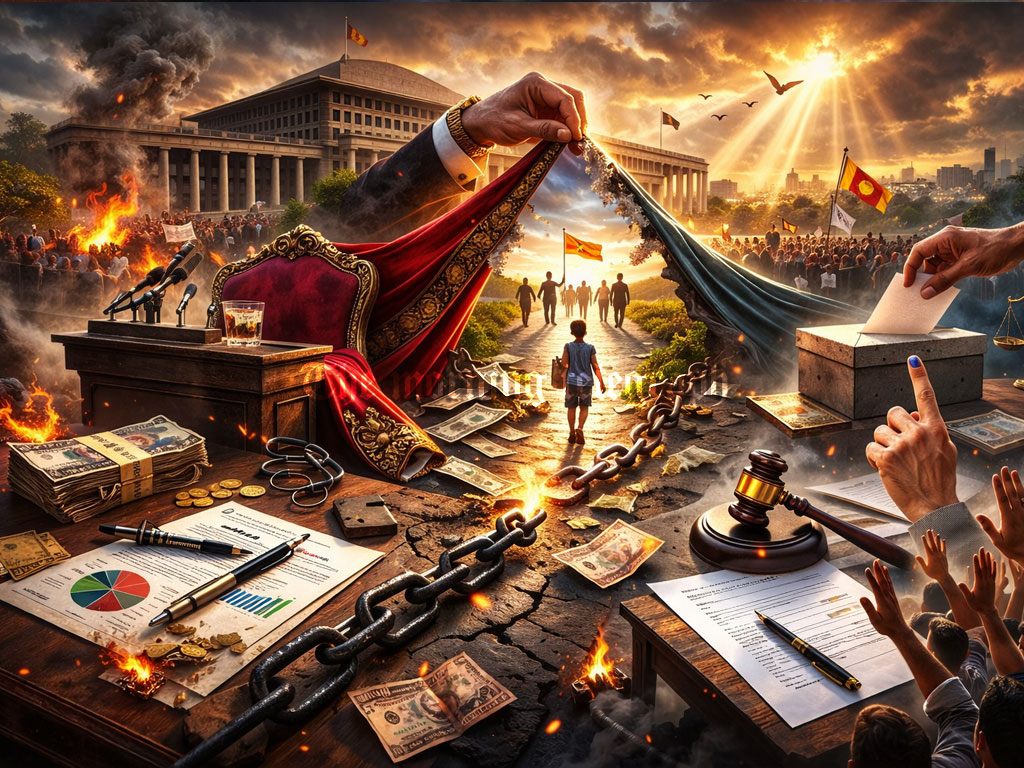
A reflection on power, public responsibility, and the patterns history asks us not to ignore.
By Roshan Jayasinghe
Author’s Note
This reflection is written from a simple conviction: societies improve only when people are willing to look honestly at the patterns shaping their public life.
Power, privilege, and political authority are not abstract ideas. They affect the daily lives of human beings. When those entrusted with leadership drift away from service and toward self-preservation, the responsibility of citizens is not silence but clarity.
History has shown repeatedly that harmful systems do not grow overnight. They grow slowly, often in plain view, until people begin to call them normal.
This piece therefore examines a recurring human tendency — the ease with which societies allow leadership to separate itself from the people it was meant to serve.

Seeing that pattern clearly is the first step toward correcting it.
The greatest theft in public life is not always committed in darkness, but in full view of the people who were taught to call it leadership.
There is something happening in public life that many people quietly notice, yet rarely pause long enough to examine.
Across the world elections arrive with ceremony and confidence. Stages are built. Speeches multiply. Leaders travel from place to place speaking in the language of service and responsibility. They promise progress, protection and opportunity for the people who place their trust in them.
For some, the words still sound sincere. They hear promises of service and improvement and hope that leadership may finally deliver what society needs.
But for others the language has begun to sound familiar. They hear the same historical phrases repeated from one election cycle to another, the same assurances of reform, the same declarations of responsibility toward the public.
History has taught them to listen more carefully.
And so a quiet question begins to form.
Do you see it as I see it, or have we lived with it so long that we now call it normal?
Politics was never meant to become a profession in the way it has today. In its original spirit public office was meant to be temporary stewardship. Someone would step forward to guide the affairs of society for a time and then return to ordinary life.
Authority was meant to be borrowed, not possessed.
Yet what we see now is something very different. People enter public office promising service and quickly discover that the structure allows them to shape the system around themselves. Positions expand. Advisory roles appear. Privileges become routine. Over time a political class forms that can influence the very rules governing its own existence.
None of this is hidden.
Which raises another simple question.
Do you still see service, or do you see a profession built around power?
Look carefully at the present world. Look at Donald Trump, Vladimir Putin, Benjamin Netanyahu, the Chinese Politburo, Recep Tayyip Erdoğan, Viktor Orbán, the Iranian leadership, the Saudi monarchy.
Different cultures. Different systems. Different languages. Different justifications.
Yet one familiar tendency.
Power gathers around itself. It protects itself. It enlarges its own significance. And the distance between those who govern and those who are governed slowly grows.
The point is not to pretend that every leader or every country is identical.
The point is to recognize the pattern.
Do we see it early enough to question it, or do we wait until its consequences become too visible to deny?
Language plays an important role in maintaining this arrangement. Political language is often emotional and persuasive. It speaks about the future of the nation, the struggles of ordinary people, and the responsibility of leadership.
But language can also become performance.
Promises are spoken with confidence even when reality may never sustain them. Complex problems are simplified into phrases that comfort the public. Emotion is carefully amplified because emotion moves crowds faster than careful thought.
When repeated often enough the performance becomes familiar.
Do you hear responsibility in these words, or are you beginning to hear something rehearsed?
Perhaps the deeper difficulty is not that people cannot see what is happening. It is that many of us have learned to look with blinkers on. Like a horse guided along a narrow road, we are encouraged to focus on one direction only. One party. One leader. One explanation for every failure.
Within that narrow view the larger pattern disappears.
Yet human intelligence was never meant for such confinement. We are capable of observing widely, remembering what has happened before, and connecting words with outcomes.
Experience is meant to teach.
If a society repeatedly witnesses performance, privilege and self-interest carried out under the language of public service yet learns nothing from it, the failure is no longer political alone.
It becomes human.
Another contradiction sits quietly in front of us.
Why do positions of public leadership require such lavish arrangements in the first place?
If leadership simply means facilitating the needs of society and safeguarding the systems created for human wellbeing, why must the role come surrounded by privilege?
One human being does not suddenly become superior to millions of others because they occupy a public office. That position exists only because citizens allowed it to exist.
Yet the moment someone enters that space the structure elevates them above the people who placed them there. Motorcades appear. Residences expand. Ceremonial distance is introduced.
And the separation quietly grows.
If leadership is truly service, why does the structure surrounding it resemble royalty?
Leadership should require humility, clarity and responsibility. It does not require grandeur.
History offers us a warning about the danger of normalizing such arrangements.
When the trials at Nuremberg exposed the crimes committed during the Second World War, the world was forced to confront something deeper than the actions of a few individuals. It revealed how systems of authority, bureaucracy and obedience can slowly normalize destructive behavior.
And the most uncomfortable truth that emerged from that period can be expressed in a simple sentence.
People let it happen.
Not always through direct action, but through silence. Through loyalty without thought. Through waiting too long before questioning what was already unfolding.
This does not mean every political failure becomes a crime of that magnitude. But history shows us a permanent human danger. When societies stop examining power critically, patterns of misuse can grow quietly until the consequences become severe.
The philosopher R. G. Collingwood suggested that the purpose of history is to help humanity understand itself. The only way to know what human beings are capable of doing is to examine honestly what human beings have already done.
History, in that sense, is not only memory.
It is self-knowledge.
And self-knowledge can be uncomfortable when it shows us patterns we would rather not admit.
Yet it also offers guidance.
Because if humanity can recognize its own patterns early enough, it can correct them.
There are examples in the world where leadership has remembered its purpose.
Bhutan offers one such example. A small Himalayan nation whose king chose to measure national progress not only through economic production but through something far more human. Gross National Happiness.
Instead of asking only how much wealth a nation produces, the question becomes whether the people living there are able to live balanced and meaningful lives.
The idea itself is simple yet profound.
Leadership should concern itself not only with prosperity but with human wellbeing.
If such leadership can exist in one place, another question naturally follows.
Why do we continue to accept its opposite elsewhere?
At this point another question arises.
If we can see these patterns clearly, what are we meant to do about them?
The answer does not begin in parliaments or presidential offices. It begins in the mind of the citizen.
Every system of power ultimately rests on the thinking of the people who sustain it. When citizens stop examining leadership carefully, systems drift toward privilege and self-preservation. When citizens begin to see clearly again, those same systems slowly begin to change.
The first responsibility is to observe honestly. To compare words with results. To refuse the comfort of loyalty to personalities and instead measure leadership by whether human life is actually improving.
The second responsibility is the courage to speak. Silence allows patterns of misuse to continue quietly. When people speak openly about what they see, when citizens, journalists, teachers and thinkers begin naming these patterns without fear, public life becomes harder to manipulate.
The third responsibility is participation with awareness. Democracies do not correct themselves simply through voting. They correct themselves when citizens vote thoughtfully, support leaders who demonstrate humility and accountability, and refuse to reward those who treat power as personal entitlement.
None of this requires upheaval.
It requires clarity.
It requires patience.
And it requires a growing number of citizens who recognize the pattern and quietly decide they will no longer cooperate with it.
That is how societies slowly change direction.
And when societies begin to change direction, another possibility appears.
Every generation is given only a brief moment on this earth. During that time we participate in shaping the society that others will inherit.
If our aim becomes competition, identity and power over one another, the structures we create will reflect that struggle.
But if our aim becomes clarity, fairness and responsibility toward one another, then leadership itself must transform.
Power would no longer exist for control.
It would exist for care.
Influence would no longer exist for advantage.
It would exist for improvement.
Perhaps the highest achievement of human life is not domination over others but the refinement of what we are capable of becoming together.
Wisdom. Responsibility. Justice. Compassion.
Or simply what might be called the finest expression of being human.
Humanity’s fineness.
Public office is not ownership of power.
It is borrowed responsibility.
And borrowed responsibility must always answer to the people.
And the direction of that responsibility ultimately rests not in the hands of leaders alone, but in the clarity of the citizens who choose them.
About the Author
Roshan Jayasinghe is a writer and observer of human systems. His work explores the gap between man made constructs and lived humanity, with a focus on how economics, trade and everyday choices intersect with questions of fairness, responsibility and inner alignment. Through essays for publications in The Morning Telegraph, he aims to remind readers that they are not passengers in a fixed machine, but active custodians of a shared world.