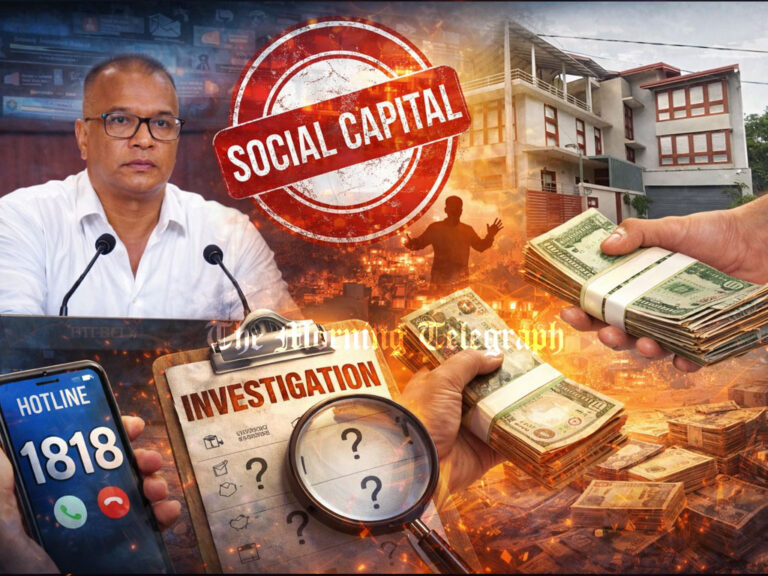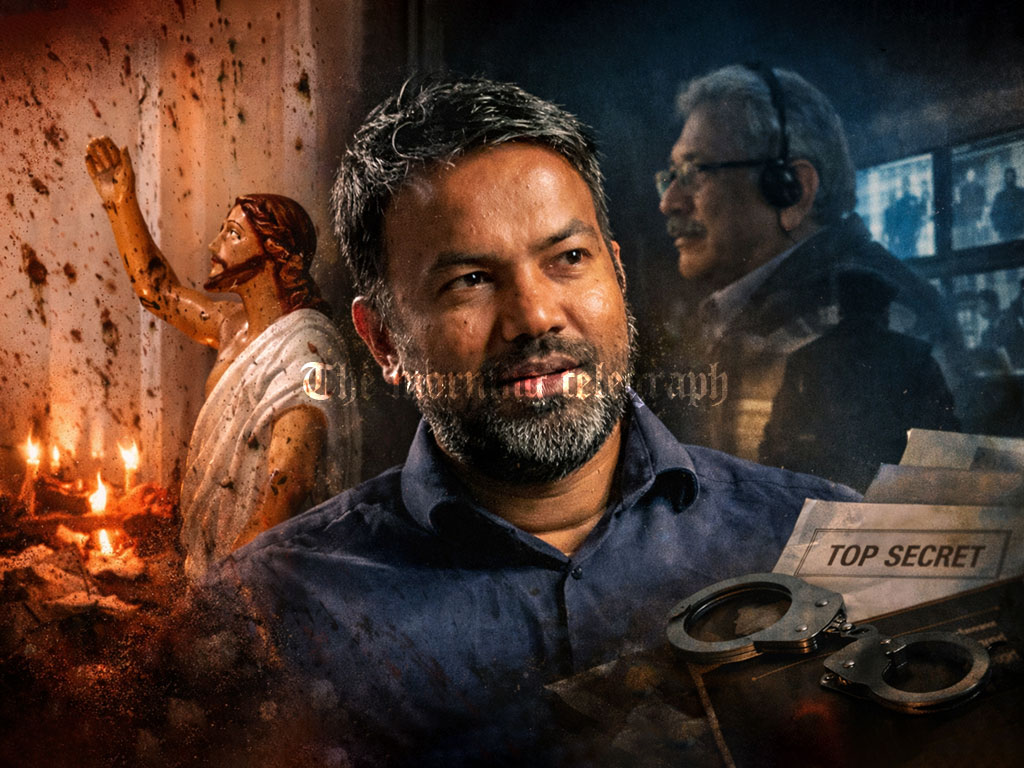
As Sri Lanka reopens the Easter Sunday investigation and detains a former intelligence chief under the Prevention of Terrorism Act, the focus has sharply shifted to Azad Maulana, the asylum seeker whose testimony fueled the controversial Channel 4 documentary, yet who remains absent from courts, investigators and the scrutiny his explosive allegations demand.
Two days ago the defamation case against Father Cyril Gamini, spokesman for Cardinal Malcolm Ranjith, came before court and was postponed for another month. When the Catholic priest walked out of the courthouse with a small group of associates and sympathisers, there was barely any media presence waiting outside. A few reporters approached the group and asked what had taken place inside the courtroom. Gamini declined to comment. Yet one of his companions suddenly remarked in a tone that sounded almost theatrical, “Let’s see, another Channel 4 documentary will come up soon on this issue too.”
The statement sounded casual at first. But it carried a clear undertone. It felt less like speculation and more like a signal that yet another media storm could soon surround the Easter Sunday investigation.

Meanwhile the Sri Lankan government, which promised during the election campaign to restart the long delayed Easter Sunday investigation, has taken a dramatic step. The former head of state intelligence has now been taken into custody under the Prevention of Terrorism Act with the approval of President Anura Kumara Dissanayake. The former intelligence chief has been placed under a ninety day detention order. Immediate family members are permitted to meet him only once a week for half an hour under supervision. His lawyers are allowed access every Wednesday.
These developments immediately raise a series of unavoidable questions. Where is Azad Maulana, the key figure in the Channel 4 documentary that accused Sri Lankan authorities of complicity in the Easter bombings? And where is the retired investigator who appeared in that documentary with his identity hidden behind shadows and digital distortion? Who created the narrative that transformed a national tragedy into an international media drama? And why are the central figures in that story now silent?
Seven years after the Easter Sunday attacks devastated churches and luxury hotels in April 2019, Sri Lanka still finds itself caught between two competing explanations. One narrative is grounded in intelligence files, interrogations and investigative evidence pointing to a network of Islamist extremists inspired by the Islamic State. The other insists the attacks were part of a hidden political conspiracy designed to influence the outcome of a presidential election.
The persistence of this second theory has left the country in a state of permanent suspicion. It has also diverted attention away from the ideological radicalisation that drove a group of young men toward mass murder. In its place there has emerged a parade of self declared informants, political opportunists and foreign media productions attempting to frame the Easter tragedy as a covert political plot.
The Easter bombings were not carried out by invisible forces. They were executed by individuals whose movements had been known to investigators well before the explosions occurred. The group was led by Mohamed Hashim Mohamed Zahran, widely known as Saharan, a fiery extremist preacher whose sermons promoting radical ideology had circulated for years.
Sri Lankan intelligence agencies had monitored Zahran and many of his associates. Several members of the group had travelled overseas, maintained encrypted communications and openly praised the Islamic State. Others attended gatherings where extremist interpretations of religion were promoted as a sacred obligation. These men were not driven by poverty or desperation. Many came from financially stable families and possessed foreign education or international business connections. Their radicalisation was ideological rather than economic. The violence that erupted on Easter Sunday was the final outcome of a worldview shaped and reinforced over time.
Yet almost immediately after the attacks the public narrative began to shift. Conspiracy theories appeared within hours. Some voices suggested foreign intelligence agencies had orchestrated the bombings. Others claimed the attacks were designed to benefit certain political actors during the upcoming presidential election. These theories spread rapidly through television debates, religious sermons and social media networks. The resulting confusion achieved one critical outcome. Attention shifted away from extremist networks that had quietly taken root within sections of society.
During this period another mysterious figure entered the story. The name “Abu Hind” began appearing in discussions related to the investigation. According to intelligence officials familiar with the matter, Abu Hind was not a real militant commander but a digital identity created by Indian intelligence agencies. The online persona was reportedly used to communicate with individuals influenced by Islamic State propaganda across South Asia.
Such undercover digital identities are common tools in counter terrorism investigations. They allow security agencies to monitor extremist conversations, gather intelligence and map networks of potential attackers. Zahran and several members of his group appear to have believed that Abu Hind was a senior Islamic State leader. In reality the identity functioned as a surveillance mechanism. Intelligence gathered through this channel was reportedly shared between Indian and Sri Lankan authorities as part of ongoing security cooperation.
Another important strand of the investigation involved a young man known as Podi Saharan, whose real name was Fazrul Rahman Mohamed Saharan. Intelligence regarding his activities was received from a Middle Eastern source early in 2019. Sri Lanka’s State Intelligence Service opened a file on him under the code name “Sonic Sonic,” a reference to the officer responsible for managing the investigation.
The intelligence material suggested Podi Saharan maintained contact with the Easter bombing network and followed the same extremist ideology. He returned to Sri Lanka shortly before the attacks and was later arrested. Investigators say he provided information suggesting that the group had planned further operations beyond Easter Sunday. These records indicate that authorities possessed fragments of the puzzle both before and after the attacks, although those fragments ultimately failed to prevent the catastrophe.
Another individual linked to the network was Abdul Latif Jameel Mohamed. Born in 1982 and educated in Kandy, he travelled to Australia for employment before returning to Sri Lanka. During his time overseas he became radicalised and attempted to travel to Syria through Turkey. When that attempt failed he returned to Sri Lanka and established an organisation called Jamaate Millate Ibrahim, which promoted Islamic State ideology.
Intelligence reports on his activities reached authorities as early as 2015. In 2018 he was questioned by the Terrorism Investigation Division but released after giving a short statement. A year later he detonated himself in Dehiwala as part of the coordinated Easter Sunday attack. His path illustrates how repeated warnings about extremist individuals circulated through the security system yet failed to trigger decisive preventive action.
Amid this already complicated investigation appeared Azad Maulana, a figure whose personal history is filled with contradictions. Born Mohamed Hanseer in the eastern district of Ampara, he studied at the University of Peradeniya before becoming connected with political figures linked to the Karuna Amman faction that split from the LTTE.
He later served as a press secretary within that political network and became involved in power structures in Sri Lanka’s Eastern Province. Over time he developed a reputation that ranged from political intermediary to financial fraudster. Complaints were reportedly filed against him in several police stations alleging fraud and personal misconduct. As legal pressure intensified he left Sri Lanka and applied for asylum overseas.
From that position abroad Maulana emerged as the key witness in the Channel 4 documentary alleging a secret political conspiracy behind the Easter Sunday attacks. In a recorded statement submitted to an international human rights organisation he claimed that Sri Lankan intelligence officials had secretly met members of the extremist group and allowed the attacks to proceed in order to create political fear that would benefit certain political actors. His allegations named senior figures including Major General Suresh Sallay, then the head of the State Intelligence Service.
Those accused strongly rejected the claims. Sallay responded through his lawyers stating that he had been stationed in Malaysia during the time Maulana alleged the secret meetings occurred. According to him diplomatic records could confirm his presence abroad. He also insisted that he had absolutely no involvement with the attackers or any plan related to the bombings.
The dispute quickly evolved into a battle between two competing narratives. On one side stood an asylum seeker presenting himself as a whistleblower exposing hidden state actions. On the other side were senior state officials describing his story as fabrication intended to shield himself from criminal prosecution.
The Channel 4 documentary amplified Maulana’s claims internationally. However the production itself also raised questions. Shortly before its broadcast the title of the programme was modified. The original title implied a clear revelation of who was responsible for the attacks. The final version suggested only that whistleblowers alleged state complicity. This shift indicated uncertainty within the production team.
Critics argued the documentary relied heavily on testimony from individuals whose credibility had not been independently verified through evidence. Supporters claimed it exposed uncomfortable truths that Sri Lankan authorities preferred to hide.
Recent developments have only deepened the uncertainty. The arrest of the former intelligence chief under the Prevention of Terrorism Act marks a significant escalation in the government’s investigation. Detention under this law allows investigators to question suspects for extended periods without formal charges. The move signals that authorities believe new investigative avenues must be explored. At the same time it raises concerns about whether the investigation is being shaped by political pressure, media narratives or public demonstrations.
The continued silence of Azad Maulana is particularly striking. If his testimony formed the foundation of a global documentary accusing the Sri Lankan state of involvement in mass murder, one would expect him to appear before investigators or courts to present evidence supporting his allegations. Instead he remains outside the country. The same question applies to the retired investigator who appeared anonymously in the documentary. Anonymous testimony may produce compelling television but it carries limited value in a court of law. Justice requires witnesses who are willing to stand openly behind their statements.
The actions of some elements within the Catholic Church have also drawn attention. Cardinal Malcolm Ranjith has been among the most outspoken critics of the state’s handling of the Easter investigation. His demand for accountability for the victims is understandable. Hundreds of people died or were injured in the attacks on churches and hotels. Families continue to mourn their losses. However when the Church associates itself with contested narratives promoted by individuals such as Maulana, it risks linking a moral cause to uncertain evidence. Justice cannot rely solely on rumours, political theatre or media productions.
Sri Lanka’s tragedy lies not only in the bombings but also in the confusion that followed. Competing narratives have repeatedly clouded the search for clarity. Extremist ideology, institutional failures, political rivalries and international media interventions have combined to create a complex and often contradictory story. The victims deserve something more solid than endless speculation.
The challenge ahead is clear. Evidence must replace conjecture. If Azad Maulana possesses proof that state officials orchestrated the Easter attacks he must present it in court under oath. If investigators believe the former intelligence chief bears responsibility they must prove it with documents, communications and credible testimony that can withstand judicial scrutiny. And if the attacks were indeed carried out by radicalised militants acting within their own ideological framework then Sri Lanka must confront the difficult reality that such extremism developed within its own society.
Seven years have now passed since the Easter Sunday bombings. Time has not healed the wounds nor resolved the unanswered questions. Instead the tragedy has produced an ongoing theatre of accusations in which politicians, clergy, activists and foreign broadcasters compete to shape the narrative. The recent arrest and the continued silence of the documentary’s central figure demonstrate that the story is far from finished. Whether the coming months bring clarity or simply another wave of spectacle will depend on whether those who claim to know the truth are finally prepared to prove it.