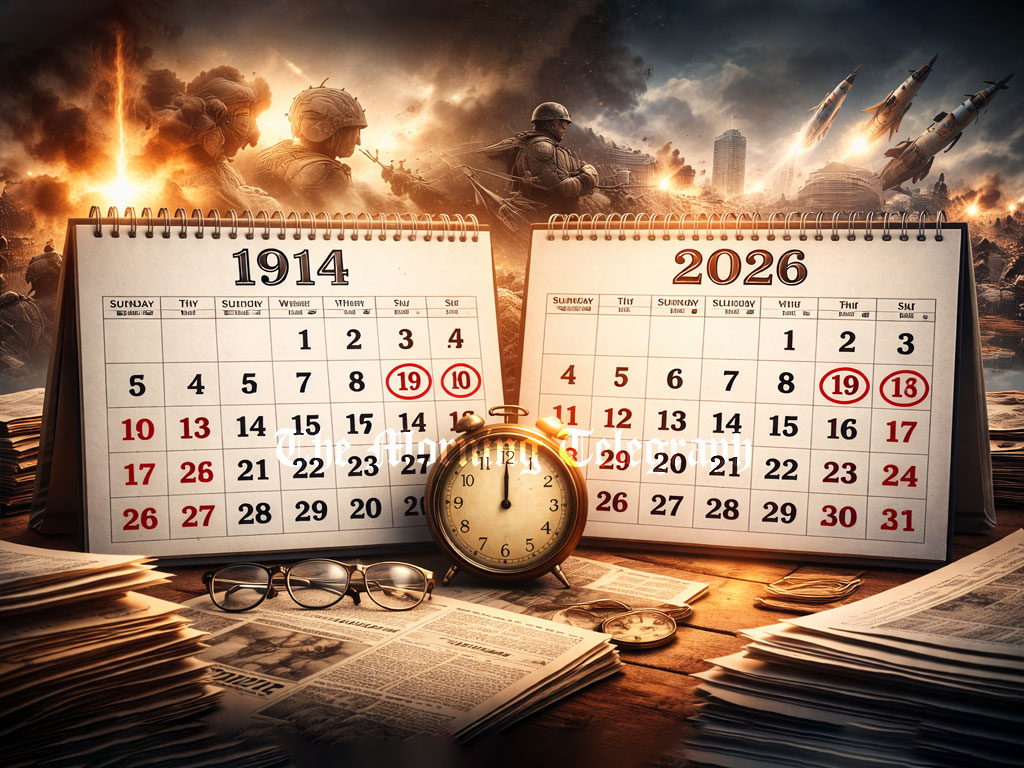
A surprising calendar coincidence linking 2026 with the year the First World War began is fueling intense online debate as rising global tensions make many wonder whether history could somehow echo itself again.
From time to time the world encounters unusual stories that capture widespread attention. This is one of those moments. What makes the situation especially intriguing is that it has surfaced during a period of growing international tension tied to the current geopolitical climate involving the United States and Iran. As global headlines continue to focus on conflict and instability, this unexpected discussion has sparked curiosity while also stirring unease among observers.

At first glance the topic seems like an interesting historical coincidence. Yet the timing has given it a slightly unsettling tone. People across social media and online forums have been asking what exactly this story means and whether it holds any deeper significance. The surprising element behind the conversation revolves around something everyone uses daily but rarely questions closely, the calendar itself.
Calendars typically follow predictable mathematical cycles, but it is uncommon for an entire year to replicate the pattern of another year exactly. When it does occur it is generally considered nothing more than a statistical alignment. Nevertheless the repetition noticed in the current year has generated considerable discussion among historians, commentators, and internet users.
Observers have pointed out that the calendar for the year 2026 is identical to the calendar used in 1914, the year widely remembered as the starting point of the First World War. This coincidence has triggered debate among those who see symbolic meaning in the overlap. The year 1914, which occurred more than a century ago, marked the beginning of one of the most devastating global conflicts in modern history.
Because of that connection some individuals have begun asking uneasy questions. Could history be repeating itself in some form. Is the world entering another period of escalating conflict. With tensions reportedly rising between nations such as the United States, Iran, and Israel, some commentators argue that the identical calendar structure creates an eerie historical parallel.
As international tensions continue to dominate global headlines, this so called calendar coincidence has drawn attention for the way it links two different historical periods. Over the past few days numerous theories about the matching 2026 and 1914 calendars have circulated widely through social media platforms, discussion forums, and digital news content. These interpretations have generated significant public interest and sparked debates about historical patterns and global events.
To better understand the conversation it is useful to look at the historical context surrounding the year 1914 and why it remains such an important moment in world history.
Historical Significance
The year 1914 holds enormous historical importance. On June 28 of that year Archduke Franz Ferdinand of Austria Hungary was assassinated in the city of Sarajevo. What initially appeared to be a regional political crisis quickly escalated into a much larger confrontation. The assassination triggered a chain reaction of diplomatic tensions and declarations of war across Europe.
Within weeks several major nations became involved in the conflict. This marked the beginning of the First World War, a devastating war that continued for nearly four years and drew many of the world’s leading powers into battle. Historians estimate that the conflict ultimately resulted in the deaths of approximately 20 million people, making it one of the deadliest wars ever recorded.
From a purely mathematical standpoint the similarity between the calendars of 1914 and 2026 is relatively easy to explain. Both years are non leap years and both begin on a Thursday. Because of this alignment every date throughout the year falls on the same weekday in both calendars. For example January 1 in 1914 occurred on a Thursday and January 1 in 2026 also falls on a Thursday. This creates an identical pattern of weeks and dates throughout the entire year.
Within the structure of the Gregorian calendar such overlaps can occur from time to time due to predictable mathematical cycles. However the association between 1914 and the outbreak of the First World War has caused some people to interpret the coincidence as something more ominous.
A similar wave of discussion emerged not long ago when people noticed that the calendar for 2025 was identical to the calendar of 1941. That year is historically linked to the escalation of the Second World War following major global developments. Several viral videos and social media posts highlighted the identical alignment of weekdays and dates in both years.
Among those discussing the topic online was YouTuber Kuldeep Singhania who shared a video explaining the calendar similarity on Instagram. In the caption accompanying the video he wrote that history appears to be repeating itself, a comment that quickly circulated across social media platforms.
The ongoing hostility between Iran and Israel has further intensified these discussions online. Various posts comparing the calendars of 1914 and 2026 have appeared across social networks suggesting possible connections to rising geopolitical tensions. Some posts even speculate about the possibility of a broader global crisis.
Despite these claims experts encourage the public to approach such interpretations carefully. Specialists in mathematics and history point out that the identical structure of the calendars is purely a numerical coincidence. The Gregorian calendar occasionally produces years where the arrangement of dates and weekdays matches that of earlier years. Because of this pattern identical calendars appear periodically and should not be seen as predictions of repeating historical events.