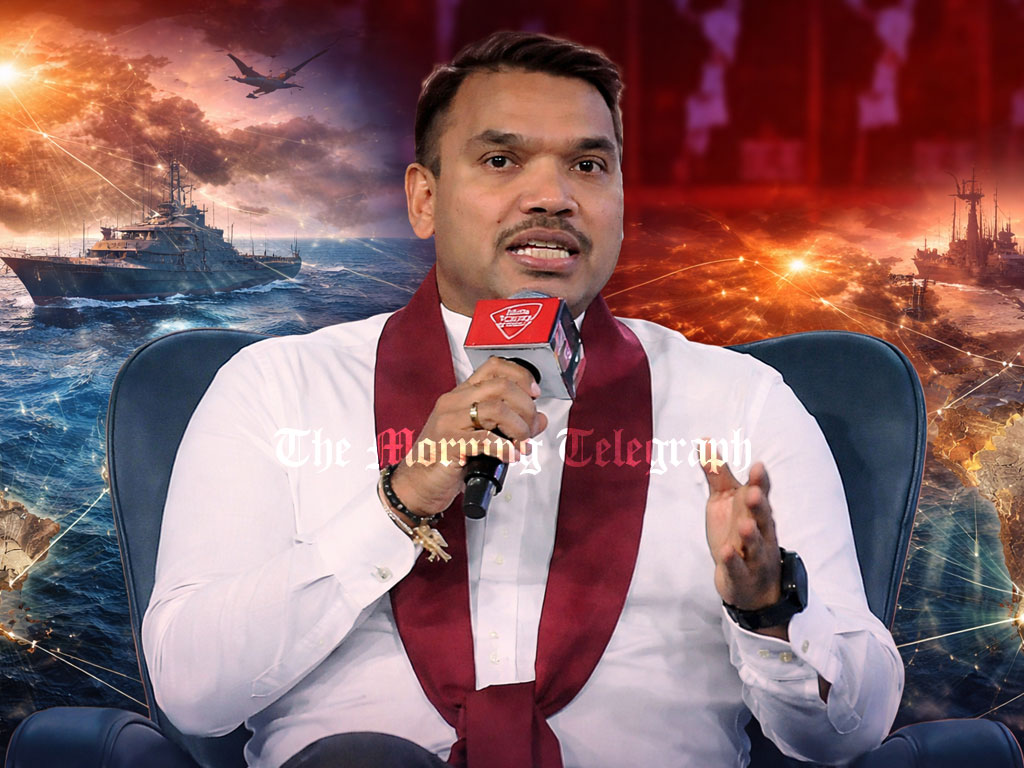
Namal Rajapaksa calls for urgent regional cooperation as the sinking of an Iranian naval ship near Sri Lankan waters raises serious concerns about Indian Ocean security and the wider geopolitical balance in South Asia.
Sri Lanka Podujana Peramuna National Organizer and Member of Parliament Namal Rajapaksa emphasized the urgent need for stronger dialogue and cooperation among regional nations to safeguard security in the Indian Ocean region. He made these remarks while participating in the India Today Conclave 2026 conference held in New Delhi, where geopolitical developments and maritime security in the Indian Ocean were widely discussed.

Rajapaksa warned that the recent sinking of an Iranian naval vessel near waters close to Sri Lanka could create new concerns for regional stability. The incident, he said, highlights the growing security challenges emerging in the Indian Ocean at a time when global tensions are already increasing.
The discussion session at the conference was titled “The Indian Ocean Faultline: Sri Lanka’s Geopolitical Balancing Act.” The conversation was moderated by Indian journalists Rajdeep Sardesai and Nagarajan Dwarkanath and focused on the strategic importance of Sri Lanka within the evolving geopolitical landscape of the Indian Ocean region.
Referring to the recent maritime incident, Rajapaksa spoke about the sinking of an Iranian naval ship named IRIS Dena near Sri Lankan waters during the ongoing conflict situation affecting parts of West Asia. The ship had previously taken part in naval exercises with the Indian Navy near Visakhapatnam, highlighting the vessel’s involvement in regional maritime cooperation before the tragedy occurred.
Rajapaksa noted that more than 80 Iranian sailors lost their lives in the incident. Survivors of the sinking are currently receiving medical treatment in hospitals located in Galle and Colombo. He said Sri Lanka responded quickly on humanitarian grounds to assist those rescued from the vessel.
“The Indian Ocean has traditionally been regarded as a safe zone for international trade and maritime navigation. An attack or incident involving a foreign naval ship in this region introduces a worrying development for regional security,” Rajapaksa said during the discussion.
He stressed that countries located along the Indian Ocean, including Sri Lanka, India and the Maldives, must strengthen dialogue and cooperation to ensure maritime stability and safe sea routes. According to him, regional security challenges cannot be addressed by a single country alone.
Rajapaksa also pointed out that cooperation should be strengthened through existing regional security frameworks such as the Colombo Security Conclave. He stated that India, given its economic strength and military capacity, is capable of playing a leadership role in maintaining stability in the Indian Ocean region. However, he added that true security can only be achieved through collective regional collaboration.
The Sri Lankan parliamentarian further said that Sri Lanka has every right to seek clarity regarding the circumstances surrounding the incident involving the Iranian naval vessel. Transparency and dialogue among regional partners are essential in maintaining trust and stability, he said.
Rajapaksa also warned that escalating conflict in West Asia could have serious economic consequences for Sri Lanka. He explained that the island nation remains highly dependent on the region for fuel imports, employment opportunities for Sri Lankan workers, remittances and tourism revenue.
He highlighted that instability around the Strait of Hormuz, one of the world’s most critical energy supply routes, could have a significant effect on global fuel markets. Such developments could indirectly impact Sri Lanka’s economic stability due to its reliance on imported energy supplies.
During the discussion Rajapaksa also responded to reports suggesting that the United States had requested Sri Lanka to repatriate Iranian sailors rescued after the incident. He said that while international partners are free to make requests, Sri Lanka must make decisions guided by its own principles and humanitarian responsibilities.
“Other countries may put forward their requests, but Sri Lanka must act based on its policies, humanitarian values and long standing neutral foreign policy,” Rajapaksa said.
The conversation also moved to broader regional relations, including Sri Lanka’s ties with India and the longstanding issue surrounding Kachchativu Island. Rajapaksa reiterated that the island legally belongs to Sri Lanka according to the 1974 bilateral agreement between the two countries.
He added that continued dialogue with authorities in Tamil Nadu is important to address sensitive matters such as fisheries disputes between Sri Lankan and Indian fishermen operating in the Palk Strait.
Rajapaksa also discussed the role of the South Asian Association for Regional Cooperation. While acknowledging that the organization was created with an important regional purpose, he said questions have arisen regarding its effectiveness in addressing modern geopolitical challenges.
According to him, South Asia may need new regional cooperation mechanisms that are better suited to respond to emerging security and economic issues facing the region today.
Addressing another frequent topic in international discussions, Rajapaksa rejected claims that Sri Lanka is allowing Chinese military influence in the country. He said that while China has invested in major infrastructure projects in Sri Lanka, the country will not permit foreign military bases to operate on its soil.
Bringing a lighter tone to the end of the discussion, Rajapaksa spoke briefly about his personal interests. He mentioned that actor Vijay is one of his favorite film stars and also praised Indian cricketers Abhishek Sharma and Sanju Samson.
Despite the lighter moment, Rajapaksa reiterated his earlier warning that the sinking of an Iranian naval vessel near Sri Lankan waters has the potential to affect security dynamics across the Indian Ocean region.