Chinese military aircraft and naval forces have intensified operations around Taiwan once again, raising fresh global concern about rising military pressure in the Taiwan Strait and the possibility of a future regional conflict.
After a brief slowdown lasting roughly two weeks, Chinese military activity around Taiwan has once again increased, according to official information released by Taiwan’s Ministry of Defense. The renewed presence of Chinese warplanes and naval vessels near the island has drawn attention from international observers who continue to monitor the fragile security situation in the Taiwan Strait.

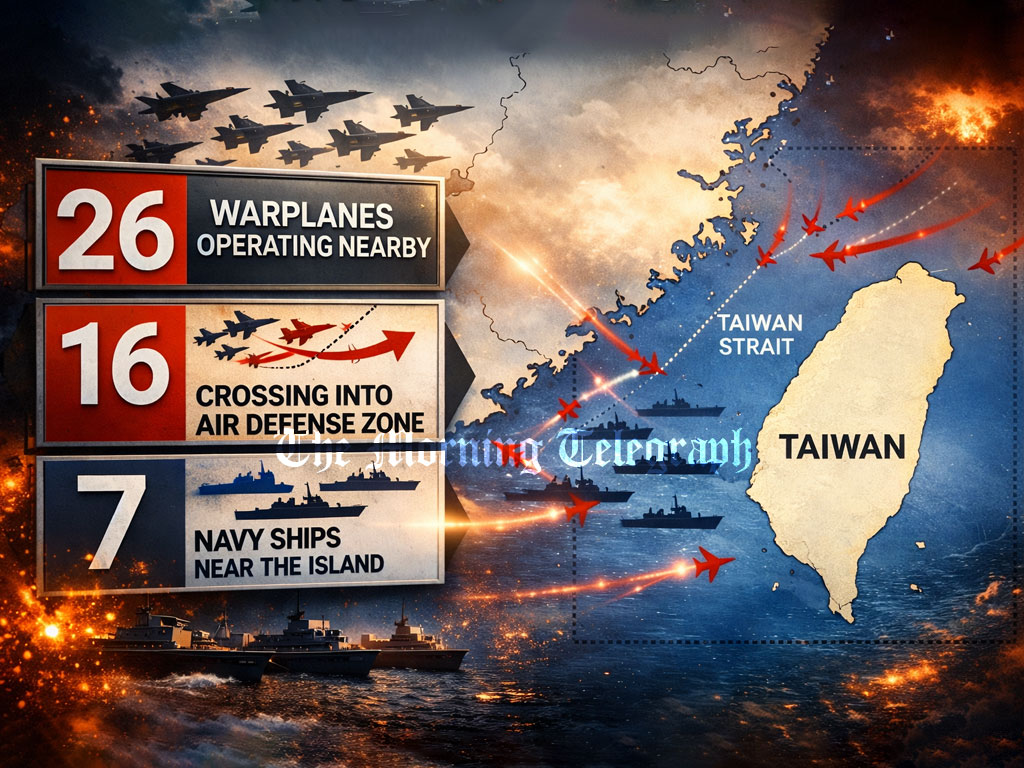
Officials in Taipei reported that Chinese military aircraft activity surged again on Saturday. According to the latest defense reports, a total of 26 Chinese military aircraft were detected operating in areas surrounding Taiwan.
Among these aircraft, 16 entered Taiwan’s northern, central and southwestern Air Defense Identification Zones, commonly known as ADIZ. Taiwan’s defense authorities closely track these zones because they represent critical early warning areas where potential military threats are identified and monitored.
Alongside the aircraft activity, Taiwan’s defense ministry also reported the presence of seven Chinese naval warships moving in waters near the island. The simultaneous presence of both air and naval forces has raised concerns among security analysts about the broader strategic intent behind the operations.
The recent spike in Chinese military operations follows an unusual lull that occurred between February 27 and March 5. During that period, Chinese aircraft did not cross the centerline of the Taiwan Strait, an unofficial but widely respected boundary that typically separates the operational areas of the two sides.
The absence of Chinese aircraft crossing the centerline during those days attracted the attention of analysts and observers who closely track military activity in the region. Although China sometimes reduces military maneuvers during important political events, the scale of the slowdown during that period appeared more significant than usual.
Military observers note that Chinese operations around Taiwan are sometimes scaled back during China’s annual legislative meetings. However, the reduction seen earlier this month appeared unusually sharp even by those standards, prompting speculation about the reasons behind it.
Another possible explanation being discussed relates to upcoming diplomatic developments. United States President Donald Trump is expected to visit China from March 31 to April 2. Some analysts believe that China may have temporarily reduced military pressure near Taiwan in an effort to maintain a more stable diplomatic atmosphere ahead of that high level visit.
At the same time, other defense experts suggest that the Chinese military may be focusing on new forms of training exercises as part of its broader modernization program. These exercises increasingly involve coordinated operations between air, naval and other military forces.
Taiwan’s Defense Minister Wellington Koo addressed the issue by stating that despite the temporary drop in Chinese aircraft activity, Taiwan has not lowered its guard. He emphasized that the country continues to maintain full defensive readiness and constant monitoring of military movements around the island.
Koo also noted that although Chinese aircraft operations decreased briefly, Chinese naval forces remained active in nearby waters during that time. This continued naval presence indicates that Beijing’s military posture around Taiwan has remained largely intact.
The tension between Taiwan and China is rooted in history. Since the Chinese civil war ended in 1949, Taiwan and mainland China have been governed separately. However, the government in Beijing continues to claim Taiwan as part of its territory.
Chinese authorities have repeatedly stated that they are willing to reunify with Taiwan peacefully, but they have also warned that force could be used if necessary. This longstanding dispute continues to make the Taiwan Strait one of the most sensitive geopolitical flashpoints in the world.