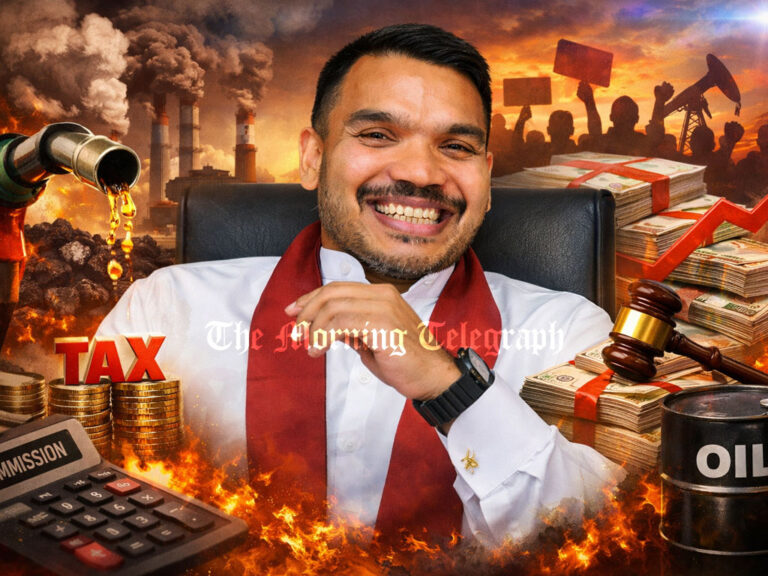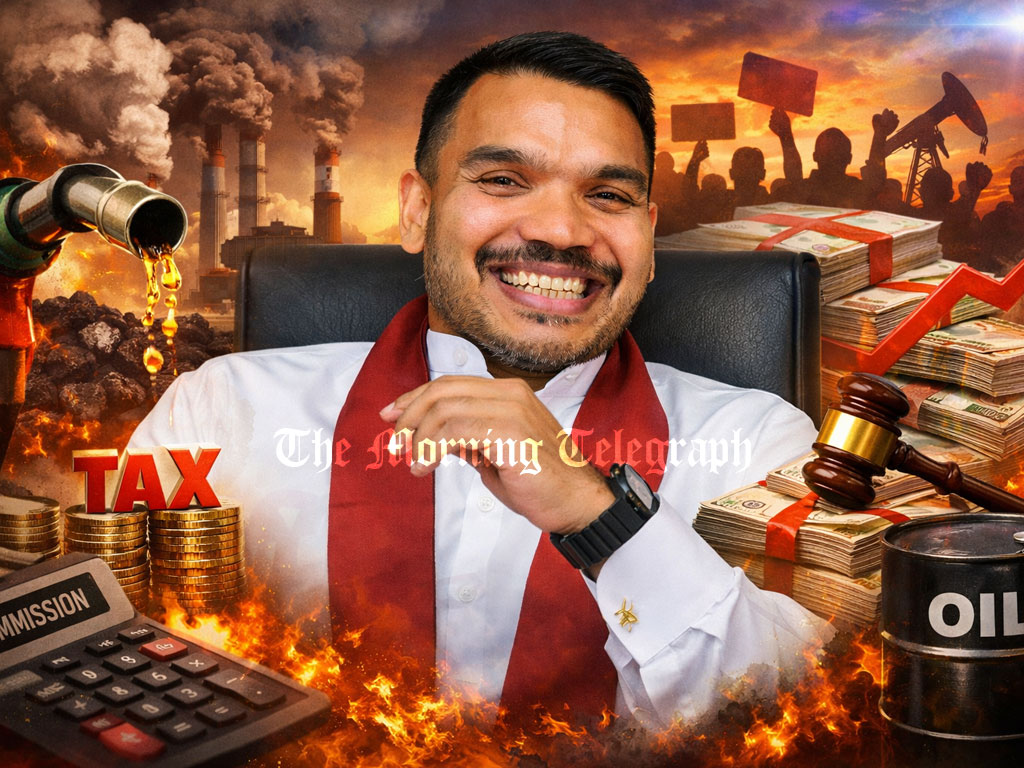
Sri Lanka’s rising fuel prices have ignited a new political clash as Namal Rajapaksa accuses the government of forcing ordinary citizens to pay for alleged corruption, mismanagement in the coal procurement process, and failed energy policy decisions.
Reduce the commission and taxes imposed on fuel and bring down the price of fuel for the public.
The government should have thought about the QR system earlier. In the past, we all heard the speeches made by this same President when the previous government introduced the fuel QR system. At that time the policy was strongly criticized. However, today we see that many countries around the world had already prepared similar systems in advance to manage fuel distribution and shortages. Therefore we can say that Sri Lanka has finally prepared for it, even though the preparation came quite late. Namal Rajapaksa, the National Organizer of the Sri Lanka Podujana Peramuna, made these remarks while commenting on the current fuel crisis and government policies.

Namal Rajapaksa further commented on the situation surrounding the increase in fuel prices.
According to him, today for the first time the price of fuel has been increased specifically to recover losses that have been created through the controversial coal procurement scandal. Therefore the financial losses that arose from what he called the coal scam are now expected to be borne by the people of the country. He argued that the burden is being transferred to ordinary citizens. He said the government is attempting to justify the increase by blaming global conditions and the threat of world conflict. However he pointed out that the losses linked to the coal deal were not created by the global market or international oil prices. Instead those losses were created by the decisions, actions, and alleged fraud of the current administration. Simply pointing a finger at fluctuations in the global oil market will not be enough to hide those issues or to explain the price increase to the public.
He also referred to earlier allegations that a minister was expected to gain a commission of one hundred and fifty from the process. If that claim was made publicly in the past, he said the government should now deduct that same one hundred and fifty from the price of fuel and provide relief to the people. If former ministers were accused of stealing that amount, then the current government should demonstrate transparency and remove that value from the fuel price structure. According to him, reducing that margin could immediately ease the financial burden faced by the public. He also criticized statements suggesting that the President cannot control fuel prices because Sri Lanka does not have oil wells. He added that the President should not avoid questions regarding the QR system by claiming a lack of technical expertise.
Namal Rajapaksa also raised concerns about the impact of fuel prices on essential services. He asked how three wheeler drivers, doctors, and other service providers could continue operating if fuel remains expensive. In both urban centers and rural areas many people depend on rental vehicles and long distance transport services for their livelihood. If fuel prices remain high, the entire transport sector will struggle. Therefore he argued that the government must examine these realities in a practical manner. He also said that sectors such as trade, business, and tourism which depend heavily on transportation must be protected with special arrangements to stabilize operating costs.
He also pointed out that the government should already be implementing policies such as work from home arrangements. Recently the President stated that the matter should be studied further before taking action. According to Rajapaksa there is nothing new to study because the world already experienced the same situation during the Covid 19 pandemic. During that time governments across the world successfully implemented remote working policies to reduce fuel consumption and maintain economic activity. Therefore the government should act quickly instead of delaying decisions through extended studies. He emphasized that Sri Lanka must adapt to the realities of global economic conditions and energy shortages.
He also criticized earlier government assurances that the country had sufficient fuel reserves and that there was nothing to fear. According to him those statements suggest either ignorance about the actual state of fuel reserves or deliberate attempts to mislead the public. In his view the government may not have properly understood how long existing oil stocks would last or how serious the supply challenge could become. He argued that political arrogance and misjudgment may have influenced these decisions. History has shown that when governments delay important decisions crises eventually lead to public protests and political upheaval. Therefore he said the current government should learn from the past and take timely decisions without repeating those mistakes.
He also drew attention to the growing fertilizer shortage affecting farmers across the country. According to him the government failed to allocate sufficient funds for fertilizer supplies earlier. As a result fertilizer prices have increased to levels that many farmers cannot afford. This has created a situation where agricultural production is threatened. If fertilizer continues to remain scarce or expensive, crop cultivation may decline sharply. Rajapaksa warned that the government appears to believe that rice and other essential food items can simply be imported from other countries. However during periods of global instability it is uncertain which countries will be willing or able to supply large quantities of food. Without strengthening local farmers Sri Lanka risks losing its agricultural self sufficiency.
He added that if farmers are not supported properly many farmlands will gradually be abandoned. If the country also fails to strengthen the fisheries sector and other food producing industries Sri Lanka may eventually depend heavily on foreign countries just to feed its own population. According to him this situation would severely weaken the national economy and food security. Therefore he accused the government of neglecting farmers and undermining the agricultural economy.
Rajapaksa also highlighted the growing gap between the conditions faced by farmers and the profits enjoyed by rice mill owners. He said the economic policies of the government appear to benefit powerful business groups rather than farmers who produce food. In addition the agricultural sector has already suffered serious damage from natural disasters such as Cyclone Ditva. Farmers have faced major financial losses as a result. He warned that if farmers continue to struggle consumers will also feel the consequences through rising food prices in the future.
Finally he referred to energy policy decisions taken during the administration of President Gotabaya Rajapaksa. At that time efforts were made to attract investors to renewable energy projects including wind power plants and solar power generation. Those investments were intended to prepare Sri Lanka for future energy challenges and reduce dependence on imported fuel. However after the change of government several of those projects were halted and investors were discouraged from continuing their involvement. Rajapaksa argued that those decisions have worsened the country’s energy crisis. Today the government is once again forced to rely heavily on diesel while powerful fuel related interests dominate the market.