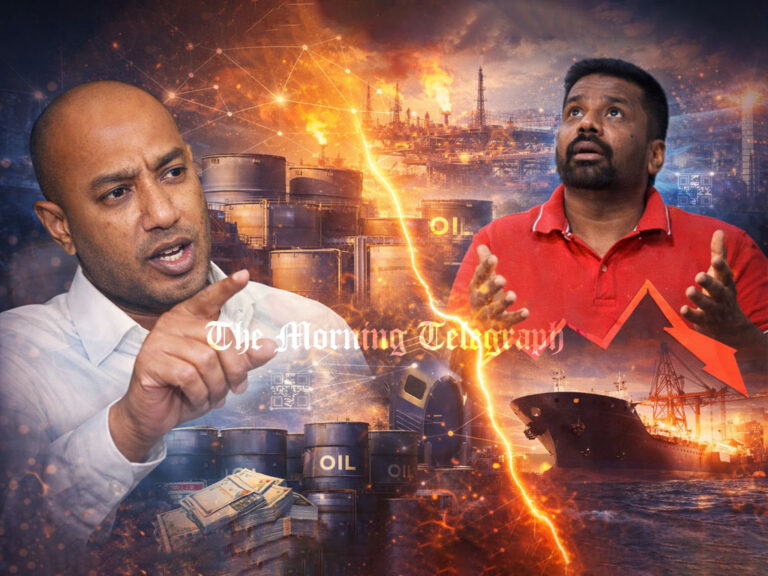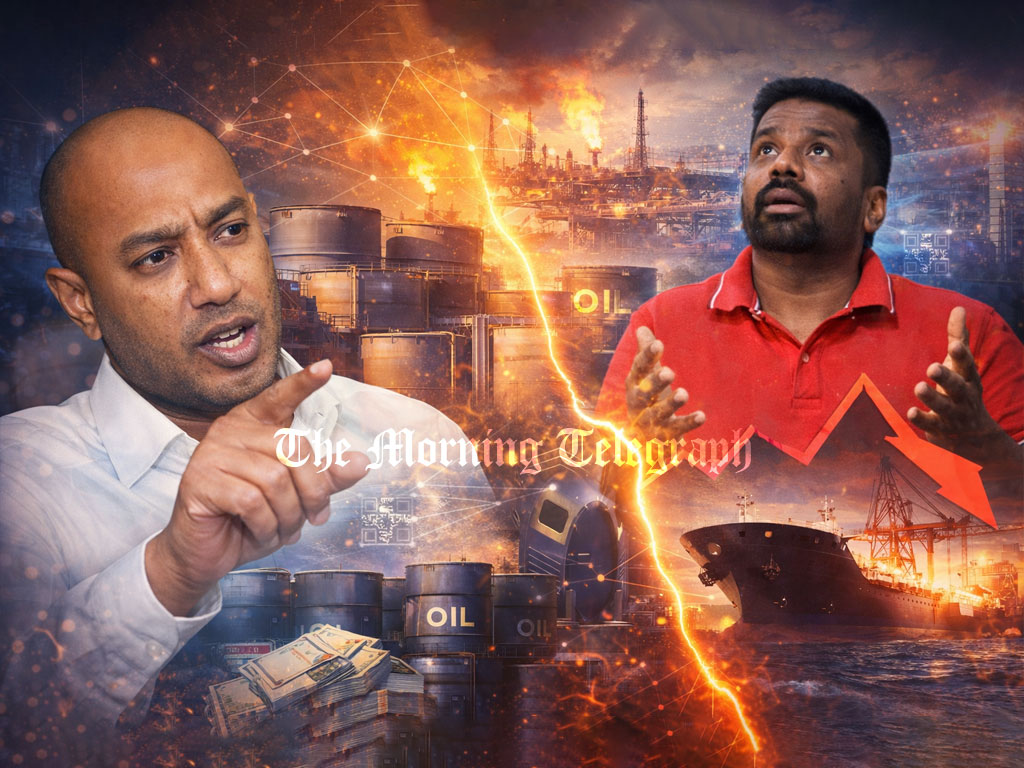
Former Minister Duminda Dissanayake launched a scathing attack on President Anura Kumara Dissanayake today, accusing him of blatantly lying to the public by first claiming 21 oil storage tanks were sufficient, then complaining about inadequate storage facilities after assuming office.
Speaking at a media briefing held at the Sri Lanka Freedom Party headquarters, Dissanayake tore into what he described as the “complete nakedness” of the current government’s leadership, alleging that incompetence and misinformation are pushing Sri Lankans into extreme helplessness regarding fuel and gas supplies.
Dissanayake characterized the President’s recent national address as nothing more than “whining” that exposed his own administrative failures rather than offering genuine solutions. He questioned the President’s credibility by highlighting a glaring contradiction in his statements before and after assuming power.

“Your President said when he first came to power that Sri Lanka does not need so many tanks to store oil, that 21 tanks are enough. Do not forget this is the same President now whining before the people, pointing fingers at previous governments for not having oil storage facilities,” Dissanayake declared.
The former minister raised specific concerns about the President’s claim of losing 100 million rupees through the Ceylon Petroleum Corporation, questioning how long the treasury would cover such losses and whether the country needs a leader with no clear plan.
Dissanayake also targeted Minister Bimal Ratnayake’s advice against hoarding oil, pointing out the irony that Ratnayake’s own friend reportedly still uses oil stored during the COVID period. He accused the JVP of deliberately creating an oil shortage during the pandemic, calling on Ratnayake to accept responsibility for those actions.
On coal shipments, Dissanayake noted that while eighteen coal ships were expected, only five have arrived, pointing to serious supply chain failures. He criticized the government’s mishandling of the QR payment system, suggesting they should seek advice from those who previously implemented it successfully rather than proceeding with arrogant incompetence.
“The President said he gave a tender to a trustworthy person. We ask, was it previously given to untrustworthy people?” Dissanayake questioned, challenging the government’s narrative.
Despite his criticism, Dissanayake emphasized that unlike the current government, he would not resort to scaring people or issuing threats about remittances, electricity cuts, or darkness. His remarks underscore growing political tension as Sri Lanka grapples with ongoing energy challenges.