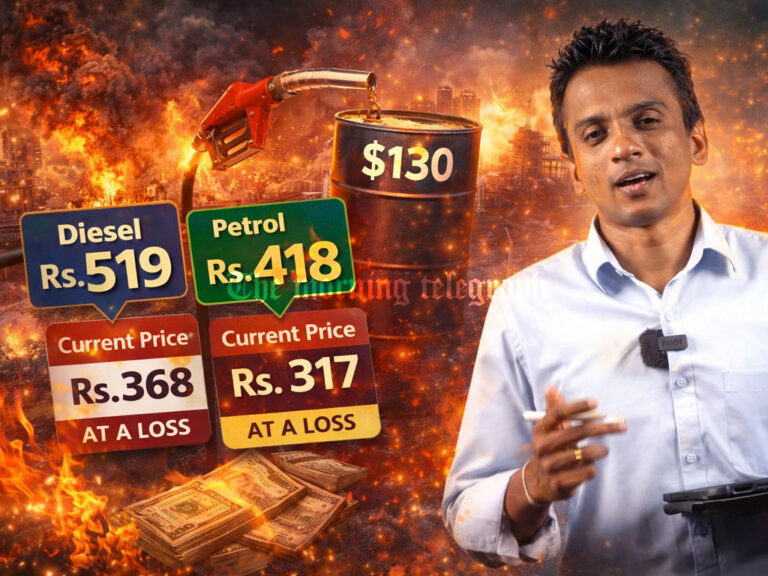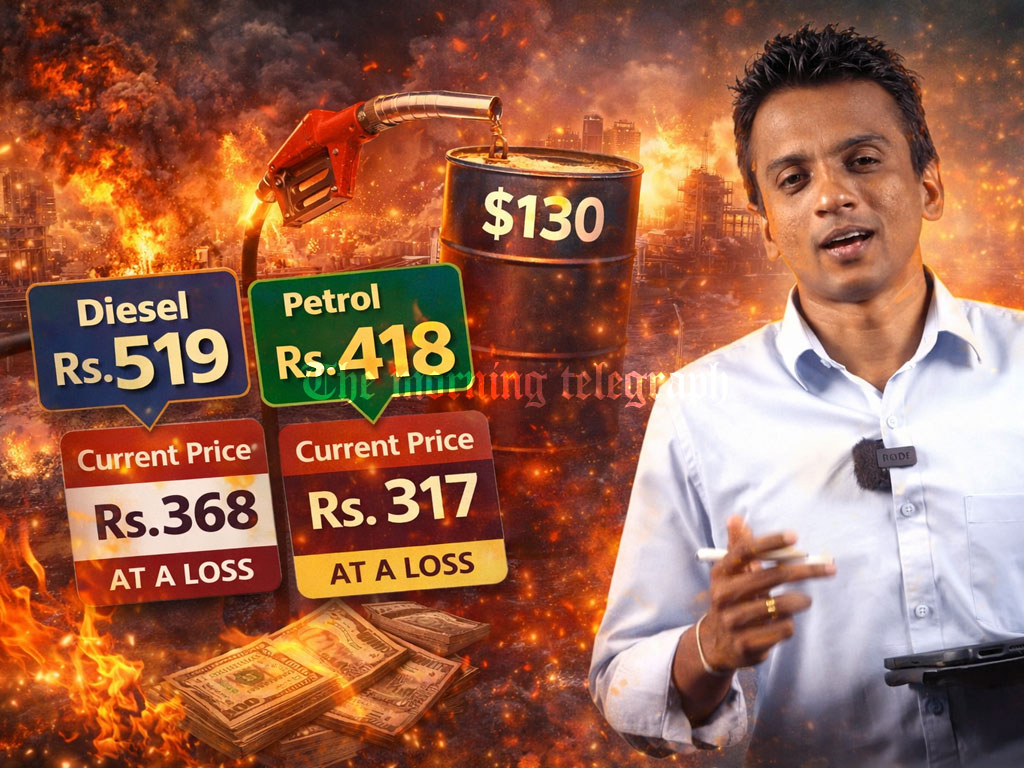
As crude oil barrels cross $130 amid Middle East turmoil, an economic analyst lays bare the brutal numbers exposing why Sri Lanka’s fuel prices are dangerously misaligned with reality, warning that selling at a loss could wreck the economy.
Sri Lanka faces an unavoidable fuel price shock as crude oil prices surge past $130 per barrel following attacks on energy hubs in the Middle East, according to economic analyst Dhananath Fernando.
Analyzing data from March 10, Fernando reveals that the actual cost of a liter of petrol has climbed to Rs. 418, yet it is currently sold at just Rs. 317, leaving a staggering gap of Rs. 101. The breakdown shows the unloading cost at Rs. 270, with government taxes adding Rs. 122, comprising VAT of Rs. 47, Social Security Levy of Rs. 3, and excise duty of Rs. 72. When transportation, storage, and distributor margins are factored in, the true cost reaches Rs. 418.

The diesel situation is even more alarming. Fernando calculates the unloading cost of a liter of diesel at Rs. 370. After adding government taxes of Rs. 98, which include VAT of Rs. 45, surcharge of Rs. 3, and excise duty of Rs. 50, the actual cost soars to approximately Rs. 519. This means diesel prices would need to rise by about Rs. 216 to align with current world market prices.
The analyst warns that while fuel price hikes place a heavy burden on ordinary citizens, continuing to sell fuel at a loss poses an even greater threat to the broader economy. Such practices, he explains, are unsustainable and could trigger deeper fiscal instability.
Fernando points directly to geopolitical factors driving this crisis. Attacks on energy infrastructure across the Middle East have sent crude oil prices skyrocketing, leaving import-dependent nations like Sri Lanka with no choice but to confront the harsh economic realities.
In light of the current situation, he emphasizes the urgent need to reduce fuel consumption and accelerate the transition toward alternative energy sources. His analysis suggests that waiting for global prices to stabilize is not a viable strategy, and proactive measures must be taken to shield the economy from further external shocks.
The numbers, he notes, leave little room for political maneuvering. With the gap between actual costs and retail prices widening by the day, the government faces a difficult decision between passing the burden to consumers or allowing state-owned enterprises to bleed further, risking a repeat of past energy sector crises that brought the country to its knees.