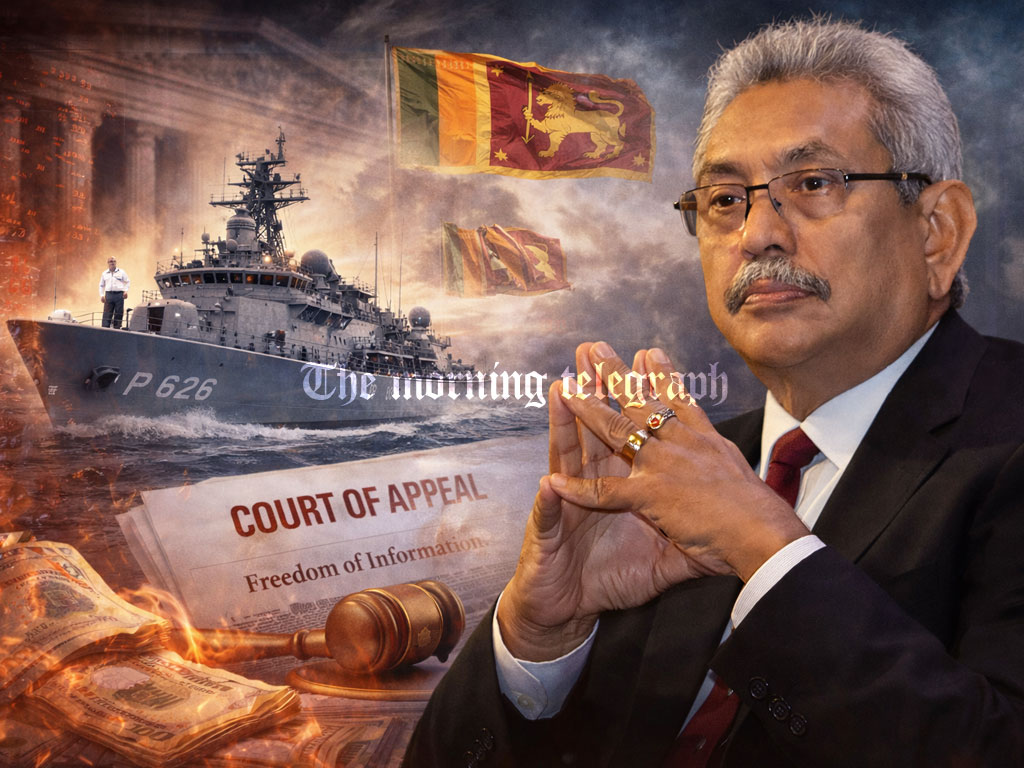
In a landmark decision, Sri Lanka’s Court of Appeal rules that national security cannot be used as a shield to hide financial details of former president Gotabaya Rajapaksa’s 2022 naval escape, upholding citizens’ right to information.
Sri Lanka’s Court of Appeal delivered a landmark ruling on March 19, affirming a previous order by the Right to Information Commission that required the disclosure of expenses and payment details related to the naval vessel allegedly used by former president Gotabaya Rajapaksa to flee the country in July 2022. The decision marks a significant moment in the country’s legal landscape regarding national security and transparency in governance.

The case originated from a Right to Information request filed in September 2022 by a citizen named A. A. M. R. Ali under the Right to Information Act No. 12 of 2016. The request was directed to the Sri Lanka Navy and sought specific details surrounding media reports that the former president had traveled aboard the SLNS Gajabahu, a naval ship. The requested information included the vessel’s name, travel duration and route, names of those accompanying the former president, the total cost borne by the Navy, and the source of payment for the journey, among eight specific points.
Initially, in November 2022, the Sri Lanka Navy rejected the request in its entirety, citing Section 5(1)(b)(i) of the RTI Act, which pertains to information that could harm national security. Dissatisfied with this response, the requester appealed to the Right to Information Commission.
After reviewing the appeal in 2023, the Commission ruled on August 29, 2023, that while requests 1 through 5 and 8 could be withheld, the information sought under items 6 and 7, specifically the travel expenses and the entity that paid for them, must be disclosed. It was against this order that the Navy Commander filed the present appeal before the Court of Appeal.
What the Court Ruling Stated
In its judgment, the Court addressed the Navy’s argument that the information constituted more than routine data. The Navy had contended that revealing fuel consumption and cost details could allow calculations regarding a vessel’s speed, operational range, and refueling patterns, thereby posing a threat to national security interests.
However, the Court observed that such technical data could already be calculated by ship manufacturers and that much of it existed within the public domain. Consequently, the Court found the Navy’s justifications for withholding information to be unsatisfactory and unacceptable.
The judgment drew upon international standards, referencing the United Nations Johannesburg Principles on freedom of expression and access to information when weighing national security against the public’s right to know.
While the Court acknowledged that a reasonable link might exist between the requested statistics and national security, it emphasized that simply claiming national security was at risk could not serve as a blanket excuse for withholding information. The Court noted that in the present case, the appellant had failed to demonstrate a clear connection between disclosing the travel costs and payers and any actual harm to national security under Section 5(1)(a) of the RTI Act.
Furthermore, the Court highlighted Section 5(4) of the Act, which mandates that information must be disclosed if the public interest in disclosure outweighs the harm that may result.
Accordingly, the two-member bench comprising Justices Dr. Sumudu Premachandra and R. Gurusinghe upheld the RTI Commission’s order dated August 29, 2023, and dismissed the Navy’s appeal.
Key Observations from the Bench
Delivering the judgment, the Court of Appeal bench noted that public authorities possess the power to withhold highly sensitive information related to national security under the provisions of the RTI Act. However, the bench emphasized that disclosure is the rule under the RTI framework, while non disclosure remains the exception.
The judges observed that for information to be withheld on national security grounds, the petitioner must present compelling evidence before the court demonstrating that real or identifiable harm would result from such disclosure.
In this specific case, the Court found that the appellant had failed to provide any substantial proof as to how revealing the travel costs and the payers would compromise national security. In the absence of such concrete evidence, the Court held that authorities could not invoke the exemptions within the RTI Act to withhold information.
Ultimately, the Court of Appeal confirmed the RTI Commission’s order and rejected the Navy’s appeal, reinforcing the principle that citizen’s right to information cannot be overridden by vague assertions of state security.