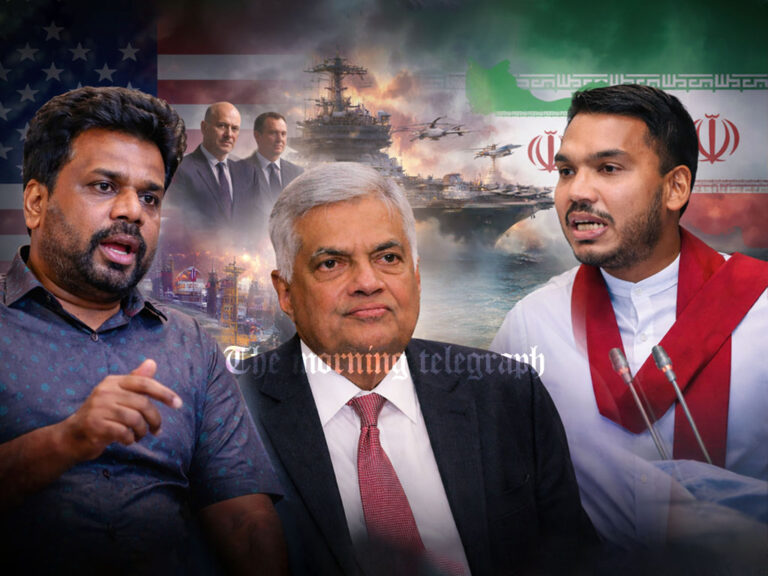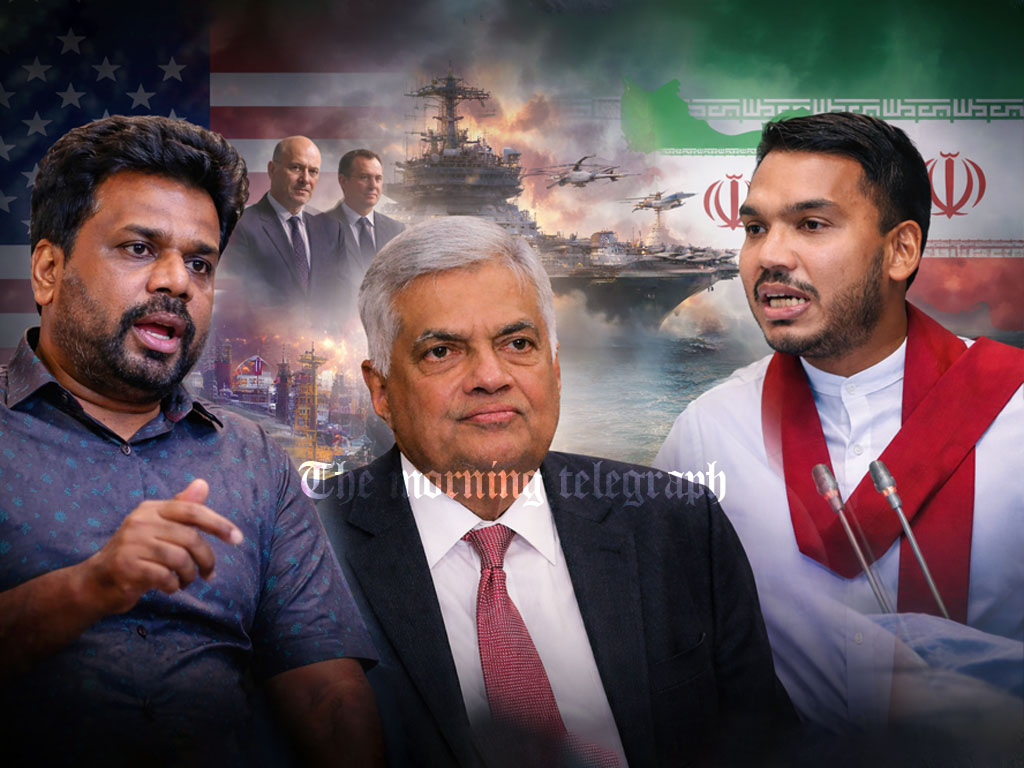
As the Middle East war escalates, two senior US officials make an unannounced visit to Sri Lanka, conduct covert inspections of Colombo Port, and trigger intense debate over the nation’s fragile balancing act between global powers while domestic political turmoil deepens.
The primary issue gripping the world today remains the war launched by the United States and Israel against Iran. With 22 days having elapsed since hostilities commenced, numerous Middle Eastern nations have been drawn into the conflict, elevating the threat of a worldwide energy crisis. In just three weeks, the Middle East war has managed to destabilize global markets, disrupt supply chains, and send shockwaves through economies far beyond the immediate conflict zone.

Against this turbulent backdrop, the government is already confronting a severe fuel and gas shortage. Like a snake inadvertently welcomed into one’s home, Sri Lanka has now found itself entangled in another diplomatic predicament following an attack on an Iranian vessel within its Exclusive Economic Zone. Immediately after the incident, the Navy stated that it was not caused by an attack. However, US authorities later confirmed that the Iranian ship was sunk by a torpedo launched from one of their submarines. In response, Iran issued a special statement warning all involved parties to be prepared for consequences. It remains ambiguous whether this was aimed directly at the United States or indirectly at Sri Lanka, particularly as Iran may have received indications that Sri Lanka is tilting toward a pro US stance. This ambiguity has left Sri Lanka in a precarious position, navigating between two global powers with competing interests.
Coast Guard Vessel Agreement
We reported last week that under an agreement between the Sri Lankan government and the United States, a coast guard vessel and ten helicopters are scheduled to be provided to Sri Lanka. Sergio Gor, Special Representative of US President Donald Trump for South and Central Asia, was expected to visit in May to hand over these assets. Given Gor’s close ties to the President, it was noted that the President could even contact Trump directly through him if necessary. However, we also highlighted the risk that Gor’s visit could spark a diplomatic crisis, especially as the Iran war continues to intensify and regional alliances are being tested.
Additionally, a delicate situation persists regarding the sailors from the attacked Iranian vessel, as well as those from a third Iranian ship, who remain at the Welisara Naval Base. Although the government initially stated that the third vessel would be moved beyond Trincomalee Port limits, it remains anchored approximately 19 kilometers off Colombo within Sri Lankan waters. Officials attribute this to a mechanical failure that has left the vessel unable to sail. This standoff has raised concerns about how Iran might perceive Sri Lanka’s handling of the situation, particularly given Tehran’s warning about consequences for parties involved.
Gor Arrives Secretly
Against this backdrop, an unexpected and highly confidential development unfolded last Wednesday. Sergio Gor suddenly arrived in Sri Lanka. He was not alone; another key figure arrived from Washington simultaneously: Michael Jeremiah. Jeremiah holds significant influence within the White House and is a close associate of President Trump. He serves as a senior official on the White House National Security Council, one of the highest advisory bodies on security matters, and is known to operate largely behind the scenes. With the Middle East war at a critical juncture, the unannounced joint visit of Gor and Jeremiah has been interpreted by many as highly significant. The secrecy surrounding their arrival suggests that the visit carried strategic importance that neither side wished to publicize prematurely.
Meeting with the President
The day after his arrival, Gor met with the President for discussions. While precise details remain undisclosed, reports indicate that talks centered on the Iran war and development activities at Colombo, Hambantota, and Trincomalee ports. Some sources suggest Gor may have discussed investment opportunities in these three ports with the President, focusing on how US involvement could counterbalance Chinese influence in the region.
There is a specific context for this. Approximately one month ago, a discussion on Sri Lanka took place in the US Senate, which we previously reported. During a meeting of the Senate Foreign Relations Committee, Assistant Secretary for South and Central Asia Paul Kapur made several notable remarks. He stated that Sri Lanka has now become one of the most important maritime routes in the Indian Ocean and South Asia. Not only Middle Eastern oil shipments, but major global import export routes pass close to Sri Lanka. Although Sri Lanka and its maritime region had not previously received much attention in Washington, the current situation means they can no longer be treated as just another South Asian country. He noted that China appears to have recognized this earlier and has been aggressively increasing its influence, already securing control over Hambantota Port. He also described the 2022 visit of a Chinese research vessel as a major warning signal, stressing that both the US and India must closely monitor developments.
When asked what steps should be taken to realign Sri Lanka toward the United States, Kapur responded that although Sri Lanka is emerging from a severe economic crisis, it lacks a proper economic plan. He suggested that the US should help Sri Lanka develop such a plan and support it through the International Monetary Fund. He also pointed out that Sri Lanka is struggling with foreign debt restructuring and attracting investment. Therefore, the US should help strengthen Sri Lanka’s ties with India as a regional counterweight to Chinese expansion.
Kapur further stated that Sri Lanka is currently under significant Chinese influence due to heavy borrowing for infrastructure projects. While some of this debt burden has been reduced, the country remains constrained. He also emphasized the need to rapidly increase military cooperation with Sri Lanka. Rather than establishing a US military base, which could provoke regional backlash, he suggested joint naval operations with India, along with providing Sri Lanka with necessary military equipment. He also highlighted the importance of developing mechanisms to monitor drug trafficking and maritime security threats in the Indian Ocean. Overall, Kapur’s remarks indicated that Sri Lanka may be in a relatively advantageous position, with opportunities to leverage international support for investment and economic recovery, provided it navigates these competing interests carefully.
Gor at Colombo Port
Many suspect that Gor’s sudden visit was linked to exploring investment opportunities in Sri Lanka’s ports. A significant incident during his visit further fueled these suspicions. Even before arriving, Gor had informed authorities that he wished to conduct an inspection tour of Colombo Port. After meeting the President, Gor went directly there. His visit had not been publicly announced, and even port employees only became aware when security was suddenly tightened, suggesting an operation conducted with a high degree of confidentiality.
Upon arrival, Gor climbed to the top of one of the gantry cranes and spent considerable time observing the Indian Ocean and the positioning of Colombo Port. From this vantage point, he would have had an unobstructed view of shipping lanes, port infrastructure, and potential naval berthing locations. He then proceeded to the Pilot Station, where he again spent a long period studying the surrounding area and consulting with port officials. He later visited the Eastern Terminal and the Western Terminal operated by India’s Adani company, continuing his observations. This raised a key question: why did Gor conduct such an unannounced, detailed inspection? Many suspect that if the Middle East war reaches a critical stage, the United States may be preparing to bring its naval vessels to Sri Lanka in an emergency, using the port as a strategic logistical hub. It is also reported that Gor is planning a similar visit to Hambantota Port, which would further indicate US interest in securing maritime access points in Sri Lanka.
Minister in Washington
Another notable development occurred on March 14 at the US State Department, where Sri Lanka’s Minister of Ports and Civil Aviation, Anura Karunatilaka, held discussions with officials from the Bureau of South and Central Asian Affairs regarding port and aviation sector development. During these talks, US authorities engaged in extensive discussions on improving infrastructure at Sri Lanka’s ports and airports, focusing on modernization, security enhancements, and potential US investment. Many believe Gor’s subsequent port inspections were a direct follow up to these talks, indicating a coordinated strategy.
However, while details of Gor’s visit have emerged, there has been almost no information released about Michael Jeremiah, who arrived with him. Jeremiah’s role in the White House National Security Council suggests that his presence was related to security assessments rather than purely economic discussions. This has drawn attention, prompting Samagi Jana Balawegaya MP S.M. Marikkar to question the government in Parliament regarding Jeremiah’s purpose and whether any agreements were reached during his stay.
Amid the ongoing Middle East war, there is growing uncertainty over whether these potential US investments will benefit Sri Lanka or create new risks. Some argue that such investments could expose the country to serious dangers, including becoming a target for Iran or its allies. The United States has previously opposed investments by countries like China in Sri Lankan ports. Therefore, questions remain about how China would respond to increased US involvement in ports it has long viewed as strategically vital. Similarly, there is uncertainty over India’s reaction, given New Delhi’s own interest in Sri Lankan maritime infrastructure, as well as how countries aligned with Iran might view these developments.
Was Anura Misled?
Last week, we reported on a discussion in which the President decided to increase fuel prices by Rs. 24 in response to the Middle East crisis. Although officials had recommended an increase of Rs. 80, the President initially rejected this and reduced it to Rs. 24. However, new information suggests that officials may have provided incorrect advice during that discussion. The President had proposed reintroducing the QR code system to limit fuel usage, a measure previously used during the 2022 crisis, but officials reportedly opposed it, claiming it would be ineffective. They argued that although the QR system was introduced during the 2022 fuel queues, it had not achieved its intended results due to implementation challenges. Despite this, just three days later, the President decided to reintroduce the QR system, raising serious questions about why officials initially advised against it and whether misleading data was presented. Reports indicate that the President has already received information regarding this matter and is reviewing the advice provided by his energy advisors.
At a subsequent media briefing, the President himself admitted that the system was reintroduced despite being aware of potential issues. This suggests that the decision was made without proper planning or preparation, possibly under pressure from the escalating fuel crisis. This was further confirmed as the public continued to face numerous difficulties even days after the QR system was reintroduced, with long queues and system malfunctions reported across the country.
Ranil’s Surgery
Samagi Jana Balawegaya leader Sajith Premadasa and UNP leader Ranil Wickremesinghe were expected to meet at a commemoration event for Gamini Dissanayake organized by Navin Dissanayake. The meeting was seen as a potential step toward opposition unity ahead of future political challenges. However, Ranil was already receiving treatment at a private hospital in Colombo for a heart related condition. His condition worsened, and after about a week, doctors advised heart surgery. His family decided to carry out the procedure at Mount Elizabeth Hospital in Singapore, where he underwent a complex nine hour operation. Due to the seriousness of the surgery, his brother and sister traveled to Singapore, along with several senior UNP members including Vajira Abeywardena, Sagala Ratnayaka, and Talatha Athukorala.
Doctors have strongly advised him to limit political activities and avoid stress during his recovery period. He is expected to remain under hospital care for at least three more weeks before returning to Sri Lanka. The successful completion of the surgery was publicly announced by MP Ravi Karunanayake in Parliament, who stated that Ranil’s condition is now improving steadily. Due to this, Ranil will be unable to attend the Gamini Dissanayake commemoration, and his political activities will likely be significantly limited moving forward. Under these circumstances, the UNP may have little choice but to move toward closer cooperation with the Samagi Jana Balawegaya, with discussions between the two parties expected to accelerate after the commemoration event.
Sajith Ready to Take Responsibility
The President suddenly decided to come to Parliament to brief it on the situation arising from the Middle East war, followed by a party leaders’ meeting. Opposition Leader Sajith Premadasa objected, stating he needed time to respond and requested a delay. Eventually, the President delivered his speech at around 11:00 a.m., addressing the nation’s energy security concerns and diplomatic challenges. Sajith then proceeded to deliver a strong response, criticizing the government’s handling of the fuel crisis and its perceived alignment with US interests without adequate safeguards.
Meanwhile, Sajith convened a special management meeting of the SJB to discuss steps the party should take if the country faces another severe economic crisis. He appointed a special committee including Ranjith Madduma Bandara, Tissa Attanayake, S.M. Marikkar, Mujibur Rahuman, and Harshana Rajakaruna to recommend both short term and long term measures to mitigate potential economic fallout from the Middle East war.
Jayakody’s Trip Cancelled
Power and Energy Minister Kumara Jayakody faces a major political crisis, with a High Court case filed by the Bribery Commission and a no confidence motion submitted against him. He had planned a six day official visit to India last week, seeking energy cooperation and fuel supply assurances, but due to the ongoing Middle East war, India informed Sri Lanka that facilitating the visit would be difficult under current circumstances. Ultimately, the visit was cancelled at the last moment, just half an hour before departure, leaving the government without a key diplomatic engagement at a critical time.
Namal Takes the Issue International
A dramatic turn occurred when the Bribery Commission informed the court about a statement allegedly made by former SriLankan Airlines CEO Kapila Chandrasena regarding an Airbus deal. However, within hours, it was reported that Chandrasena had submitted an affidavit claiming the statement was obtained under pressure. MP Namal Rajapaksa, attending an event in New Delhi at the time, consulted senior party members and has decided to take the issue to the international stage. He plans to lodge complaints with the Geneva Human Rights Commission, the Inter-Parliamentary Union, and the United Nations. Upon returning, he reportedly informed SLPP members that based on information he has received, the situation could worsen further by June and July, urging party unity in the face of what he described as politically motivated legal actions.