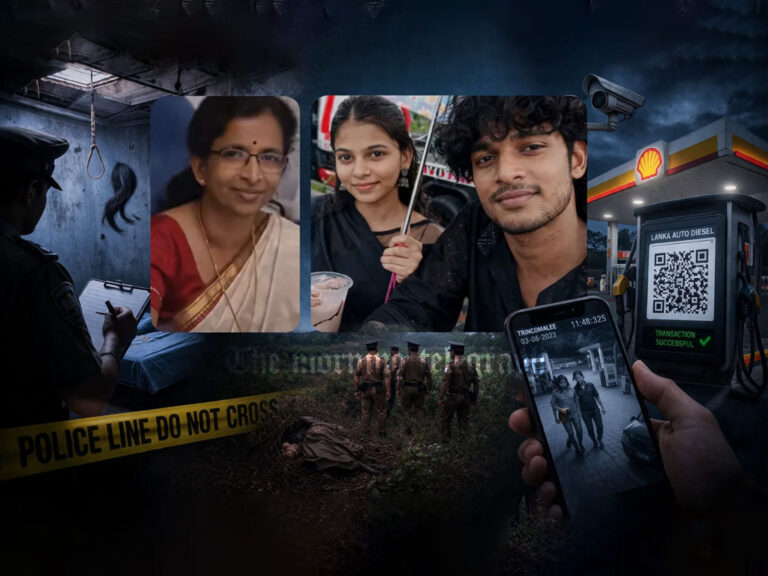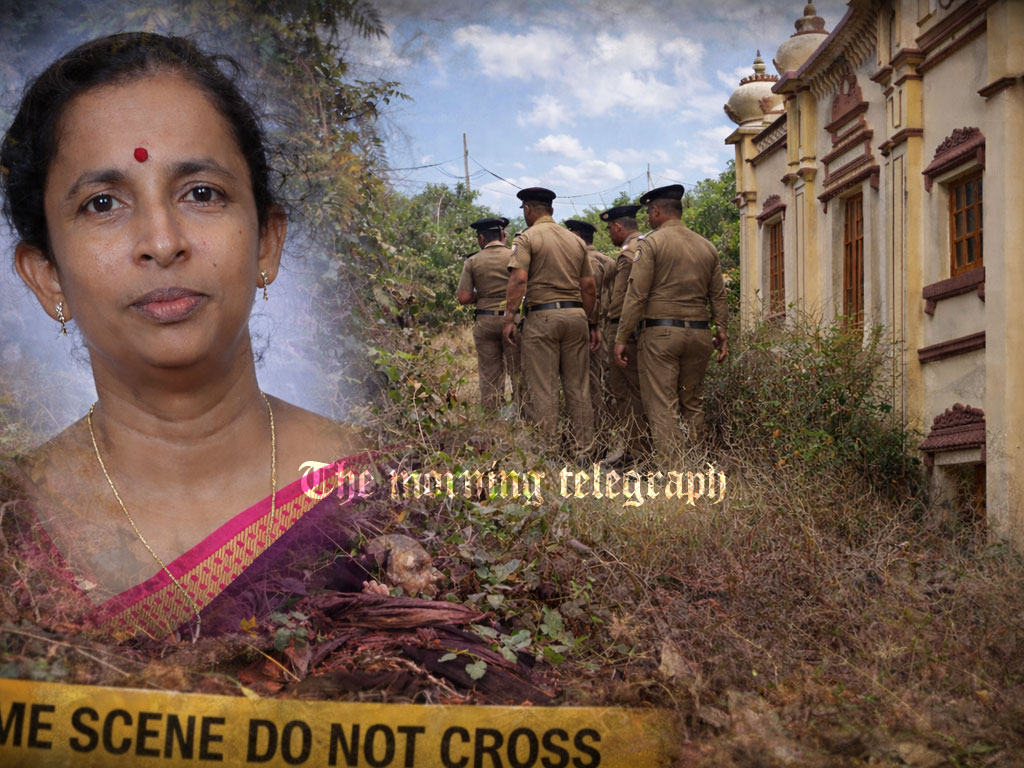
A senior lecturer at the University of Jaffna was murdered by her own daughter and son-in-law in a shocking family tragedy, with police using ATM tracking, QR code fuel data, and CCTV footage to uncover the crime and recover the body hidden in a remote jungle.
A horrific murder has sent shockwaves through the Northern Province and the entire country. Dr. Dileepan Dayalini, a 54 year old senior lecturer at the Faculty of Indigenous Medicine at the University of Jaffna, was brutally killed by her own 19 year old daughter and 21 year old son-in-law. The victim, a highly respected scholar in traditional medicine, resided in Pandiyanthalvu near Ariyalai in Jaffna and was widely admired for her expertise and contributions to the academic community.

The tragedy stemmed from long standing family turmoil. The lecturer’s son was entangled in a divorce case, creating a consistently volatile atmosphere within the household. Against this backdrop, on the 19th, the son lodged a serious complaint with Jaffna police, expressing suspicion that his mother and 19 year old sister had been forcibly taken away by his brother-in-law.
Recognizing the gravity of the complaint, Jaffna police investigators immediately proceeded to the family home in Pandiyanthalvu to conduct preliminary inquiries. At the scene, officers discovered that roof tiles had been removed, and a rope was found hanging, suggesting a possible point of entry or escape. Inside the house, they also recovered a cut lock of hair as evidence, raising immediate suspicions of foul play.
Police launched a large scale operation to locate the missing individuals and the suspects. Modern technology and digital evidence played a crucial role in the investigation. Bank records revealed that the suspects had withdrawn money from an Automated Teller Machine in Paranthan, indicating they had left the Jaffna peninsula. Investigators then utilized the QR code data system linked to national fuel permits to track the vehicle they were traveling in. This system confirmed that the vehicle had refueled at a filling station in Trincomalee.
Proceeding to the Trincomalee filling station, police meticulously examined CCTV footage, which clearly identified the 21 year old suspect and his 19 year old wife. Acting swiftly, authorities apprehended the young couple hiding in Trincomalee and brought them back to Jaffna for further questioning.
During lengthy interrogation at Jaffna police station, the 21 year old primary suspect confessed to the murder. He admitted that following a heated family dispute, he had severely assaulted his mother-in-law and strangled her to death. Evidence suggested that his wife, the victim’s own daughter, was also complicit in or present during the violent act.
After the killing, the couple devised a plan to dispose of the body to evade capture. They transported the lecturer’s remains to the Aruguvelli area within Thanankilappu village, located approximately two to three kilometers from Chavakachcheri town. This remote, sparsely populated agricultural area with dense scrubland was deliberately chosen to conceal their crime.
Acting on the confession, Jaffna and Chavakachcheri police jointly conducted an extensive search in Thanankilappu. After considerable effort, investigators recovered the body hidden deep within thick jungle. Due to the passage of several days, the remains had significantly decomposed and were distorted, making identification difficult.
As the location fell under the jurisdiction of the Chavakachcheri Magistrate’s Court, police reported the findings to the judiciary. The acting magistrate subsequently visited the crime scene and the site where the body was dumped to conduct a preliminary inquiry, observing all physical evidence and the condition of the remains. Following legal procedures, the lecturer’s body was sent to Jaffna Teaching Hospital for a complete postmortem examination and an official judicial medical report.